


If one thing became crystal clear over the summer it was this – the disconnect between the media and political classes and those they are meant to serve seems to have never been greater.
Whether it’s overt political calls and dictums surrounding the royal commission into what led up to the Bondi attack, or floppy justifications for cancelling Dr Randa Abdel-Fattah’ appearance at the Adelaide Writers’ Week (AWW), or the faux-rage targeting cartoonist Cathy Wilcox over legitimate political commentary, there appears no end to the unrelenting campaign to paint genocide opponents as hatemongers.
But the enormous response to the self-flagellation South Australian Premier Peter Malinaukas and the wider Adelaide Festival Board inflicted upon AWW with the decision to cancel Abdel-Fattah might suggest the arts community has had enough.
The fall out has been well covered. Less discussed is that writers and artists – like Ren Wyld, Amy McQuire, Clare Wright, Melissa Lucashenko, Michelle de Kretser, Evelyn Araluen, Chelsea Watego and others – who withdrew were forced into once again becoming the moral and ethical culture heartbeat, while sacrificing livelihood and security.
Their steadfastness came on the heels of the Bendigo Writers Festival, where many had been forced into the same position after a similar destructive decision to limit criticism of Israel. They had warned their fellow writers and artists then of what was already here, but it took the wanton destruction of one of the nation’s most important cultural institutions and with it, the loss of AWW director Louise Adler, to wake up many in the establishment as to what was at stake.
As Abdel-Fattah herself said in response to being targeted for her identity:
“I think in this moment we must also pay close attention to some of the fault lines that are being drawn. We have to be very careful about the way the narrative is being framed to equate all speech as equal, undermining the right of marginalised people to call for the cancellation of those who incite harm in the name of liberal principles of the so-called marketplace of ideas – as we all know, Indigenous artists and writers of colour pay the price for.”

Because let’s be clear here, it was the solidarity among writers, academics and journalists across the political spectrum which saw most of the media treat Abdel-Fattah with open curiosity and fairness. A fairness that has been sorely lacking in most coverage dealing with those who criticise Israel – not the racism which sparked it.
Contrast the time and space given to people explaining this issue, to the media campaign for a royal commission. The campaign that had declarative sentences about media-agreed ‘facts’ – including, at best the implication and at worst outrageous accusation that anti-genocide protesters had contributed to the mass murder of Jewish Australians. Both approaches stemmed from the same impulse – the media class at large deciding it knew what was the correct take.
But when it came to covering Adelaide, all voices were afforded an opportunity to explain their position, something sorely lacking in the national ‘debate’ in the aftershocks of Bondi.
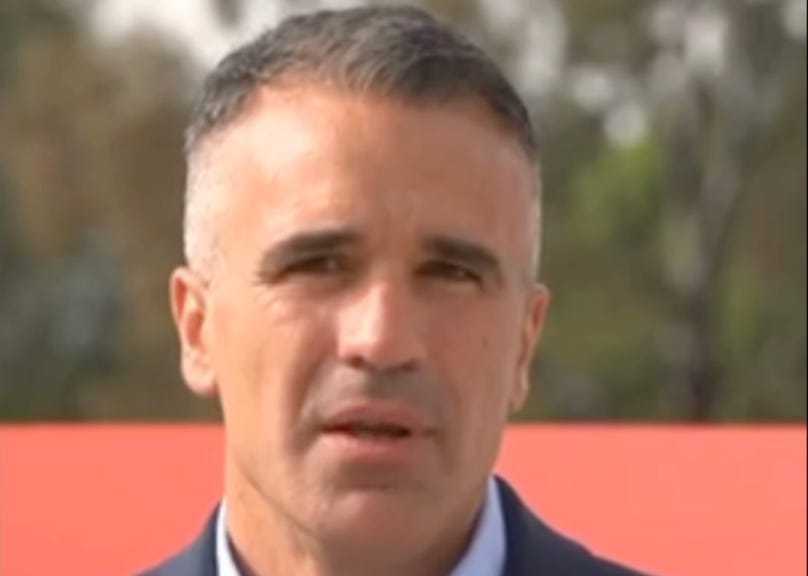
In trying to defend the indefensible, Malinauskas also gave us an insight into how those with power are pushing these decisions.
“Can you imagine if a far-right Zionist walked into a Sydney mosque and murdered 15 people?” he said in widely reported comments from his Tuesday press conference.
“Can you imagine that as premier of this state, I would actively support a far-right Zionist going to Writers’ Week and speaking hateful rhetoric towards Islamic people? Of course I wouldn’t. The reverse is happening in this instance, and I’m not going to support that either. I think it’s a reasonable position for me to have, it’s a view that I believe.”
It may be a view that he believes, but it is not based in reality. Or history. In creating his false equivalence – an absolutely delusional fantasy that criticising a political ideology like Zionism is akin to terrorism or hate speech – Malinauskas reveals just how little thought politicians like him have put in to forming their positions.
Malinauskas’ view ignores history, experts and 78-years of evidence, but he believes it enough to destroy a major cultural institution, risk defamation, tar Adelaide’s international reputation and his own. That he seems shocked at the response shows he still refuses to learn.
And that seems to sit at the core of the disconnect we are witnessing growing between politicians and the mainstream media on one side, and the public on other – a refusal to learn, to evolve, to bend.
That rigidity in thought means they both can’t and won’t see the shifting sands in front of them. It also means disagreement, dissent and criticism will continue to be reframed into very narrow definitions of ‘hate speech’, ‘agitators’ and ‘social cohesion’.
That’s not going to make anyone safer. It will however, make it easier to target and crush those they don’t agree with. And you know who that will be.
If you have a story tip, drop an email to tips@deepcutnews.com or send an anonymous Signal to @deepcut.25.
I watxhed his interview on 7:30 last night and was stunned at the consistenxy with which he said people need to feel included and given the chance to air their views...almost as if he forgot that he pushed so hard to shut someone down that the whole thing got shut down. These people in power really do seem to lose a grip on reality.
The roiling mess of my thoughts only makes sense when you write it down Amy. Thank you for your clarity.