



This country performs the same ritual whenever allegations of sexual assault are levelled at elite men’s football. Clubs generally respond by trying to make the issue go away, and the public is instructed to dutifully wait before we comment – first for the police, the charge, the trial and ultimately the verdict – if an “incident” ever gets that far.
All the while, we are told it is too soon to comment until we know all the details, and even as information emerges it is never an opportune time to confront the culture of entitlement or ‘boys will be boys’ that produces these men. That insistence on due process is grounded in fairness. But in practice, it can also become a form of institutional protection and reputation management, shutting down questions about culture until the moment for asking them has passed.
We saw the first steps of this tried-and-true ritual kick into motion this week after Victoria Police launched an investigation into an alleged sexual assault at the Melbourne hotel where the Sydney Swans were staying. Several players were linked to the investigation. Separately, by Wednesday the Swans had suspended five players for the remainder of the 2026 season after determining that their conduct breached club standards, amid mounting public pressure following club CEO Matthew Pavlich’s original comments to the media.
It is important to note that police investigations remain ongoing, no players have been charged and all parties are entitled to the presumption of innocence. It is also not suggested that the five players suspended by the club are themselves accused of the alleged sexual assault.
Notwithstanding the legal process, the club asserts their decision to sanction players concerns its own standards and not the outcome of any potential police case. That distinction is crucial, because it highlights that institutional accountability and criminal liability are not the same thing.
The Swans are an interesting ‘test case’ because they demonstrate that clubs can act if they choose to. Historically, this has not been the case. Here, the club looked at how their players behaved, decided that on balance it was unacceptable, and proceeded to suspend players.
Regardless of what any police finding reveals, these sanctions are the beginning of a demonstration that when a club wants to move, it can. But the waiting game the rest of us have to play allows an environment of entitlement to fester. It also points to a broader culture in which sexual assault remains vastly under-reported and legal accountability is extraordinarily rare.
Only 7 per cent of allegations result in a conviction
Jane Gilmore, drawing together data from the Australian Bureau of Statistics, estimates that out of more than 400,000 people who were sexually assaulted in Australia in 2023, only around 4,500 were convicted of a sexual offence. Almost all convicted offenders were men. These figures are damning, especially since most people who are assaulted never go to the police, and the share who do has been falling for 20 years – from about one in five in 2005 to fewer than one in 10 by 2021.
Of the small number of cases that will reach a courtroom, a sexual assault charge is proven far less often than almost any other kind of assault – around 35 per cent of the time against 69 per cent for other kinds of assault. Put plainly, sexual assault is a crime for which the gap between its prevalence and legal accountability is enormous.
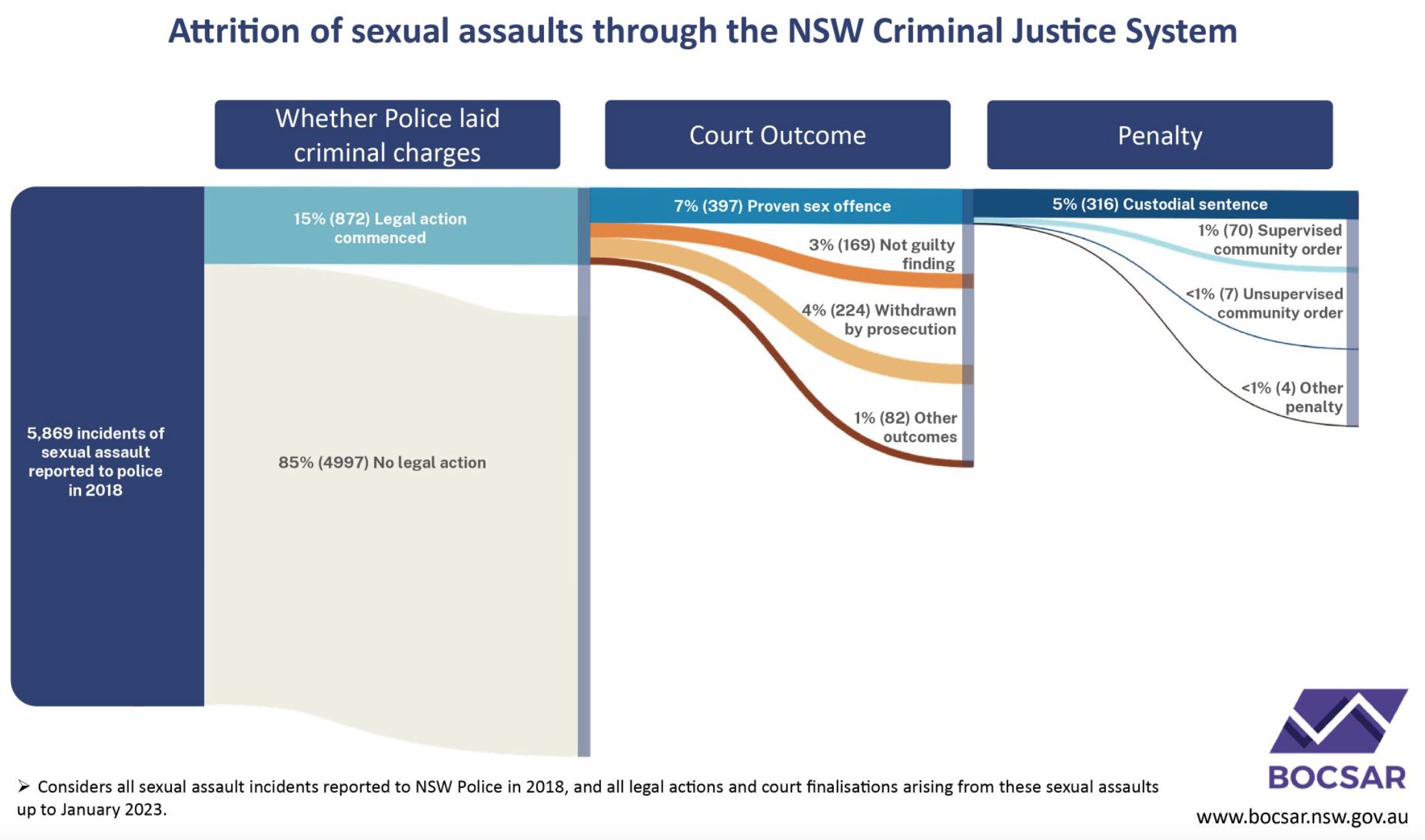
A 2024 NSW Bureau of Crime Statistics and Research study makes the attrition even clearer. It followed 5,869 sexual assault incidents reported to police. Eighty-five per cent resulted in no legal action against an accused. Among reported adult sexual assaults, just 6 per cent ultimately resulted in a proven charge.
Add in the power and privilege of elite sport, and we get an even more complicated picture. When allegations involve high-profile footballers, the complainant does not enter a socially neutral environment. Celebrity status, money, elite legal representation, professional communications advice, powerful sporting institutions and emotionally invested fan bases shape the environment in which an allegation is made. None of that tells us whether an allegation is true, but it does tell us that the two parties do not enter the process with equal power.
Since speaking out about this, I have received hundreds of messages on social media from women and girls across the country who have a story about an AFL player’s actions. Again and again, what those women describe is the awareness of an imbalance that speaking about the conduct of a well-known player can mean confronting far more than one man. It means confronting the status, money, fandom and institutional machinery that scaffold him from consequences.
For a woman deciding whether to report, speak publicly or persist through an adversarial process, that imbalance has material consequences. The potential costs can be personal, financial and reputational. Is it any surprise, then, that so many sexual assaults go unreported?
An industry protecting footballers
More than a decade ago, Deb Waterhouse-Watson – a researcher at Monash University – gave part of this phenomenon a name: “narrative immunity”. She found that of the over 55 elite footballers accused of sexual assault between 1999 and 2016, none were convicted.
Studying media coverage of sexual assault allegations involving Australian footballers, Waterhouse-Watson showed how familiar stories about masculinity, football, sex and supposedly untrustworthy women could generate doubt around complainants before a courtroom ever did. The legal system does not operate outside that culture. But neither does a woman deciding whether entering it is worth the cost.
Whatever the outcome of these allegations, institutional sport and in particular football functions as one of the largest engines of male culture in this country. Boys and men learn from the example that players and the institution as a whole set about what being a man is, what men are entitled to, and what they can get away with.
The lesson on offer from much of the early media reporting following the Swans allegations was that talent buys sympathy and that allegations are not a test of moral character, but a public relations exercise requiring swift management to make the woman disappear from the story. That is why the way football responds matters. The game is not simply reflecting wider culture back at us, it is one of the very sites where culture is made.
The strange thing is that football understands accountability perfectly well. Players are held accountable for missing training, breaking rules, failing to execute, letting down a teammate or not meeting professional standards. Entire careers are built around discipline, standards and responsibility to the collective. It is only when accountability reaches beyond the boundary line, particularly into men’s conduct towards women, that we suddenly become philosophically confused about what the word means.
Yet, the underbelly of male peer cultures in these environments can reward a type of manhood that is predicated upon hypermasculine dominance where women and girls are often viewed as secondary. That is the part underpinning so much of what we see when players’ off-field behaviour is brought into view.
The Swans did not get everything right, but they did demonstrate something important this week: a football club does not need a criminal conviction before it can decide what kind of institution it wants to be. The rest of Australian football should take notice. Due process determines criminal guilt, but it cannot be allowed to become an excuse for cultural silence.
Because long before a court decides whether a crime can be proved beyond reasonable doubt, boys and men are watching what our most powerful sporting institutions choose to excuse, what they choose to condemn, whose futures they rush to protect and whose pain they allow to disappear.
That is how a culture of entitlement is made.

So often SA is an assertion of dominance. Whether that is an elite sportsperson or a manager.
While I don’t disagree that it’s a good thing, I feel like I must be too much of a cynic to view the swans suspending their players with such good faith. Since the last big “”sex scandal”” in the AFL, I think the climate has changed a fair bit, and the political/community/online pressure and expectations has changed to the extent where having to act in such a way, and quickly, is the bare minimum that needed to be done to avoid a complete and total shitshow, and potentially the AFL giving worse penalties. I think a lot of what I’ve seen this week still screams of a club desperately trying to have the best PR possible and bury the worst aspects of the story as much as possible, along with focussing on the mirage of ‘bloods culture’, rather than a culture that is genuinely there and genuinely positive.