

Exclusive: Australia’s secret diplomatic cable on Iran on the eve of war
Heavy redactions raise concerns Albanese government may have known there were no legitimate grounds for war

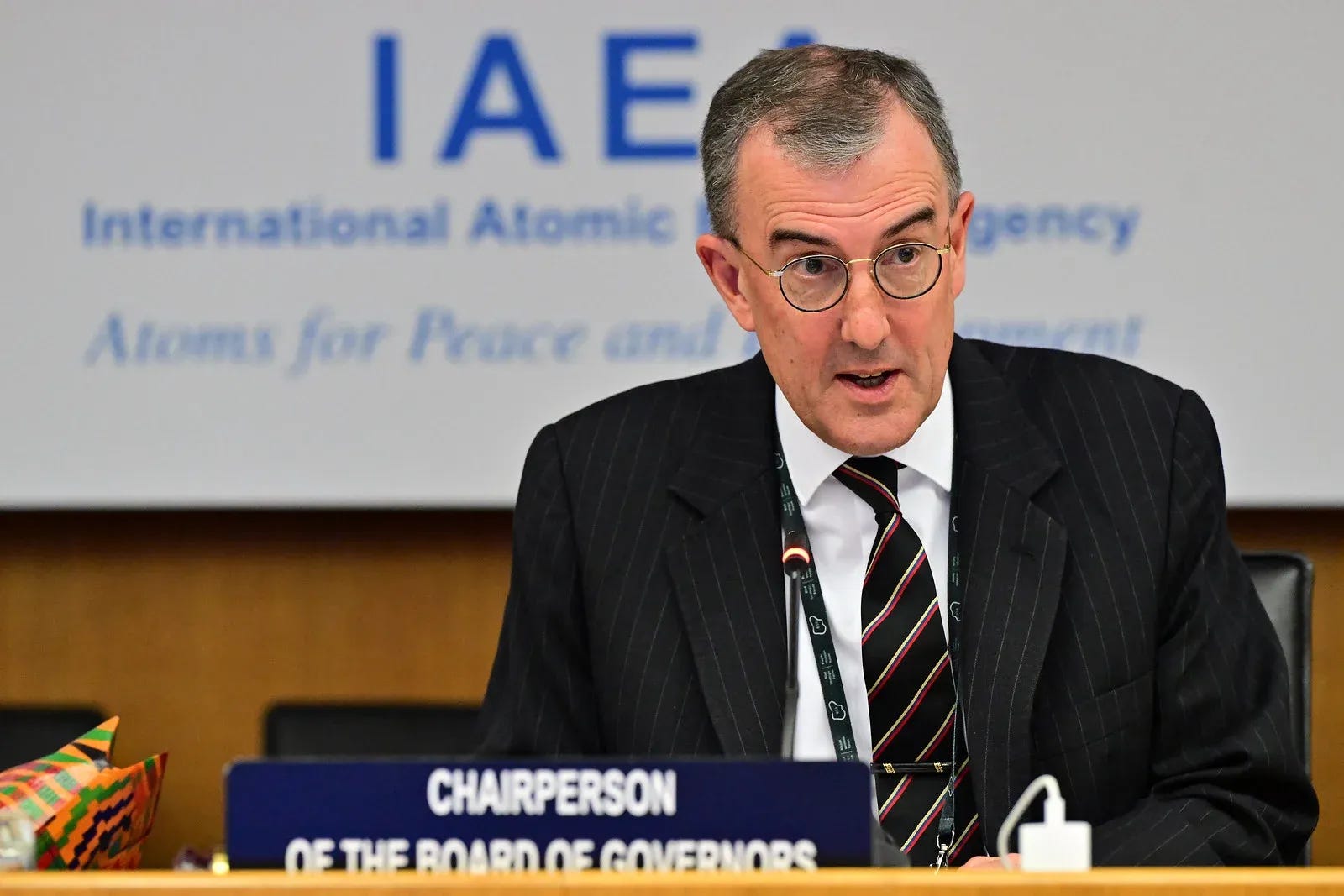
Australians are being kept in the dark about the contents of a diplomatic cable sent from Vienna to Canberra just hours before the US and Israel started bombing Iran.
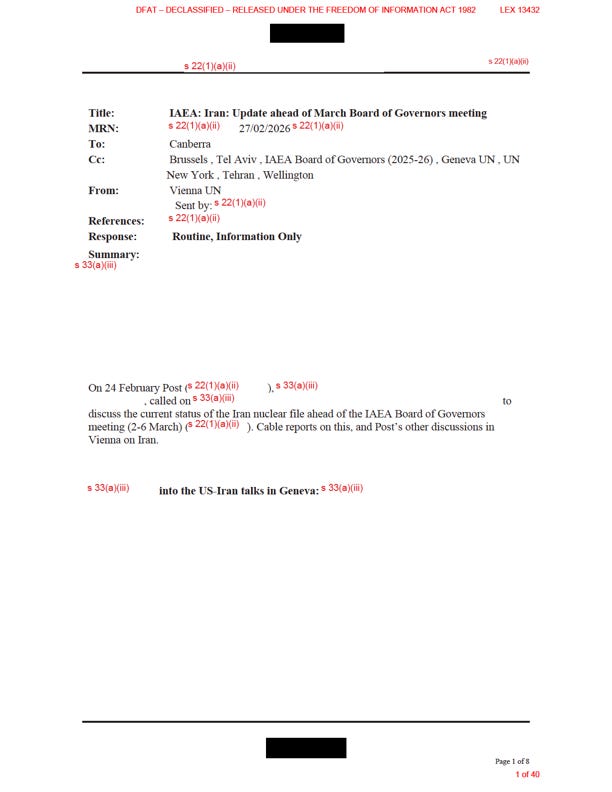
Deepcut News can reveal that one day before the US and Israel started attacks widely seen as illegal under international law, Australian diplomats finalised a sensitive report relaying what progress had been made in nuclear negotiations.
Vienna is home of the International Atomic Energy Agency (IAEA), which has a critical role in monitoring such negotiations, and Australia has an elevated responsibility as current chair of the IAEA board of governors.
Documents obtained by Deepcut under freedom of information (FOI) laws show a diplomatic cable about “discussions in Vienna on Iran” was circulated within the Australian Department of Foreign Affairs and Trade (DFAT) on February 27.
It included information about “the US-Iran talks in Geneva” and “the current status of the Iran nuclear file ahead of the IAEA Board of Governors meeting” scheduled for early March.
The cable itself was heavily redacted before its public release, with DFAT officials claiming disclosure could harm Australia’s international relations – adding fuel to concerns about transparency under the Albanese government.
Why does it matter?
The Australian government later cited accusations about Iran’s secret pursuit of a nuclear weapon to justify its support for strikes launched on February 28 – the day after the cable was sent to Canberra and copied to several other Australian diplomatic missions.
According to the Guardian, UK national security adviser Jonathan Powell attended the final pre-war talks between the US and Iran and believed Tehran’s latest offer regarding its nuclear program was significant enough to prevent a rush to war.
But just hours after the bombing began, Prime Minister Anthony Albanese said: “We support the United States acting to prevent Iran from obtaining a nuclear weapon and to prevent Iran continuing to threaten international peace and security.”
This justification is contentious, in part because US President Donald Trump claimed in June 2025 to have already “obliterated” Iran’s nuclear capabilities. Reports suggest US intelligence agencies saw no imminent threat, while mediator Oman believed a diplomatic breakthrough was possible.
Albanese owes Australians an explanation
Tilman Ruff, founding chair of the Nobel prize-winning International Campaign to Abolish Nuclear Weapons (ICAN), said the Australian government “really needs to explain to the Australian people why it chimed in so quickly” to support the US and Israel’s illegal attacks.
“That was really striking because Australia’s in a position of consistently claiming to be active and squeaky clean on non-proliferation,” Ruff said.
“You can’t bomb your way to non-proliferation. That’s a recipe for the complete erosion and dismantling of the hard-won gains through the Non-Proliferation Treaty and the IAEA’s safeguards regime, and seems a retrograde and concerning step.”
Ruff said it would be alarming and dangerous if Iran and other nations concluded that “the best way to preserve regimes that may have powerful enemies and prevent an aggressive attack is to follow the North Korean path and clandestinely develop nuclear weapons and then break out once it’s already a fait accompli”.
The FOI Act has long included a provision exempting documents from public release if they could damage Australia’s international relations. But Ruff said ICAN had “real concerns” about the FOI system as it was “getting increasingly difficult and lengthy and becoming less and less possible to obtain information”.
“We’ve been pursuing FOIs since ICAN was founded and what one can find out now has definitely decreased.”
Avoiding questions
Other documents released in this FOI batch included DFAT “talking points” to guide the government’s answers to media questions.
As first reported by Crikey, which also obtained the talking points, questions about whether the strikes broke international law were to be answered with: “It is for Israel and the US to explain the legal basis of their actions. Australia does not have access to the intelligence that Israel and the US had prior to the launch of these attacks.”
The Medical Association for Prevention of War (Australia) argued the government’s stance was in contrast to its condemnation of Russia’s “illegal and immoral invasion of Ukraine”.
The association’s president, Sue Wareham, said diplomats were currently meeting in New York for the regular review conference of the Treaty on the Non-Proliferation of Nuclear Weapons where the attack on Iran was “the elephant in the room”.
She said Iran had been enriching uranium “to a fairly alarming extent” while possibly keeping the nuclear weapons option open for the future, but Trump had sabotaged diplomatic avenues multiple times, including by abandoning an Obama-era nuclear deal with Iran that restricted enrichment and allowed international inspections.
“This is such a big setback to the cause of nuclear non-proliferation to have two nuclear-armed states [the US and Israel] take the law into their own hands and attack a non-nuclear state on the pretext of nuclear weapons concerns,” Wareham said.
She wrote to DFAT’s Australian Safeguards and Non-Proliferation Office (ASNO) on April 8 to ask whether Australian government ministers had received any IAEA advice regarding the status of Iran’s nuclear program before announcing support for the war.
Wareham also asked: “As part of ASNO’s work in strengthening global non-proliferation, what action has been undertaken to address the only nuclear weapons program in the Middle East, that of Israel?”
ASNO replied on May 1 to say foreign policy questions “fall outside ASNO’s statutory remit”.
Deepcut asked DFAT to provide a broad overview of its view of progress in US-Iran nuclear negotiations as of the eve of the war, including whether it agreed with the UK national security adviser that Tehran’s then-offer had been significant enough to prevent conflict.
A DFAT spokesperson said: “We do not comment on negotiations to which Australia was not a party, nor on other countries’ assessment of them.”
Got a tip? Send an email to tips@deepcutnews.com or send an anonymous Signal to @deepcut.25.
 | A guest post by
|
Penny Wong was respected as a politician with integrity, but with her claim that it was up to the US and Israel to determine the legality of the Iran attack, she reduced her status to that of a mouthpiece for craven and duplicitous nonsense. Depressing to observe..
Dr Strangelove Remix.