


By Claire Davanne – Claire is a foreign affairs analyst, formerly press attaché at the French Ministry of Foreign Affairs and development specialist at the World Bank
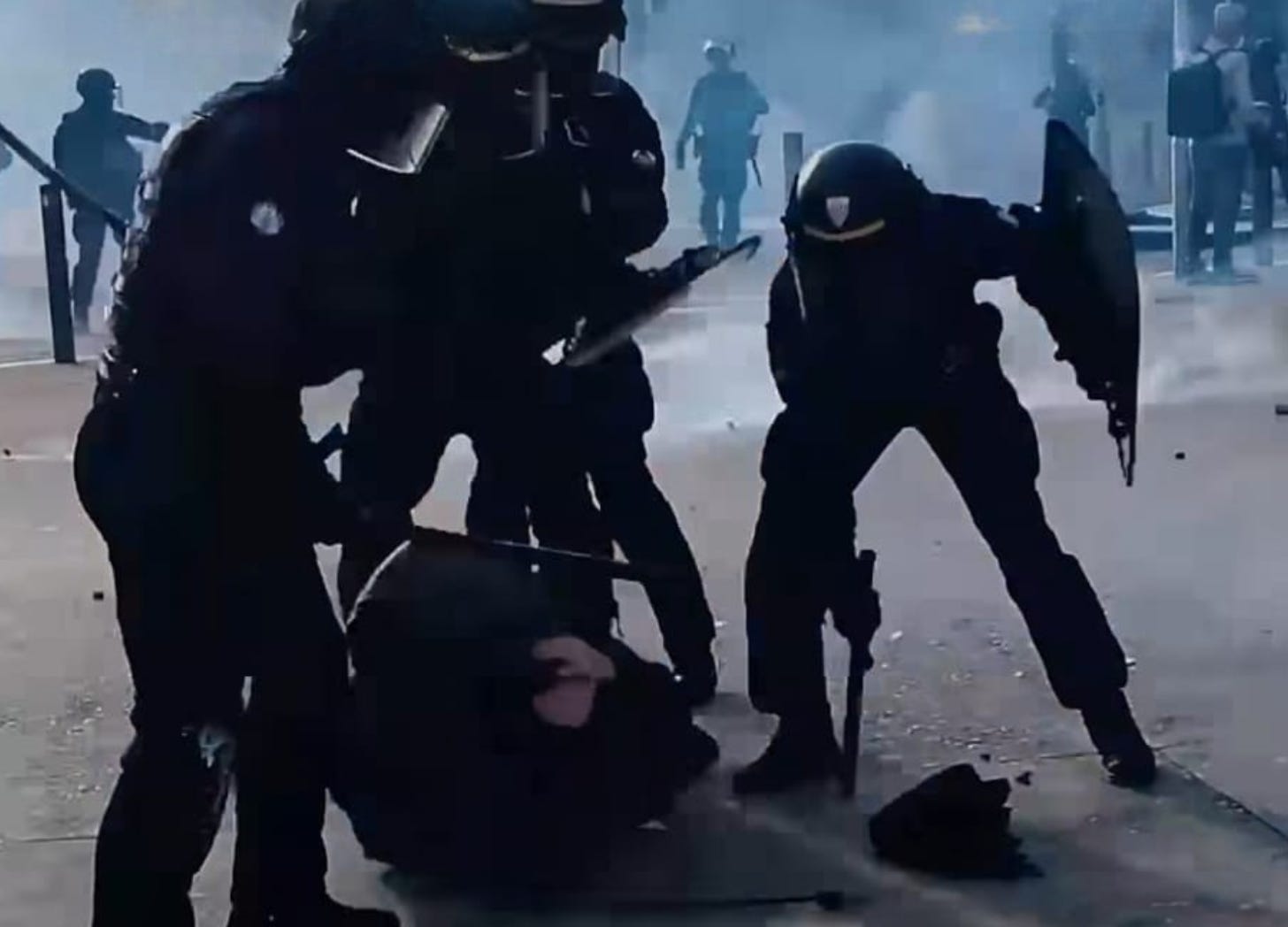
State violence in France has rarely been so visible; its legitimacy, rarely so openly discarded.
Scenes of running battles between police and protesters in the country I call home have continued for two weekends.
The mobilisation was initially meant to give voice to the unbearable cost of living for far too many. More than 800,000 French people from every walk of life took to the streets on 17 October to vent their frustration after weeks of government deafness to the socio-economic demands not only of Gen Z, but also of firefighters, nurses and farmers – all of whom face a form of acute financial insecurity.
It ended with more than 2,000 minors and young adults arrested – mostly school and university students – and many protesters maimed: from orchestra musicians tear-gassed mid-performance to indiscriminate violent blows alongside documented chokeholds, lost eyes and fractured jaws.
Even by the standards of France’s long tradition of confrontational social movements, these are unprecedented markers of brutal repression.
Cumulative inflation (over 20% this past decade) driving rising deprivation and inequality; growing budget austerity in the service of a €3.6tn (A$5.7tn) debt; worsening exposure to climate and environmental risks; and a deliberate choice of military rearmament have all heightened social tensions while shrinking the State’s room to manoeuvre.
It is this trajectory – genuinely unsustainable – and the pitfalls it heralds that the French have in mind when they take to the streets.
A week of tension
Since 17 October, the Macron government has responded with what it describes as a “massive” security operation, deploying 70,000 police and gendarmes nationwide, authorising the use of the Sentinelle military force and pursuing “casseurs-payeurs” legislation that would hold anyone near a protest financially liable for damages. It placed the bill on the Senate’s fast-track agenda.
“Count on my firmness,” Laurent Nuñez, the interior minister, declared ahead of the second weekend of protests, promising forces would “go up a notch” to “hit” troublemaker groups.
This past week, the Macron government has systematically curtailed the right to protest by ordering prefects to ban demonstrations not organised by trade unions and restricting authorised marches to routes that avoid commercial areas and seats of power. Amnesty International condemned this as “a slide toward authoritarian practices”, adding that the French government was “fuelling a climate of fear that would justify any and all restrictions on freedoms”.
Judicial sanctions after 17 October also demonstrated the State’s unyielding response. The French justice ministry reported over 170 incarcerations, with fast-track trials producing heavy sentences, including a contested case in Bobigny where a man was handed an immediate six-month prison sentence for receiving stolen baby formula after a pharmacy looting. Left-wing lawmakers seized upon the case to denounce a “class justice” and a “strategy of fear”.
For the first time, the government also threatened to cut off social media and mobile network access. Prime Minister Sébastien Lecornu reportedly wrote to Orange, SFR, Free and Bouygues Telecom asking the operators to prepare to suspend platforms including TikTok, Instagram, Snapchat and X, with restrictions intended to target mobile networks and specific areas rather than a nationwide blackout.
Despite the government’s scare tactics, between 410,000 to 800,000 (the former figure claimed by the interior ministry, the latter by one of France’s largest trade unions) came out on 24 October, with the marches unfolding largely peacefully before tensions erupted in several areas.
The State’s main tactical shift was from a static, territory-holding posture on 17 October to a deliberately mobile and offensive model after Nuñez acknowledged that forces had “lost control” in several cities on 17 October.
Macron’s contempt for democratic representation
Before this tipping point, no one had missed the government’s democratic deficit.
That deficit includes several nationwide citizen consultations quietly shelved: the Citizens’ Convention on Climate (2019–20), the National Great Debate and the 2019 Grievance Registers. In 2024, legislative elections called by President Emmanuel Macron himself were lost by his ruling party to a left-wing coalition, yet he never agreed to appoint a head of government reflecting the national representation that had emerged from the vote.

It also includes ignored mass citizen mobilisations, such as the 2 million signatures on a petition in 2025 against the farm law (Duplomb) authorising a pesticide proven to cause cancer, or the millions who demonstrated in 2023 against the pension reform, ultimately forced through by executive power, bypassing a parliamentary vote.
None of these democratic actions, direct or representative, produced the political or legislative outcome that a mature democracy is expected to deliver.
All were brushed aside by the Macron government – incompetence at best, contempt at worst. Protests were a predictable consequence of a population ignored by its political elite.
State violence in service of whom?
If the State, in the words of the sociologist Max Weber, holds the monopoly on physical violence, that monopoly rests on legitimacy. It is not violence in itself that distinguishes the State, but the fact that it is recognised by those on whom it is exercised – that is, founded on the basis of democratic elections and citizen participation. Our very social contract. Yet after two terms of Macron, heavily criticised on precisely these issues, it is exactly this recognition that we have seen fall away.
It is not the State’s violence that is contested (its power to coerce is not in debate), but its legitimacy: in whose name, and to protect whom, is this violence exercised?
Over the years, the Macron doctrine has revealed itself to be one of maintaining order – through the abusive use of an increasingly militarised police arsenal – rather than maintaining peace, which is the result of political dialogue and compromise.
In every domain of public life, a few narrow interests have been systematically traded off against the common good – our water, our soil, our biodiversity and our health. Our present and our future.
Arrogant power
Added to the spectacular dismissal of democratic representation is the absence of decisions on substance, taken in disregard of the most basic scientific facts.
Recent French political decisions have shown nothing but contempt for science in favour of short-term commercial interests permitted by legal mechanisms that allow tricks and loopholes.
Take, for example, an artificial water reservoir at Sainte-Soline or the infamous A69 highway. Both projects were scientifically invalidated for their proven harm (destruction of protected species, invalidation of climate adaptation) and their lack of public benefit (high economic costs, destruction of farmland). But the Macron government didn’t care – it forced these projects through anyway.
These two episodes are but a taste of the level of arrogant power displayed by the Macron government, and it turns up in policies on transport, energy, agriculture and land-use planning.
Ultimately, the government’s brutal response to legitimate anger is only raising the temperature in a country simmering with rage. It stands to lose far more than it might hope to gain from a ‘firm’ approach that, as Amnesty pointed out, “does not respond to the legitimate demands of the protesters”. The French State has so far kept the monopoly on physical violence, but is squandering its legitimacy.
Brilliant analysis that is sorely missing in the media we see here in Australia which only seems to focus on any property damage caused by the protests. One can only imagine the response some of the state and territory police forces would have here in Australia should protests like these break out - the question is, will we find out?
It's truly frightening how governments around the world are behaving in an undemocratic way. All because the people are attempting to call them to account for their incompetence and refusal to listen to what the people who voted them in are saying! As usual, governments who listen to the big corporations and not their populations.