


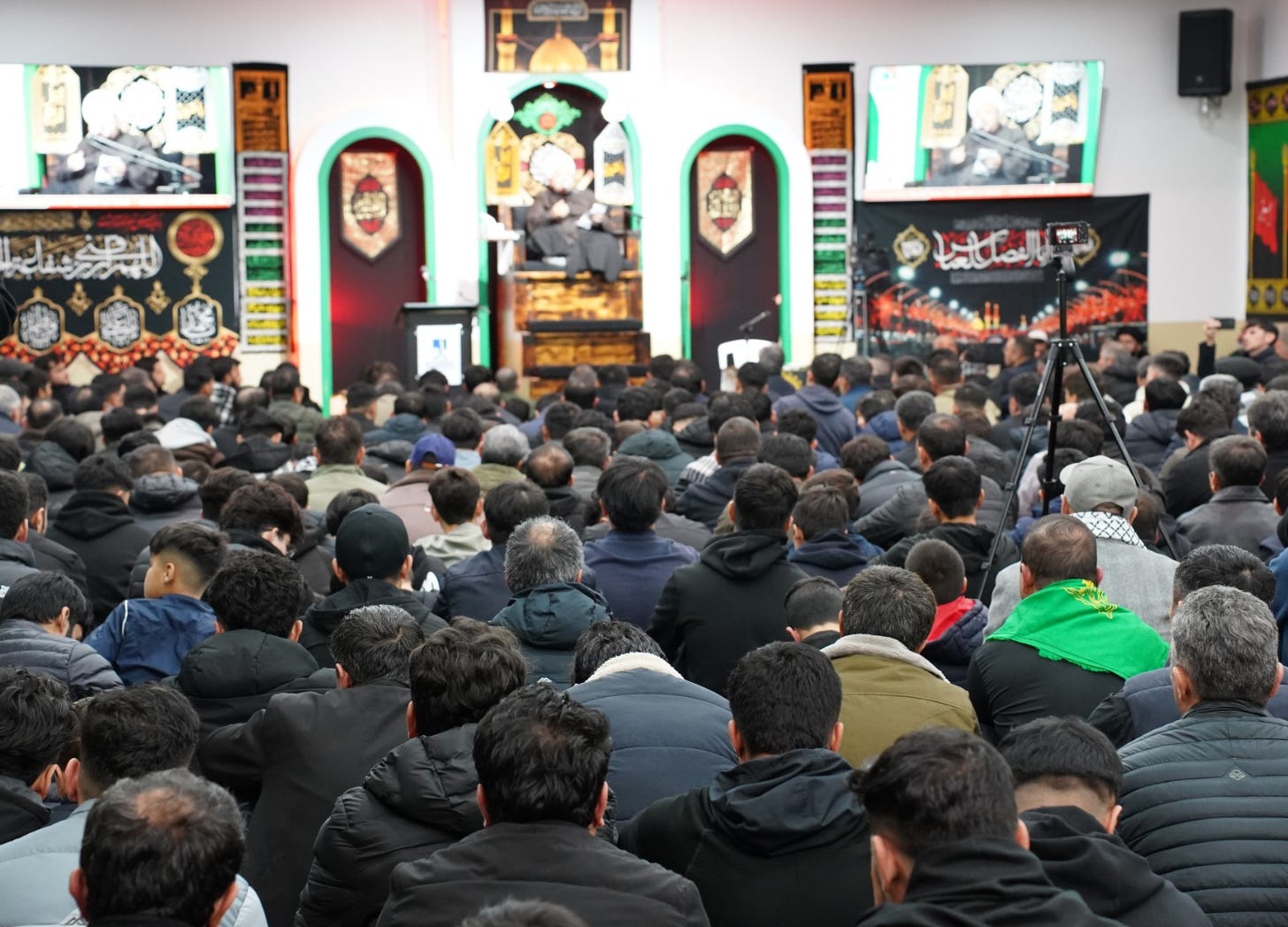
The Special Envoy to Combat Islamophobia, Aftab Malik, says he was not told of the federal government’s decision to rescind a $670,000 grant to a Shia Muslim community organisation.
“Nobody contacted me for my thoughts about that. I actually read about it in the newspaper,” Malik told Deepcut.
Last week, Multiculturalism Minister Anne Aly cancelled the grant to the Taha Humanity Association of Victoria – a Shia community group largely made up of Afghan Australians – following media reports that Shia mosques had held memorial services for Ayatollah Ali Khamenei, the supreme leader of Iran. Khamenei was assassinated in a US-Israeli airstrike on his official residence in Tehran on February 28, along with his wife, daughter, 14-month-old granddaughter and several in-laws.
Mainstream media outlets and pro-Israel politicians were quick to denounce the Shia community groups that held memorials for Khamenei in Sydney and Melbourne. NSW Premier Chris Minns called the mourning “atrocious”, while Prime Minister Anthony Albanese urged mourners to uphold what he called the “Australian covenant: [that] no matter where people are from, is that if they have any hatred or prejudice, it’s left at the customs hall”.
Right-wing media narratives are hard to fight alone. That’s why we need the support of readers like you.
Mourning a religious scholar
In a media statement on March 6, the Taha Humanity Association said “media reporting and parliamentary commentary... has fundamentally misrepresented the nature of our gathering”, and that the grant was cancelled “on the basis of an unchecked narrative without consultation with our organisation, our leadership or our community”.
“Our community is not an abstraction. It is made up of real families – many of them Afghan-Australian, Hazara, and others who endured ethnic and religious cleansing before finding safety in Australia,” the Association’s press release states. “For these people, the current media and parliamentary narrative is not merely offensive – it is retraumatising.”
“Our youth are reading these headlines,” the Association said. “They are watching their community be labelled. They are seeing social media commentary about their families and their faith. This is how Islamophobia takes hold, and we are profoundly concerned about the physical safety implications for our members.”
Malik also took exception to the condemnation of the memorials, emphasising that Shia communities did so out of regard for Khamenei’s status as one of Shia Islam’s foremost scholars, rather than for his political position as Iran’s head of state.
“I’m not Shia myself, but I reached out to several different Shia organisations and asked what exactly about him they were mourning,” Malik said. “Everyone I spoke to emphasised that he was a Shia scholar; the Shia communities mourning his death weren’t mourning him so much as a political leader as they were [mourning] a religious scholar of the highest order, as he was for Shia Muslims. The separation of state and religion that has taken place in the west doesn’t really apply in this instance, and that’s caused a great deal of confusion and conflation.”
‘We’ve got to be courageous’
Speaking to Deepcut from New York, where he addressed the UN commemoration of the International Day to Combat Islamophobia on Sunday, Malik warned the government to “be careful” in how it publicly characterises issues affecting Muslim Australians.
Malik also urged the government to adopt the 54 recommendations of the National Response to Islamophobia released by his office in September, including by establishing national commissions of inquiry into Islamophobia, anti-Palestinian and anti-Arab racism and addressing “the role of foreign actors and domestic affiliations in spreading Islamophobic content as part of broader foreign influence operations”.
“Islamophobia is increasing. Muslims across the country are being vilified not for what they’ve done, but for who they are,” Malik said. “Grants are welcome, dialogue is important, but to really get at the nub of Islamophobia, we’ve got to be courageous and look at legislative architecture. We need to systemic and institutional reform, not a comms package.”
Aly’s office did not answer questions, instead sending a short statement on Aly’s behalf.
“Due to social cohesion concerns, I’ve decided to not go ahead with a grant for the Taha Humanity Association. We are not proceeding with this election commitment,” the statement reads.

"Multiculturalism Minister Anne Aly cancelled the grant to the Taha Humanity Association of Victoria"
I agree this should be the start of cancelling grants to all religious organisation in Australia no matter the denomination.
Religion is mans worst invention no matter the franchise as we have seen over the last few months in Australia and the genocide in Gaza and in other parts of the world in the name of someone's god.
The good part for any person who thinks it is real (gods) there are at least 18,000 gods to pick from so a wide choice and plenty of competition.