


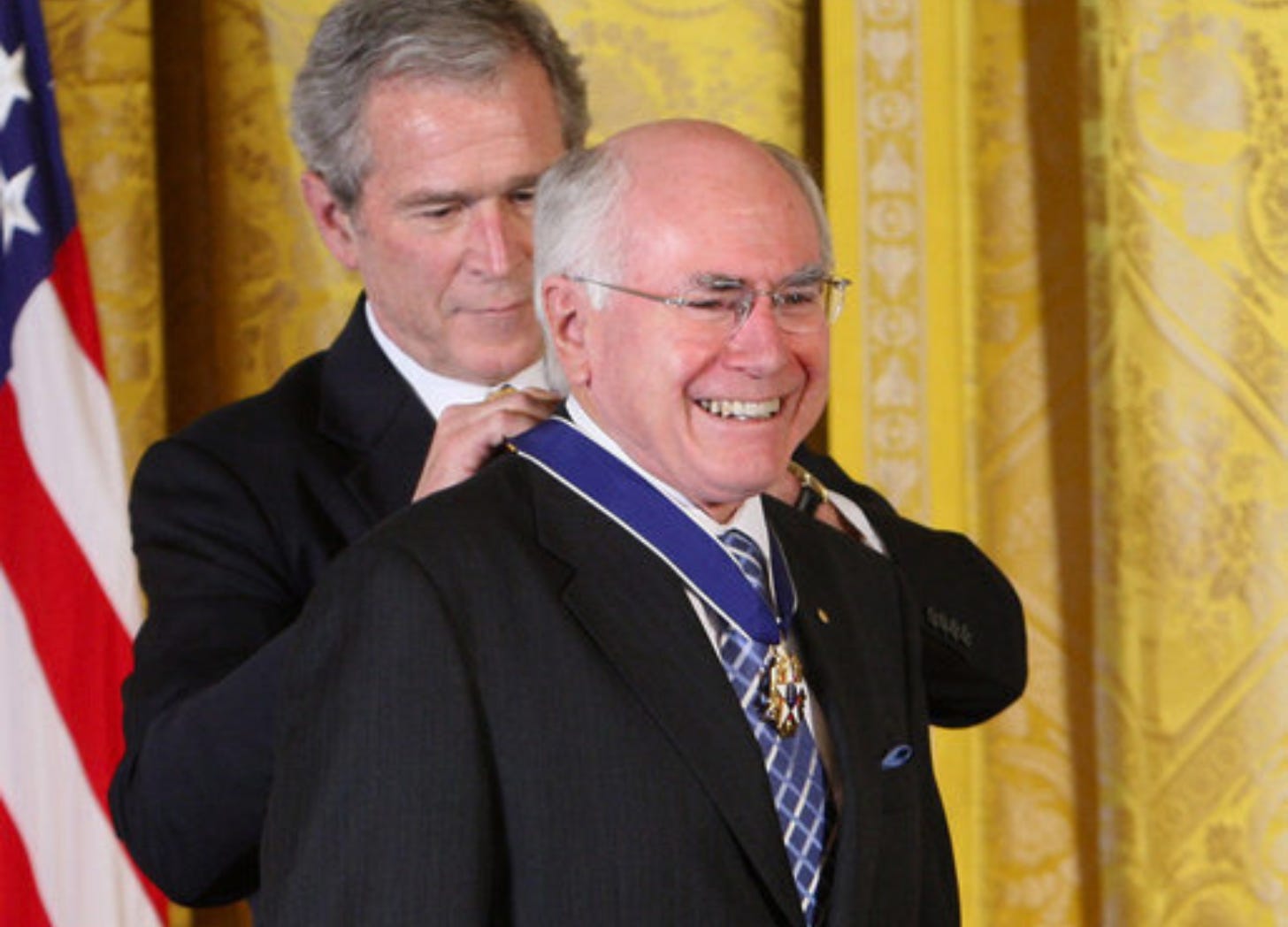
The following is an excerpt from ‘Where It All Went Wrong: The Case Against John Howard’ by Amy Remeikis – out today in all good bookstores.
The US ‘shock and awe’ Iraq invasion in 2003 may have cost up to one million Iraqis their lives, and hinged on a widely disputed report that then-leader Saddam Hussein had been stockpiling nuclear weapons. Despite UN weapons inspectors finding no evidence to support the US and UK claims Hussein was stockpiling ‘weapons of mass destruction’ and planned to make more in early 2003, the US, the UK and Australia were all in and invaded just a couple of months after the UN report. By 2004, it was clear the reports were false.
Insert [John] Howard’s gasp face.
“I felt embarrassed, I did, I couldn’t believe it, because I had genuinely believed it,” he said in a 2014 interview.
“So, I felt embarrassed and I did my best to explain… that it wasn’t a deliberate deception. It may have been an erroneous conclusion based on the available information, but it wasn’t made up.”
Howard believed the claims so strongly that he sent Australia to war with just an oral submission to the Cabinet in 2003. The decision sent hundreds of thousands of people into the streets in February 2003, a month before the formal decision, in what was then one of the biggest national protests ever seen. The then-Labor opposition leader, Simon Crean, called the invasion decision “a black day for Australia”. Andrew Wilkie, who later became an independent MP, resigned from the Office of National Assessments in protest. The Cabinet papers released show there was barely any discussion of the decision, with most of the calls seemingly made in the National Security Committee (NSC) – a secretive committee Howard set up in 1996 to sit inside but separate to Cabinet, to limit transparency even further.
We cannot do this important work without your support. If you can, please consider becoming a paid subscriber for as little as $2.30 a week.
Howard, who in 2002 had declared the United States “has no better friend anywhere in the world” and who had accepted the “deputy sheriff” moniker from Bush (despite the unease it caused with Australia’s Muslim neighbours in the Pacific) had committed Australia to an open-ended war, with no goals in sight, without even requesting any advice on the pros or cons of the decision. The public service, well aware of the situation, did not offer any advice which either supported or cautioned against the decision. There was no cost-benefit analysis. The UN Security Council had not explicitly signed off on the decision, so Howard relied on a ‘Memorandum of advice to the Commonwealth government on the use of force against Iraq’ from two junior bureaucrats to assure the public that Australia’s involvement in the invasion of Iraq was ‘legal’.
When the Governor-General at the time, Peter Hollingworth, had asked to see legal advice from Attorney-General, Daryl Williams, on Australia’s involvement under international law, given the longstanding precedent that it was the Governor-General who declared war, he was told there was no need.
Instead, Howard used a clause in the Defence Act which gave the defence minister the power to give instructions to the heads of service.
All so he could be all the way with the US and strengthen an alliance with the country he had admired since childhood. In the early stages of Australia’s involvement in the US’s war, Howard also approached the US over signing a bilateral free trade deal, which, as Emeritus Professor of Politics Robert Manne pointed out, Australia had previously rejected three times, including under Howard, as not being in the national interest.
So eager at this point, or perhaps wildly miscalculating Washington’s actual gratitude at Australia’s subservience, Australia ended up with a deal that was, shockingly, not in the national interest.
We have never rebalanced the scales. Not even Labor dare criticise or distance Australia from the US, not in strategic and defence policy, and not in foreign policy, even as it becomes increasingly authoritarian and anti-democratic. Labor had stood against Australia’s entry into America’s war (while still supporting the ADF), but by the time a young Mark Latham described the Howard government as a “conga line of suckholes” desperate for the approval of “the most incompetent and dangerous president in living memory” in 2003, the relationship between the US and Australia was so enmeshed that the US ambassador to Australia at the time complained. Latham was denounced in the Australian media for a lack of civility, and so began Labor’s cowing on the US question. Latham was elected Labor leader less than a year after the controversy. He held a press conference shortly after with a US flag in the backdrop and very quickly declared, “I believe in the American alliance”.
We still believe in the American alliance. No matter what, no matter who. Australia has signed up to deliver at least $360 billion in a strategic defence deal with the United States and the United Kingdom, in the hopes of receiving nuclear-powered submarines from the US that they are under no obligation to deliver.
Even as Donald Trump carries out extrajudicial killings, sacks public servants who try to uphold the law, goes after the judiciary, targets political opponents for retribution, uses his public office for personal wealth building, encourages the kidnapping of people from US streets, unloads tariffs on allied nations, sparks trade wars, insults world leaders and allies, starves his citizens, guts public services and spending, pushes for gerrymanders, declares himself a king and above the law, lies, appoints reality TV stars and cronies to senior ministerial roles, and openly discusses a third term, Constitution be damned, Australia is by his side. Literally. At a dinner held for APEC leaders in South Korea in late 2025, Albanese was sat at Trump’s side. His ‘right hand man’ as it were.
It doesn’t matter that America’s democracy is crumbling as it projects its political violence outwards in its attempts to violently rebuild its ‘empire’, or that the ‘shared values’ Australian leaders have long claimed we and the United States have in common are more nostalgic than reality – Australia is in lockstep with the US. Howard tied us to America so tightly, it would take a world-altering event to unshackle us. The tragic truth is, though, even then, we would probably be on America’s side, even if it meant our own destruction.
Got a tip? Send an email to tips@deepcutnews.com or send an anonymous Signal to @deepcut.25.
My goodness Amy , I’ve just read this . The local bookshop don’t open for another hour and three quarters!
We have had some poor prime ministers but Johnny is the winner by a country mile, not one else's fault but our own we believed the lies and kept voting for him.
Bush, Blair and Howard have never and will never be in front of a court for war crimes.