


By Nourdine Shnino – a Palestinian reporter based in Gaza
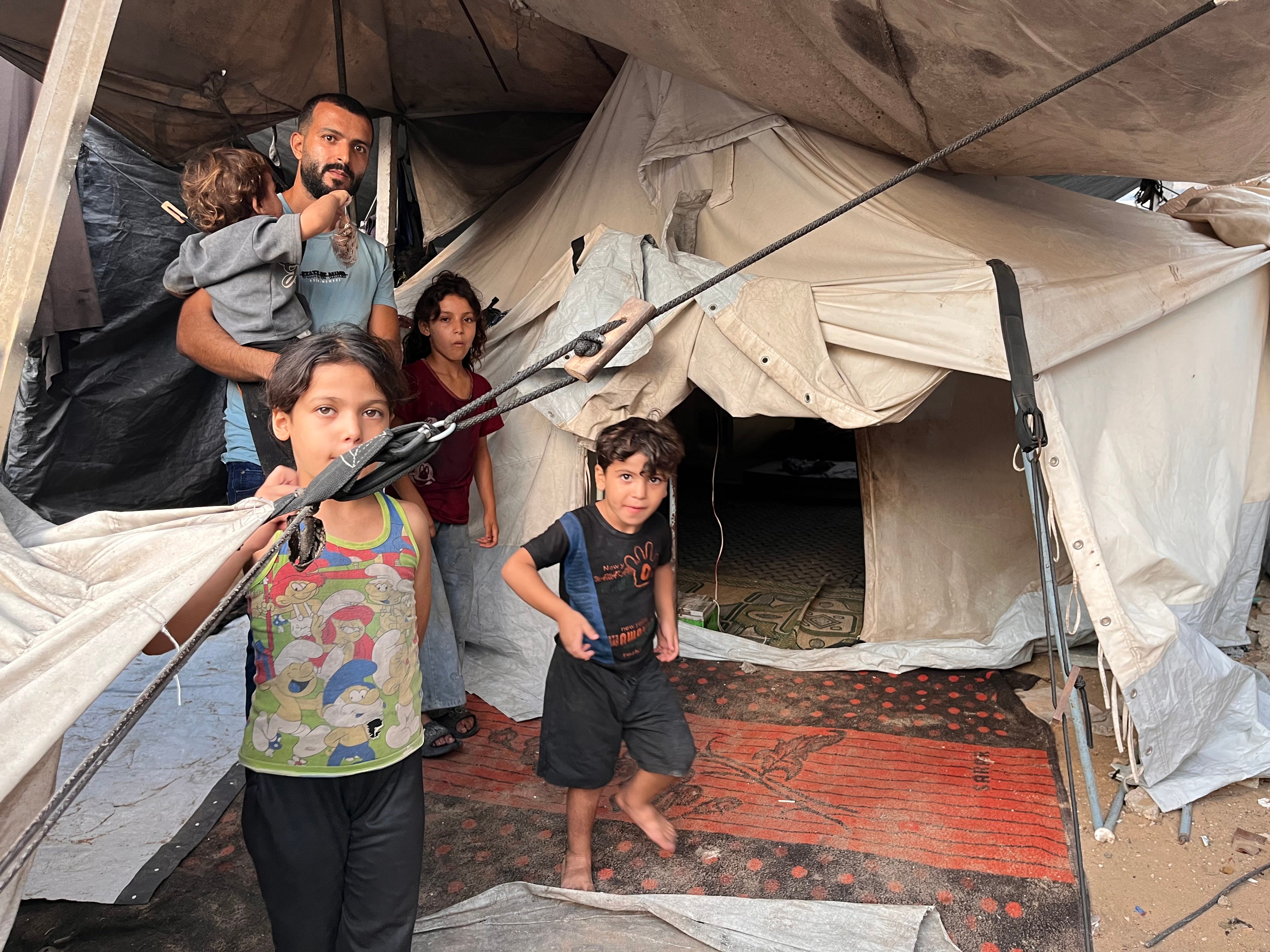
GAZA CITY – Inside a torn tent in Sheikh Radwan, northern Gaza City, Majdi Shareef tends to his five children. The eldest is 10-year-old Gazal, and the youngest, Jehad, was born during the war in 2024.
The children frolick about, moving in and out of the tent, trying to keep their minds occupied. But to Majdi’s eyes, they exhibit clear signs of disturbance.
“They were once fearless children,” Majdi, 30, says. “Now everything has changed. Fear has grown greatly in their minds. They’re afraid of any sound that reminds them of Israeli bombings.”
Before the war, Majdi would take his children to the beach, to parks and other places across Gaza. Their childhoods were typical – hours spent playing with toys and running around with other children.
Now, he says, they rarely leave the tent.
“They are afraid to go outside because they think the bombing could start again,” he tells Deepcut.
“With every Israeli airstrike nearby, my children wake up terrified. After a while, they get used to the sound of bombing. But even now, when there is no bombing, a loud sound is enough to make them think an airstrike is coming.”
Psychologically damaged children
Majdi’s experience reflects a much wider crisis among children in Gaza. A UNICEF assessment conducted between December 2025 and January 2026 surveyed 2,071 households with children across all of Gaza’s governorates. Caregivers reported sleep problems in 40 per cent of children, bedwetting in 32 per cent, aggression in 19 per cent and withdrawal in 15 per cent. In 92 per cent of cases, caregivers said these symptoms had begun after October 2023.
A separate peer-reviewed study published in January examined 933 displaced children aged three to 12 living in shelters and tented communities in Gaza.
The children had experienced an average of seven forced displacements, while 98 per cent had experienced hunger and 95 per cent the destruction of their homes. The study found that 58 per cent met the researchers’ criteria for probable post-traumatic stress disorder, while more than 46 per cent showed significant psychosocial difficulties.
The researchers described the findings as evidence of an acute and potentially generational mental-health burden among Gaza’s children.
A family made homeless
Repeated displacement has added to the distress of Majdi’s children.
Before the war, Majdi worked as a barber in Sheikh Radwan. An Israeli airstrike destroyed his workplace in November 2024.
The intense attacks and repeated ‘evacuation orders’ forced the Shareefs to move several times, often on foot, for hours, to wherever safety could be found. Their journey took them as far south as Khan Younis – roughly 28 km from Sheikh Radwan.
“The journey south was exhausting. I was carrying my son and had to stop every now and then to rest,” Majdi says.
The family arrived at Khan Younis with no belongings and no money. They managed to find a spot in the overcrowded al-Mawasi camp, relying on humanitarian aid to survive.
“During the first week, we barely had anything to eat. After some time, things started to improve as a charitable food distribution point for displaced people was established in the camp,” he recounts.
The family returned to Sheikh Radwan following the announcement of the so-called ceasefire in October 2025. But they returned to a pile of rubble – a month earlier, in September, Israeli forces destroyed the Shareefs’ home.
That hasn’t stopped Majdi from doing whatever he can to provide for his family. He’s since returned to barbering, but without a shop. He travels to customers and cuts their hair wherever they can find space – inside tents or amid the rubble and ravaged roads.
But his work barely keeps up with the high costs of basic goods, as Israel continues to block essential supplies despite repeated UN calls for unrestricted humanitarian aid.
“I need about 80 to 100 Israeli shekels (A$37-45) per day to meet the family’s basic needs. I’m earning less than half of that,” he says.
A mother’s burden
Much of the family strain, Majdi says, is falling on his wife, Amal.
“She is carrying more than she can handle,” he says.
A lack of supplies and a home means Amal often has to source firewood to cook meals, and when her husband is absent at work, she cuts it herself.
“Cooking over a fire has also taken a toll on her health. The constant exposure to smoke makes it difficult for her to breathe,” Majdi says.
Amal, like so many mothers in Gaza, is exhausted, he says.
“But despite all of this, she continues to care for her children and keep the family going.”
As for the children, Majdi says he no longer recognises their behaviour.
“My children have become more aggressive, especially after experiencing hunger during the war. Their lives have changed. Their personalities have changed,” he says.
The lack of education – Israel has destroyed or damaged 97 per cent of Gaza’s schools – is only exacerbating the enormous strain on parents.
“School was not only important for their future, it was also a place where they met their friends, played and enjoyed their childhood. They have lost all of that now,” Majdi says.
Although the intensity of Israel’s onslaught has decreased, a constant fear among children remains – and for parents like Majdi and Amal, a sense of hopeless despair.
“I would prefer death to watching my children cry from hunger,” he says. “We cannot help them become the children they were before the war.”
One of the many forms that genocide takes.