

By Stephen Lawrence – NSW Labor MLC. Stephen was a barrister prior to being elected to parliament. Stephen’s legal career included lengthy periods overseas including in Solomon Islands, Afghanistan and the Occupied Palestinian Territories.
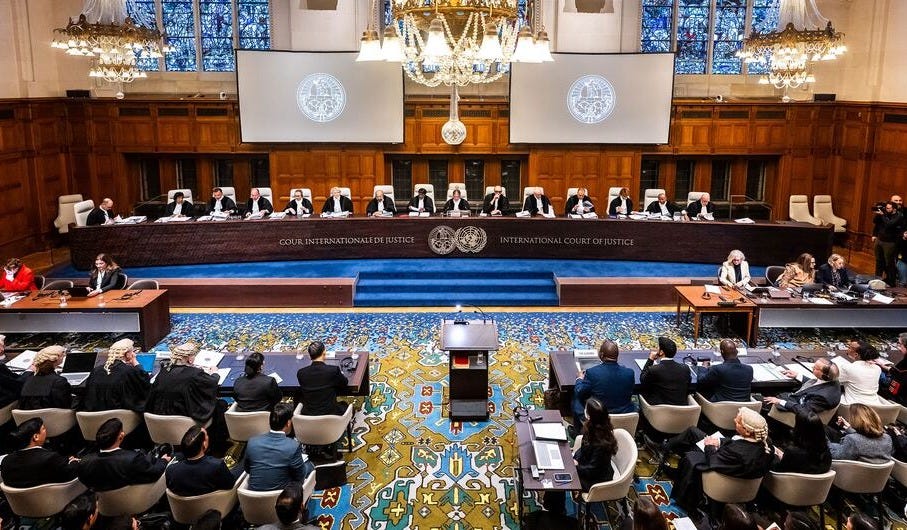
Myanmar last week became the world’s first state to be adjudged by the International Court of Justice to have committed genocide, the world’s most serious international crime.
Of course, many other states have committed genocide, but Myanmar is the first to have been found to have breached its obligations under the Genocide Convention.
Some may ask, why not Germany? The holocaust was a crime of genocide unprecedented in its scale, industrial organisation and totalising intent to murder every member of a targeted group.
But even the Nazi leaders were never tried for the crime of genocide, for the simple reason that it had not yet been formally established as a distinct basis of liability under international law at that time. Rather, they were tried for conspiracy, crimes against peace, war crimes, and crimes against humanity.
The Genocide Convention of 1948 has since created both individual and state responsibility for genocide. The intent that must be proved in both cases is the specific “intent to destroy, in whole or in part, a national, ethnic, racial, or religious group as such”.
Widespread destruction a factor in ruling
Myanmar committed genocide against the Rohingya, a Muslim minority targeted in a counterinsurgency campaign that culminated in the so-called “Clearance Operation” in 2017.
The court took into account a range of factors proved to the criminal standard of proof – a death toll of about 10,000, mass sexual violence, the destruction of houses and infrastructure, mental harms inflicted and the impact on the ability of the Rohingya to have children.
The Myanmar judgment has clarified the law of genocide in a vital respect, one that may be critical in the South Africa v Israel case.
Israel has destroyed human life on a mass scale in Gaza and almost completely destroyed the infrastructure of life.
Long after all of us are gone, the history books and the people of the world will talk about how this grotesque crime was financed by the United States and committed against a civilian population.
A prison enclave of refugees and imprisoned people was bombarded, and hospitals, mosques, churches, schools, playgrounds and homes were all destroyed by one of the world’s most advanced militaries.
Past confusion around ‘genocidal intent’
In a previous case involving Serbia, the ICJ made statements that have often, correctly or otherwise, been interpreted to mean, that the intent to destroy, in whole or in part, must be “the only reasonable inference” – meaning that a state is not guilty if other intents exist, for example an intent to ethnically cleanse.
If that was the state of the law, it is highly problematic because very often a genocidal intent subsists alongside an intent to expel the unwanted population, or some other purpose.

Indeed, the plan to exterminate a group in part, which is a genocidal intent, might be undertaken in order to ethnically cleanse the majority, by driving people to flee and thus avoid being killed. Extermination as the hand maiden of ethnic purity, or at least dominance, however it is actually achieved.
This analysis is of course applicable to Israel – a state that desperately wants to safeguard a Jewish super majority and to absorb the West Bank and Gaza, with the Palestinian population of these places standing in the way.
The long-term plan, as it has been since before the creation of Israel, is ethnic cleansing. October 7 was an opportunity to enact the plan, as was 1948 and 1967.
The ICJ’s clarification
In the Myanmar case, and significantly for Israel, the court clarified that genocidal intent does not have to be a state’s sole intent, purpose or goal.
Myanmar could pursue other aims and have other motives, such as counterinsurgency or ethnic cleansing, alongside the intent to destroy part of the Rohingya people. They could still, notwithstanding, be liable for genocide.
Also of significance is that the court inferred genocidal intent from a wide pattern of circumstances, including land clearing and physical destruction, despite Myanmar’s claim of a counterinsurgency motive.
The scale of the crimes in Gaza far exceed Myanmar’s, and the level of destruction, the death toll, and the indicia of genocidal acts and intent are more severe.
But the claim of a security justification is similar and that claim failed for Myanmar.
Israel case a test for humanity
However clear the evidence, however cogent the findings, a guilty verdict for Israel has the potential to become a crossroads event for our human civilisation.
It may break the court, it may break any international consensus on genocide, it may further and fatally fracture the United Nations system.
On the other hand, a verdict that is not true will have a far more certain impact. It will send a signal to the world that a people can be destroyed with impunity by another people in the 21st century, in the full glare of the world, with the full support of the world’s superpower.
Accountability is a necessity if the world is to avoid barbarism and live according to an international rule of law. But only an international movement for peace and justice can ensure institutions like the ICJ survive the cost of imposing accountability on the world’s most powerful and rogue states.