


It was lunchtime when I caught my father in his regular pose – seated at the kitchen table, his chair angled toward the courtyard and beyond. There, his gaze wandered the grey clouds in search of an opening to a hidden sun.
It’s where I often find him these days, peering into the distance as time fades and mortality creeps closer.
For me, however, his pensive state presented an opportunity. Dad, now in his late 70s, is a stoic man typical of his era – full of thought, devoid of words. Perhaps now, as he appeared transfixed by the sky, some insight into his mind could be gleaned.
Mum joins us, the table now adorned with random assortments of food.
“Tell me a story or a joke,” I say, to Pauline Hanson’s horror, in Arabic.
“I don’t have stories or jokes,” Mum responds – the woman who recently unburdened herself of traumatic civil war memories that I’ve just shaped into a book.
“Ok, a poem,” I insist.
And there, snapped out of his trance, Dad opens:
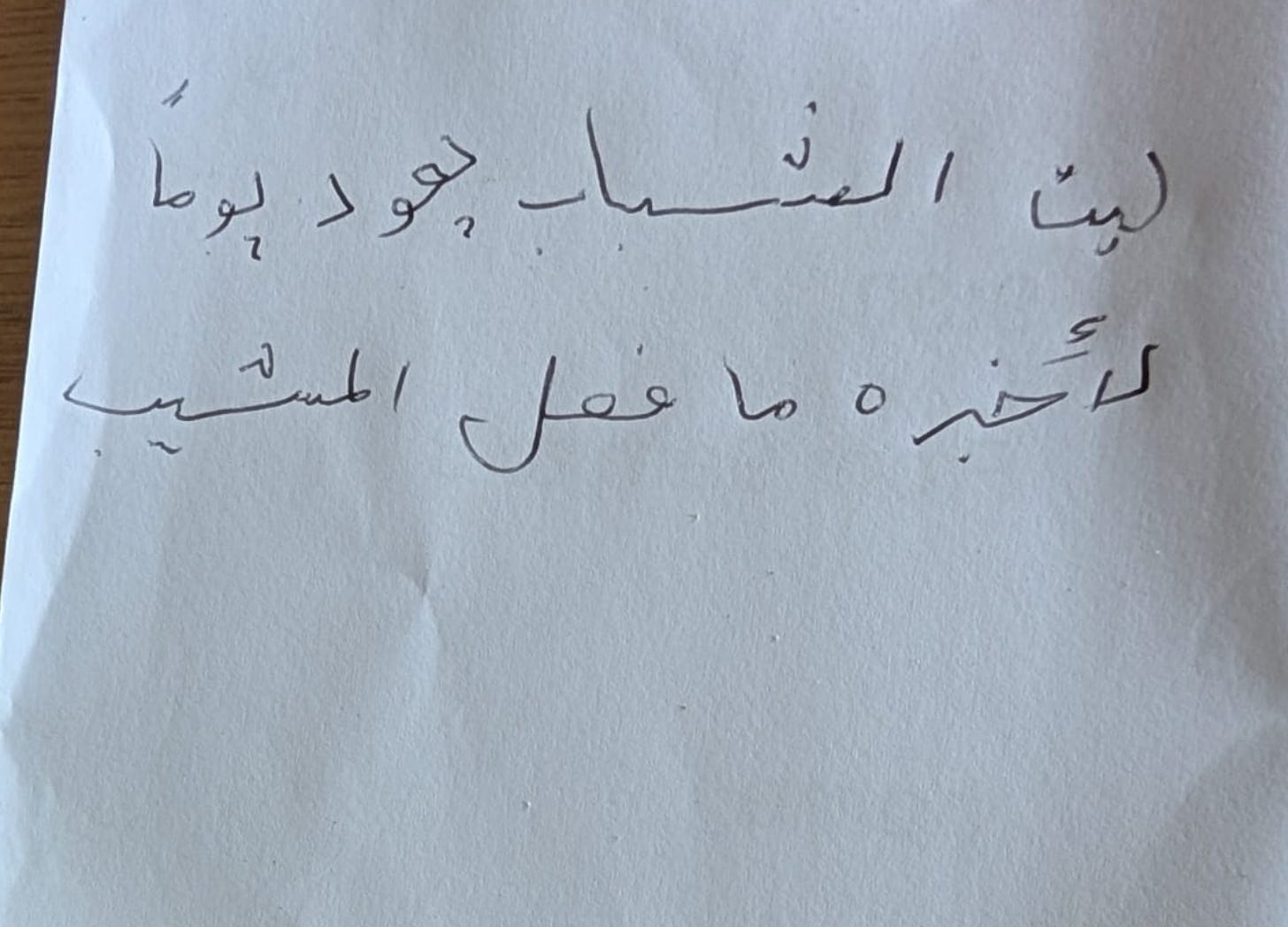
“… ليت الشباب ىعود يوما”
“If only youth could return for a day …”
“لاخبره مافعل المشيب…”
“… so I could tell it what the grey hairs have done,” Mum completes for him.
My eyes beam at their impromptu duo as I lower the fork to my plate.
“Who said that? Write it down,” I say.
“Naim, Mikhail … something,” they fumble between them, their memories blurring with age. Dad scribbles the verse on a scrap of paper (pictured above) while I pull out my phone for a quick search.
“Mikhail Naimy, a Lebanese poet, born 1889.”
A more thorough search reveals its true origin: an eighth-century poet by the name of Abu al-Atahiya writing during the reign of the Abbasid Caliphate – the golden era of Arab Islamic civilisation, when a majestic Baghdad was the beating heart of the world.
(The same civilisation Pauline Hanson labelled a “social cancer” at the National Press Club).
A simple gesture for conversation over lunch suddenly exposed the extent of a cultural continuum stretching back 1,200 years.
“I used to sit with friends and recite and talk about all these poems,” Dad revealed.
Mum recounts one of those friends, since passed. “He was a good man, I liked him.” Couched within their exchange, and this verse, is a deep longing.
“What do you think of your life in Australia, looking back on it all now?” I ask them.
“Work,” Dad says, now turned to face me sitting at the opposite end of the table. “Work and peace.”
“Not happiness?”
“Peace.”
Mum nods in agreement.
“What did you both lose, do you think, in coming here?”
“Everything,” Dad says, consistent in his single-word, vague answers. My eyes remain fixed, however, seeking more.
“Everything …” Mum continues, as if answering for both. “A loss of belonging. A loss of friendships. Everyone we loved, the way we lived, all the memories we had,” she says, tears forming in her eyes.
“Would you still have decided to move here, if you had the choice again?”
They pause.
“No,” he says. Mum moves in to correct his softening rearview mirror.
“War doesn’t give you a choice,” she says.
I reach for my book, parked next to Mum’s seat where she has kept it since reading it two months ago – she refuses to part with it.
“I want to read what your dad said to Mum when she first got here,” I tell him.
I flick the book open, sifting through the final chapters. Dad waits patiently – he’s yet to read it.
“Our homeland, as broken and hard as it is, has a pulse you will never find here. Here in this land our stomachs are fed while our hearts go hungry.”
Dad exhales with force, pressing his index finger into the table.
“That’s it. That is it.”
My parents are at an age where their bodies are yielding, prematurely, after a lifetime of stress and upheaval caused by war, migration and the responsibility to navigate their families through both.
It’s not uncommon – group chats are filled with friends managing their migrant parents through an overbearing end-of-life depression and the physical ailments that come with it.
But the hard truth is that there’s nothing we nor any psychologist can do to repair the wound of forced migration – of separation from an indigeneity that now exists only in memory.
As First Nations wisdom teaches us, land and community are one. Indigenous communities rooted in their surrounding environment for millennia are inseparable from the natural landscape. Uprooting from the land of forebears leaves one, as Mum described, lost and torn.
It’s a transition rendered more difficult by an often inhospitable climate – switching from a familiar world to a distant society that outcasts, ridicules and scolds at the sound of a different tongue, musical note or ancient custom.
Years of parenting and work offered both Mum and Dad convenient distractions from these persisting wounds. But with no distractions left in their later years, the wounds are inescapable, overwhelming their minds and bodies.
When I think of their trajectory – surrendering their world to war, moving to the other side of the planet, trying desperately to get their immediate families to safety, settling and stabilising, having children, working hard on meagre wages while enduring racism in a society that forever treats you like an alien – it’s no wonder their bodies are failing before their time.
I would be the first to consider my parents’ story irrelevant and pointless were this isolated in Australia. Sadly, it is not. Our suburbs and towns are filled with exhausted migrants who spend their days waking up early to work long hours, shrug off racist taunts with a smile, and return home to news networks and politicians beaming through smartphones and TV screens, berating them for existing. An unwanted “social cancer”, they’re reminded. All in the hope of finding “peace”.
If Pauline and the far-right influencers (or grifters per Cheek Media) bothered to dig into the reality of Australia, they would find migration immovable from the Australian story.
A simple search of Census data reveals quite a bit. For example, 11% of us originate from southern and eastern Europe – areas ravaged during World War II (and the Balkan wars in the 1990s). Another 4% from southeast Asia, many fleeing the Vietnam war in the 1960s, on top of the 3% from the Arab and Islamic world who left for similar reasons. Adding up the Australians of southern/eastern European, non-European and Indigenous heritage gets us to 35% of the population – not an insignificant minority.
And such stories are not limited to the non-Anglo Australian. In a recent past, those who fit under the 'Anglo-Celtic’ category were new arrivals too. We’re told as much by the many local museums that frame – and freeze – Australia in colonial settlement. Inside, as I discovered on one trip to a museum in Adelaide, letters and diary extracts of 19th century English migrants can be found. Letters that speak of the enduring pain of leaving England behind, a longing for a homeland never to be seen again.
It’s the same longing I see in my father’s eyes. It’s a shared story that defines a unique Australian experience (for most of us) – of incredible sacrifice to build something new. This is the real Australia, and it belongs to all of us.
Antoun’s book, Rebirth: A Love Story from the Depths of War, is available online and in your nearest bookstore.
Evocative portrait of loss and longing. You have pinpointed the inextricable truth about country. No matter from where you spring you are tied to your country and leaving tears the soul. Give me the wonderful song of varied tongues and notes over the nasty twang of whining grievance.
Beautiful, and thanks for all the fine work you do. Have just ordered your book from Readings.