


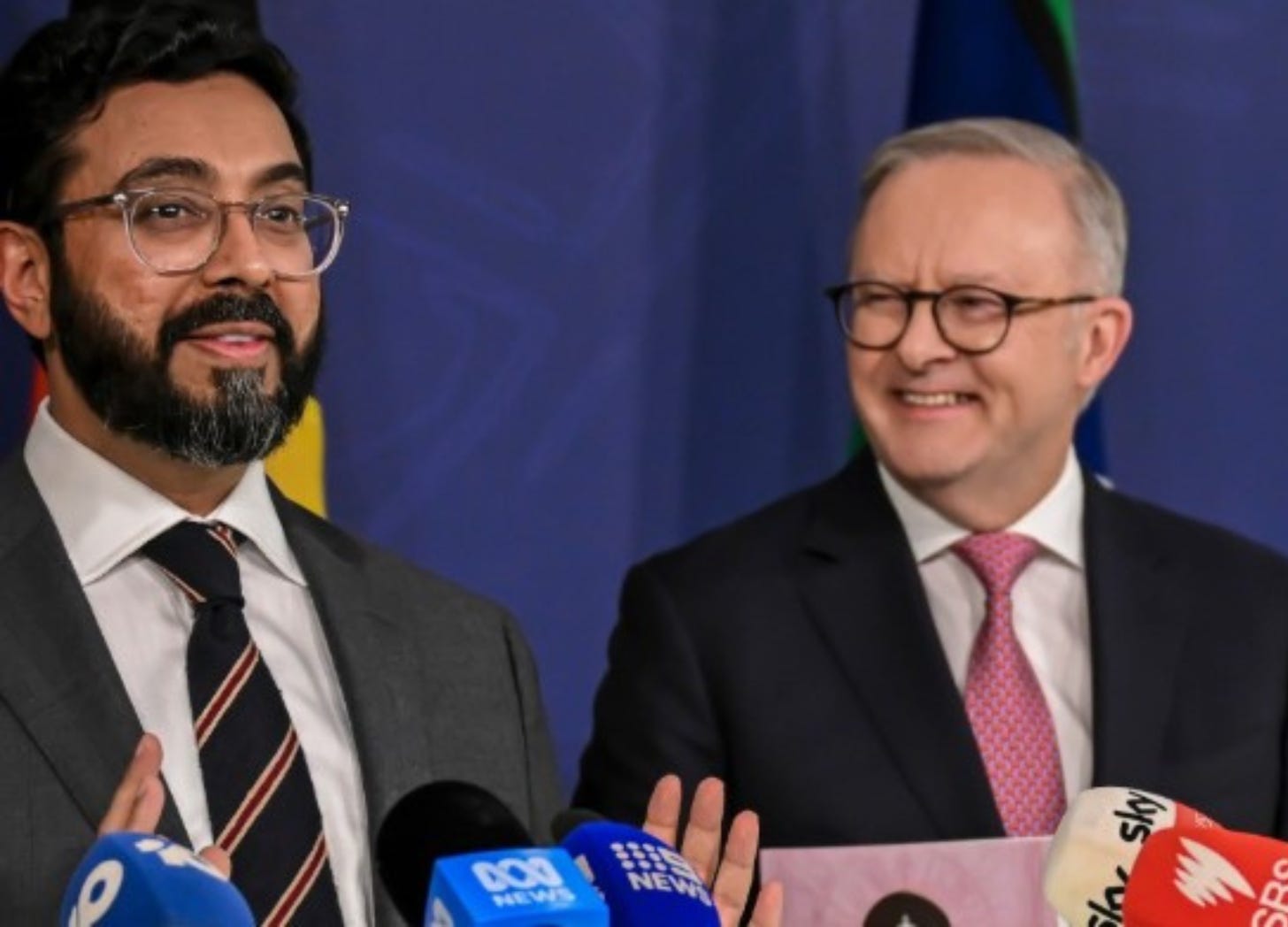
The Special Envoy to Combat Islamophobia has come under fire from within the Muslim community for extending a Ramadan iftar invitation to far-right leader Pauline Hanson.
The envoy, Aftab Malik, extended the invitation to Hanson last week, saying in a press release that “my door is always open”.
“I am happy to talk to her about Sharia, the different types of Jihad, the Qur’an, violent extremism, women in Islam and any other questions she may have,” Malik said.
The invitation followed Hanson’s statements on Sky News on February 16 questioning whether “there are good Muslims”. In a follow-up interview on ABC News Breakfast, Hanson claimed that “people can’t go into certain suburbs in this country” and that people “feel unwanted” in the Sydney suburb of Lakemba, which has a large Muslim community.
On Friday, Australian Federal Police said they “received reports of a crime” related to Hanson’s remarks, while Canterbury-Bankstown Mayor Bilal El-Hayek called for Hanson to be charged under hate speech laws for the “public incitement of hated, discrimination or violence” against Muslims.
Islamic Council of Victoria President Mohamed Mohideen was scathing of Malik’s invitation to Hanson, writing on LinkedIn: “I don’t think we need such an envoy who doesn’t stand up for the community.”

Responding to questions, Mohideen said that politicians “who actively promote racist and Islamophobic rhetoric, and show no willingness to engage constructively with multicultural communities, should not be granted access or opportunities for engagement with these communities”.
“An invitation to share iftar during Ramadan can be a meaningful way to build... understanding, through open dialogue and building awareness of the lived experiences and contributions of Australian Muslims,” Mohideen told Deepcut.
“However, these engagements must be grounded in mutual respect and good faith. Dialogue is only productive if all parties approach it with an open mind and a willingness to listen and learn. Otherwise, these engagements are at best tokenistic, and at worst an opportunity for politicians with a record of openly racist or Islamophobic rhetoric to fuel further division.”
The Special Envoy’s office was contacted for comment.
We can’t do this important work without your support. If you can, please consider becoming a paid subscriber for as little as $2.30 a week.
The Lebanese Muslim Association, which operates Lakemba Mosque, took a more conciliatory tone, welcoming Malik’s invitation to Hanson and offering “an open door to all who come in good faith”.
“Ramadan is a time when our doors are open even wider. Anyone is welcome to visit the mosque respectfully and join us to break bread at iftar, including Senator Hanson,” an LMA spokesperson said. “If people have concerns or questions, the best way to address them is through conversation, not assumptions.’
Lakemba Mosque has received several threatening and Islamophobic letters in recent months, including one shortly after Hanson made her comments.
Abandoning the ‘good Muslim’ myth
The controversy has rekindled a larger debate in Muslim communities about how to engage with politicians, media outlets and powerful institutions that engage in Islamophobia.
Dr Yassir Morsi, a La Trobe University academic who has written extensively on Muslim identity and political engagement in Western societies, believes Malik’s invitation to Hanson is an example of Muslims being expected to “perform respectability”.
“On a surface level, you can understand the generosity he’s trying to show. It’s an attempt to counter the narrative; to show hospitality to those who would harm you,” Morsi says. “On a deeper level, many of us believe that racism is built on ignorance and a lack of familiarity or contact, which can be countered by showing generosity.
“But this isn’t new. We’re going into our third decade of performing this role of ‘the good Muslim’. Your dignity might let you do it if, at the end, there was relief from racism, but there’s not. We’re never off the hook.
“Aftab has a responsibility to his community, first and foremost, to be clear about what Islamophobia and anti-Islamophobia are. His statement does a poor job of that, I think.”
Hanson’s derogatory comments about Islam and Muslims span more than a decade, including repeatedly calling for a ban on Muslim migrants and wearing a burqa on the floor of the Senate. In 2015, she claimed without evidence that halal certification funds terror networks. In 2017, she called for a ban on the Islamic faith itself.
Hope that a figure like Hanson is open to changing their views on Islam and Muslims is misguided, Morsi argues.
“Pauline was talking about the ‘Asian scare’ back in 1996. She knows exactly what she’s doing. It’s the same tactic being used in Europe and the UK and elsewhere,” Morsi says.
“Pauline wants to present to her followers that she’s the gatekeeper of a ‘pure’ Australia that’s under threat. It has nothing to do with facts, or about who we really are, or the ‘contribution’ we make or don’t. It’s a performance.”
The rise of political movements like The Muslim Vote and Muslim Votes Matter, Morsi believes, is a symptom of a growing frustration in Muslim communities with the more conciliatory approach to power long taken by many Muslim peak bodies and public figures.
“For a long time, the strategy of so-called community leaders has been to tell those in power to behave differently. That never happens,” Morsi says. “The people who engage with power – the meetings with government, the iftar dinners – they’re not separate from those in power. They’re managers of power. They’re anointed by power. They’re not necessarily representative of different community sentiments.
“So there’s a growing call for self-determination – to assert our rights and our civil liberties and not to pre-emptively apologise. It’s not about withdrawing and refusing to engage with government entirely – it’s about honest, proper engagement with government. We want government to listen, not just to hand-pick who they listen to.”
Got a tip? Send an email to tips@deepcutnews.com or send an anonymous Signal to @deepcut.25.
This while people are scrabbling for food to observe their Iftar? Nah.
Religion mans worst invention no matter the franchise.