


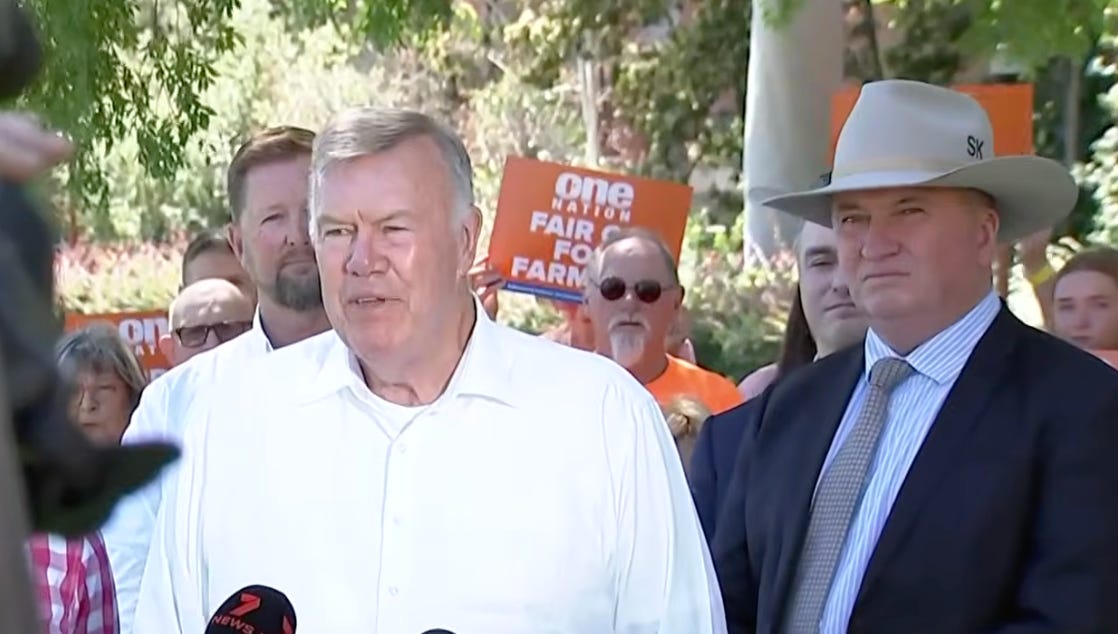
As I write this, One Nation is on track to win the seat of Farrer. The race is down to either One Nation’s David Farley, or community independent Michelle Milthorpe. Before the byelection was called, most Farrer watchers believed Milthorpe would take the seat, given her strong performance against Sussan Ley at the last election. Those hopes have since dimmed, with Farley now considered the frontrunner by those on the ground. This should matter to everyone.
Support principled, ethical, independent journalism. If you can, please consider becoming a paid subscriber.
As with all things One Nation, Farley’s past actions don’t seem to matter. Neither does it seem to matter that he doesn’t know if Gina Rinehart is funding his campaign or not. Farley told a recent candidate forum that he knew where the local donations had come from, but as for Rinehart he was “not sure” that he could answer that question as “it’s not in my pay grade, as they say”.
The Nationals look like preferencing Farley and the Liberals have placed him above Milthorpe, with the Coalition unable to stop shooting itself in the foot, instead continuing to hasten its end by sacrificing itself to prop up the party cannibalising it.
If One Nation wins Farrer, the narrative of their unstoppable march becomes all but locked in. The Victorian election will be next. And while both the last federal and South Australian elections showed that more people voted against conservative candidates than for them, the narrative will be that One Nation is in control. With that comes more mainstream kowtowing to One Nation’s baser instincts. That should worry anyone who cares for democracy.
It should also worry people that Rinehart has found her direct line into the public narrative, having helped pull the Liberals into oblivion. Rinehart has always been about raw power, but this time she has managed to not only hijack the political situation by demonising renewables and the energy transition through political lackeys like Barnson (Barnaby Joyce and Hanson) and co, she is also, on the flip side, making bank.
Rinehart is well on her way to becoming one of the world’s forces in critical minerals and rare earths, as she invests in projects and companies all over the world to lay claim to the future. At the same time, she continues to deny climate science and fund campaigns spreading lies and misinformation about renewable energy.
There is very little curiosity outside of the business pages about why Rinehart is doing this (Sarah Martin at the Guardian a noted exception). Context has very rarely been a forte of mainstream media, which tends to see adding in historical facts and events in their total context as rubbing up against their ideas of ‘objectivity’. That’s always been a problem, but it’s becoming an increasing threat to our democracy, with legacy media – not just in Australia, but also in the US and the UK – showing itself incapable of handling a backslide in democracy, partly because it doesn’t see context and proper analysis of power as necessary.

We very rarely see power examined in Australia, either as a concept, or in context of how it is being used. Instead, stories and narratives tend to appear in siloed vacuums, as if one doesn’t lead into the other.
Advocacy group GetUp! has had some material impact on the ground in Farrer, simply by alerting voters to Hanson’s unwavering support for Donald Trump. None of this is new – Hanson and her acolytes invited media to film them drinking champagne outside Australia’s parliament house when Trump was first elected in 2016. Since then, she has only increased her love of all things Trump, travelling to Mar-a-Lago with Rinehart while speaking at Trump-friendly conservative events. It should probably be mentioned in every story that features Barnson, but it only seems to become relevant when either is directly asked.
Which brings us back to Farrer, where a frontrunning candidate gets away with not being able to answer whether or not Rinehart is contributing to his campaign. (He received applause for the ‘above my pay grade’ answer from the forum attendees.)
There is a view that One Nation’s cosy relationship with figures like Rinehart is seen as a positive among their most ardent supporters, as well as those who have fallen victim to anti-establishment propaganda, which positions billionaires like Rinehart as being only concerned with the national interest and not their own.
But the rest of us should care more. Democracies live and die on high expectations, and it is by design that we have been conditioned to expect low standards from our politicians. The lower the standard we expect, the less likely we are to hold them to account. Power players like Rinehart and Barnson not only know this, they know how to exploit it. It should matter that One Nation’s candidate in Farrer is backing in an unpopular hospital redevelopment proposal (over a greenfield, purpose-built site) and is open to the privatisation of state services, contrary to local interests, because One Nation does not have a health policy.
It should also matter that One Nation’s lack of health policies is not a national issue, at the same time as we are continually hearing about the unstoppable force that is One Nation.
Just as it should matter that LNP senator Susan McDonald was doing her best impression of a gas company lobbyist at a Senate hearing looking at a 25 per cent gas export tax this week, claiming it would be “a carbon tax on gas” and running defence for an industry that almost no one, outside of those with vested interests, thinks is paying their fair share.
It should be a national scandal that Japan makes billions of dollars on the import tax it places on gas (40 per cent of which comes from Australia). Japan raises around $1.8 billion a year from gas imports, including $710 million on Australian gas and $8 billion in total through its Petroleum and Coal Tax. Australia raises about $1.4 billion from its Petroleum Resource Rent Tax in a good year.
But we are more likely to hear from gas companies and billionaires about why taxing gas in Australia is not a good idea, rather than what Australia is missing out on. And more often than not, we let those speaking on behalf of power in Australia skirt by on with homilies and half-truths.
We should all care about that, a lot more than we do.
Have you checked out our new podcast Deepthink? Episode two just dropped – a deep chat with Lebanese-American journalist Rania Khalek on the war in Lebanon. Watch or listen on YouTube, Spotify, Apple or your preferred podcast platform with this RSS feed.
Just as well we have you Amy, making sure that we all now know what is going on . We are so saturated with Trump that what is happening in Australia is often buried .
Brilliant piece as always, Amy. Thank you.
Sue Barrett has written some insightful explainers on How to Vote (Substack). Many Australians simply have no idea what each tier of government is responsible for, further eroding our democracy! We will likely see these impacts play out in Farrer...