


Deepcut’s journalism is free to read because our readers choose to fund our work. If you want to support fearless Australian reporting, consider becoming a paid subscriber or making a donation today.
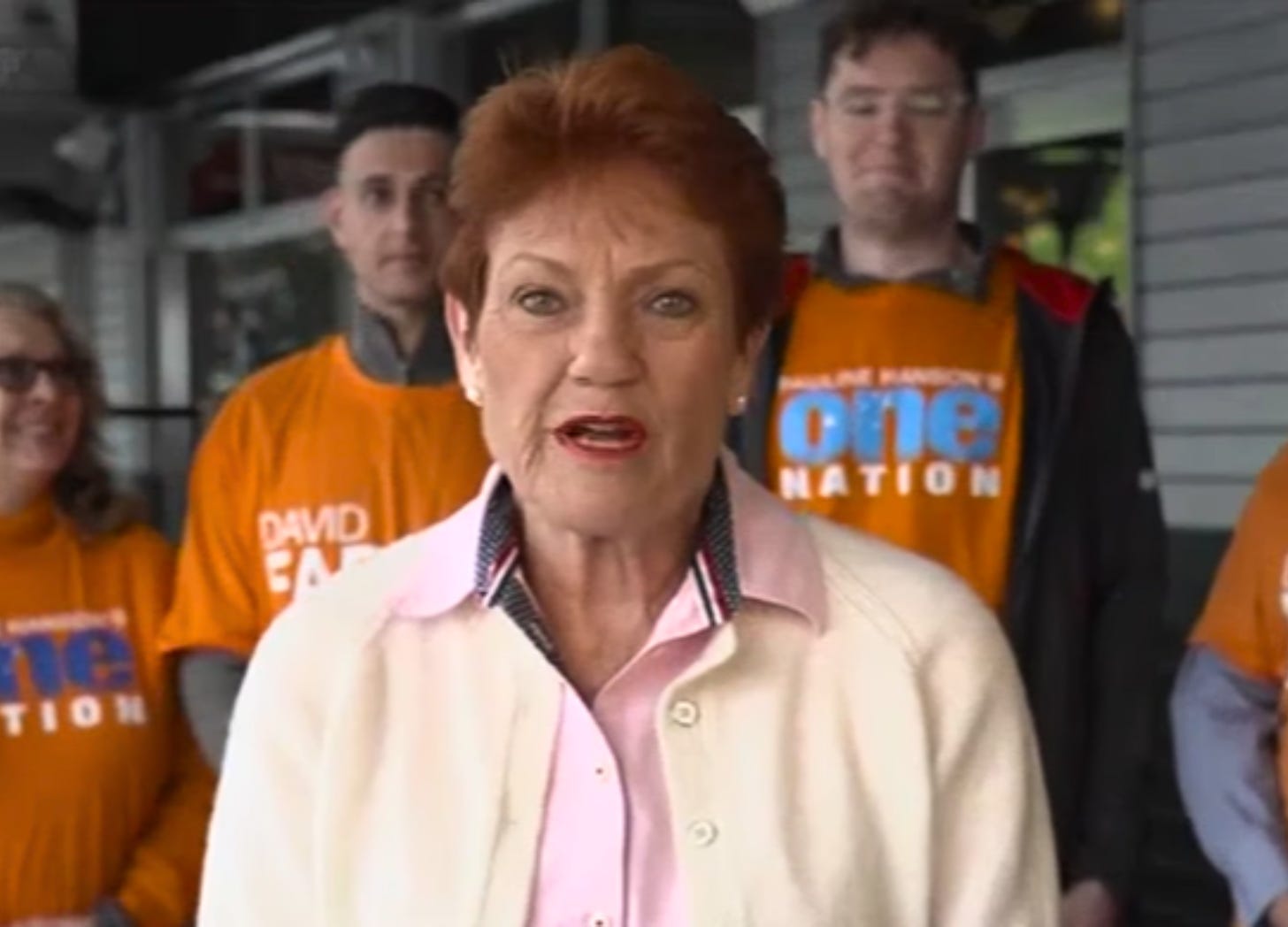
One Nation’s victory in the Farrer byelection was a long time coming. After 30 years of effort, the party’s backers have finally laid the groundwork to establish the party as a major and permanent fixture in the Australian electoral landscape.
For decades, Pauline Hanson’s career was kept on life support by the corporate, political and media establishment as she scraped by on the margins of public life. Now that One Nation has broken through, the forces that propped it up will look to build on their success, turning the party into a domestic vehicle for the same transnational far-right electoral project that put Donald Trump in the White House and turned Nigel Farage into a prime ministerial contender.
The new default party of the right
On Monday, longtime ABC election analyst Antony Green argued that One Nation now represents “an existential threat to the Liberal and National Parties … a threat to their relevance, their chances of ever governing again, and to their continuing existence”.
The Farrer byelection illustrates why. After the disastrous 2022 and 2025 federal elections, the Coalition’s remaining seats are now overwhelmingly based in two areas: regional Australia and Queensland. The collapse of the combined Liberal-National vote in a blue-ribbon rural seat like Farrer means One Nation is primed to cannibalise the Coalition’s only remaining electoral base. Labor and the ‘teal’ independents have almost entirely locked the Liberal Party out of Australia’s major cities and suburbs. If it loses its regional seats, there is simply nothing left, and no way back.
While the community independent movement will also benefit from the Coalition’s structural decline — the independent runner-up in Farrer, Michelle Milthorpe, polled higher than the Liberal and National candidates put together — One Nation is now on track to become the party of the regions at the next election. By default, that would make it the largest right-wing party in the country, or at least put it on par with the Coalition parties.
While there are still a few holdouts (Clive Palmer is still buying front-page newspaper ads spruiking his next electoral vanity project, for some reason), Australia’s broader right-wing ecosystem has recognised this and is scrambling aboard. One Nation can now offer hard-right politicians what the Liberal and National parties could once give them — a real shot at a seat in Parliament — without the trade-off of having to moderate their views in public or compromise in the party room.
Desperate to keep their remaining talent from defecting, the legacy conservative parties are already inviting One Nation into the old ‘big tent’ hollowed out by the collapse of mainstream centre-right politics. Liberal and National leaders now routinely cut preference deals with Hanson and voice sympathy with the ‘concerns’ of her voters. So-called ‘moderates’ like Tim Wilson have begun openly wondering if One Nation could join the Coalition down the road. A One Nation minister holding the immigration portfolio in a future Coalition government is no longer outside the realms of possibility.
Certain sections of the business community have never been shy about courting One Nation — Hanson will be flying around in a private jet courtesy of Gina Rinehart for the foreseeable future — but the party’s electoral success will also give corporate Australia the green light to deal with it more openly.
Mining companies, gambling lobby groups, property moguls and billionaire trust funds will add a zero or three to their existing One Nation contributions. Big business will happily fund One Nation’s vision of an Australia where any migrants allowed in for work purposes are even more underpaid, exploited, maligned and cut off from support than they are already.
Driven by Donald Trump’s War on Woke, ASX200 companies have already begun winding back their internal diversity, equity and inclusion programs. As Hanson picks culture-war fights over Welcome to Country and treaty negotiations, corporate ‘commitment’ to multiculturalism and First Nations justice is also going to go quiet.
What comes next?
One Nation still has profound weaknesses, the biggest of which is Hanson herself. In her 30-year career in politics, Hanson has demonstrated a chronic inability to work with her colleagues or build and sustain a functional party organisation. The party inevitably attracts candidates and staffers who quickly disqualify themselves on the grounds of criminality, bigotry, or both. Hanson herself turns 72 this month, and there is no one in the broader constellation of far-right weirdos jostling to become her heir who has her distinct, Trump-like brand of charisma.
The project for One Nation’s backers now is to build the party into something that is bigger than Pauline — that can survive her eventual retirement or implosion and maintain its newfound status. That effort is already well underway. Through its massive online presence and free-to-air broadcast deal in regional areas, Sky News is quietly doing to older rural Australians what FOX News has done to conservative Boomers in the United States, hooking its audience on an endless drip-feed of far-right talking points, paranoia, conspiracy theories and scapegoating.
Sky’s traditional audience metrics are tiny, but on Facebook and YouTube — where it has nearly 2.4 million and more than six million followers, respectively — it’s become a feeder channel for the greater MAGA project undermining what’s left of Western democracy. Current and former Sky personalities are interviewing Donald Trump, churning out podcasts for far-right American think tanks, popping up at Mar-a-Lago and planning tours of red states. Regardless of what public drama or lineup changes cause One Nation’s polling to rise and fall week to week, the vast, well-funded and highly organised push to entrench far-right politics in Australia and the rest of the Anglosphere will keep chugging along.
Hanson has already flagged the party’s next target: working-class voters in the outer suburbs who are already abandoning the Labor Party. She aims to repeat the winning strategy that saw Farage’s Reform sweep UK Labour’s traditional strongholds in council elections on the weekend. Unlike in the UK, as yet there is little sign of the Greens or other parties to the left of Labor seizing the initiative and building popular support for a progressive alternative. Labor itself seems happy to gloat as the Coalition implodes — a dangerously complacent attitude for a party whose primary vote sits at just 30 per cent.
Since its founding in 1996, One Nation has reshaped our politics and society in deeply unpleasant ways. Now that the party has officially arrived, that process is going to accelerate and intensify. Old institutional safeguards will fall away. Doors will open to the party that, until now, have remained shut. The material conditions that allowed a party like One Nation to rise are not going away, making the question of how its opponents respond more pressing than ever.
Check out the latest Deepthink episode with Lebanese-American journalist Rania Khalek, where we go deep on the war in Lebanon. Watch or listen on YouTube, Spotify, Apple or your preferred podcast platform with this RSS feed.
I agree with everything said in the article except the bit about Pauline Hansen having charisma. Really? I don't see it but have to recognise that she and the party she represents are on the rise. But we have to remember she is a racist and punching down on immigrants only gets you so far.
The worrying thing is that One Nation are filling the void vacated by the coalition and to a lesser extent the ALP not recognising peoples grievances. One Nation is the protest vote. It doesn't matter that they don't have any policies. Just like the MAGA wave in the US, Pauline Hansen is the disruptor and voters are sending a FUCK YOU to the major parties.
ON is doing so well becasue the other parties are not listening to the people, say on immigration, gas taxes this is not to say ON will follow through with any promise the same as all the other parties. The Greens have totaly lost the plot, fairy dust will not fix the problems as the polls are showing.
ON will do what Gina tell them and change when she tells them not much different to all the other parties just doing their masters bidding.
Not a care for the working class from any of them.