


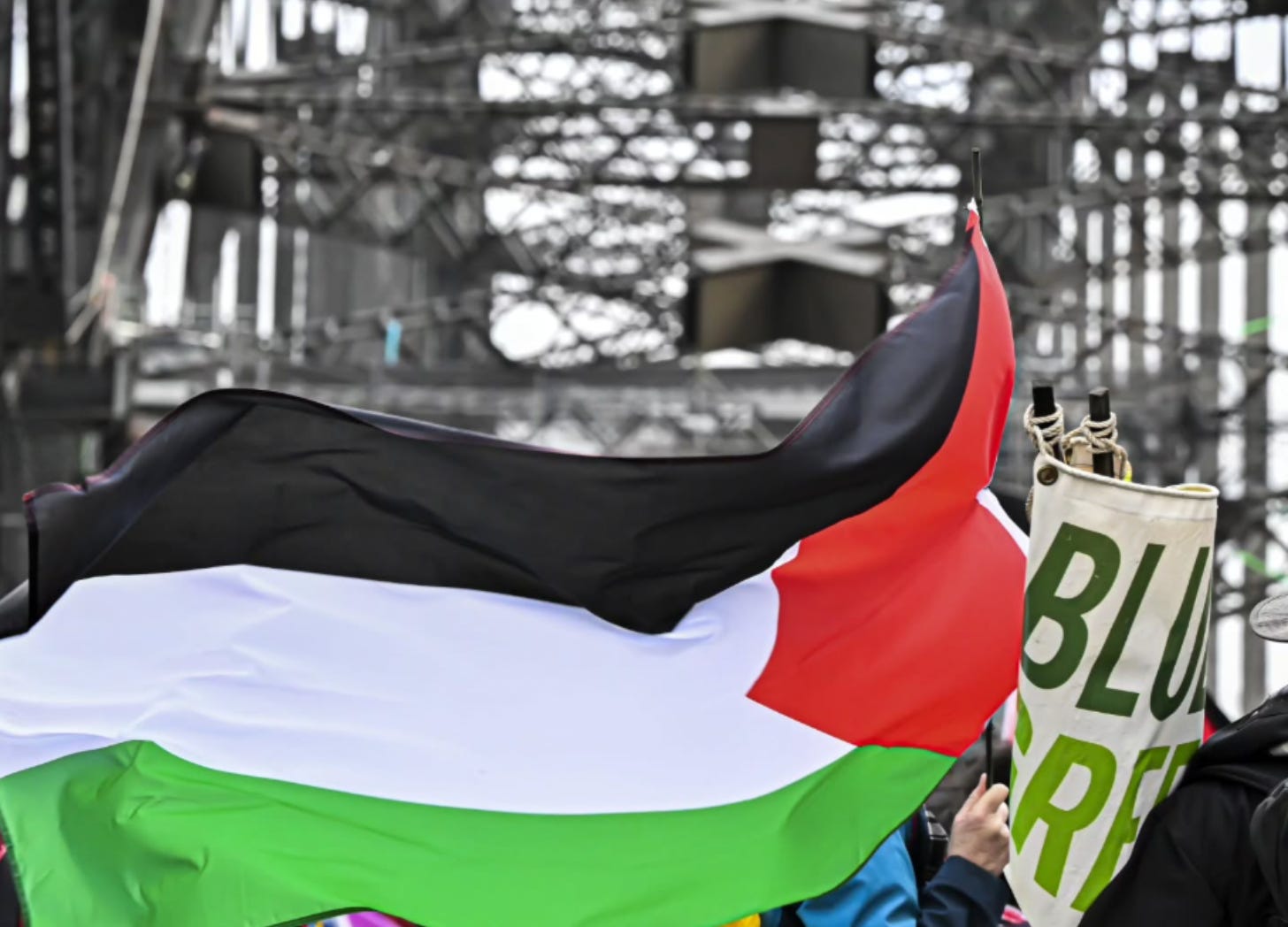
Saying, publishing or displaying the phrases ‘from the river to the sea’ and ‘globalise the intifada’ will be punishable by up to two years jail under new laws set to pass in Queensland.
Reforms to hate speech laws will be introduced to Queensland Parliament today that prohibit “the public distribution, publication, display or recitation of proscribed phrases”, mandating a maximum penalty of two years imprisonment.
The laws will also increase maximum penalties for the display of “terrorist symbols”, including the flags and emblems of Hamas and Hezbollah alongside Islamic State and Nazi iconography, and mandate a minimum three years jail for “impeding or harassing people attending religious services”.
Announcing the laws at a press conference on Sunday, Premier David Crisafulli described the pro-Palestinian chants as “terrorist slogans”, seemingly laying blame for December’s Bondi terror attack at the feet of the pro-Palestine movement.
“We won’t accept terrorists on our shores and we won’t accept the seeds of antisemitism that became what they were [at Bondi]”, Crisafulli said.
Freedom of speech is under attack. Support quality independent media.
Speaking alongside Crisafulli at the Queensland Holocaust Museum on Sunday, Jewish Board of Deputies president David Steinberg said that “two and a half years” of pro-Palestine protests “hasn’t made us feel safe”.
“When a school kid in a Queensland school gets attacked by their classmates, saying, ‘from the river to the sea’, or ‘free Palestine’, or ‘globalise the intifada’ – that’s a line that needs to be stopped,” Steinberg said.
Australia Palestine Advocacy Network (APAN) executive officer Katie Shammas called Crisafulli’s comments “anti-Palestinian racism”.
“When leaders frame political speech as menace, they participate in and legitimise discrimination. It does not make anyone safer,” she added.
“Palestinian Australians are demanding an end to Israel’s genocide and illegal occupation, and accountability under international law. To portray that as extremism is to deliberately demonise a whole community and its allies.”
Queensland Labor signals support
The reforms are all but certain to become law, with Crisafulli’s Liberal-National government holding a majority in the state parliament’s single legislative chamber.
Queensland Labor has signalled it may support the laws once they are tabled in parliament, with shadow multicultural minister Charis Mullen telling the Courier-Mail the opposition “supported considered laws that addressed the scourge of antisemitism, hate and racism in our state”.
The opposition’s stance to the laws appears to be at odds with a suite of motions adopted at Queensland Labor’s state conference in November urging the Albanese government to take a more critical stance toward Israel and increase support to Palestinians.
The motions called on the federal government to review Australia’s “political, cultural, educational, economic and military” relations with Israel, institute a two-way arms embargo, increase sanctions on Israeli ministers, increase funding to the UN Relief and Works Agency and act to prevent illegal settlement expansion in the West Bank.
Mullen and shadow attorney-general Meaghan Scanlon did not respond to requests for comment.
Queensland Greens MP for Maiwar Michael Berkman decried the ‘proscribed phrases’ provisions as “kneejerk authoritarianism from politicians who want to look like they’re doing something”.
“The government is making itself the thought police. If they decide your words are offensive, you can go to jail for them. That is an assault on our democracy,” Berkman said.
Queensland Council for Civil Liberties vice-president Terry O’Gorman compared the laws to “the dark days of the Bjelke-Petersen street march ban in 1977”.
“Banning or criminalising a catch cry, especially in public protest situations, merely because it may ‘cause offence’ is an affront to free speech rights,” O’Gorman said.
“The meaning of both of these phrases is highly contested. To many Jewish people the phrases are seen as slogans that can escalate tensions and fear. To those using the phrases, particularly in anti-Israel public demonstrations, these phrases can be used to oppose Israel’s actions in Gaza and in the increasingly violent West Bank settler movement.”
Got a tip? Email tips@deepcutnews.com or send an anonymous Signal to @deepcut.25.
Where is George Brandis ("People have the right to be bigots"), erstwhile champion of free speech, when you need him?!!!