


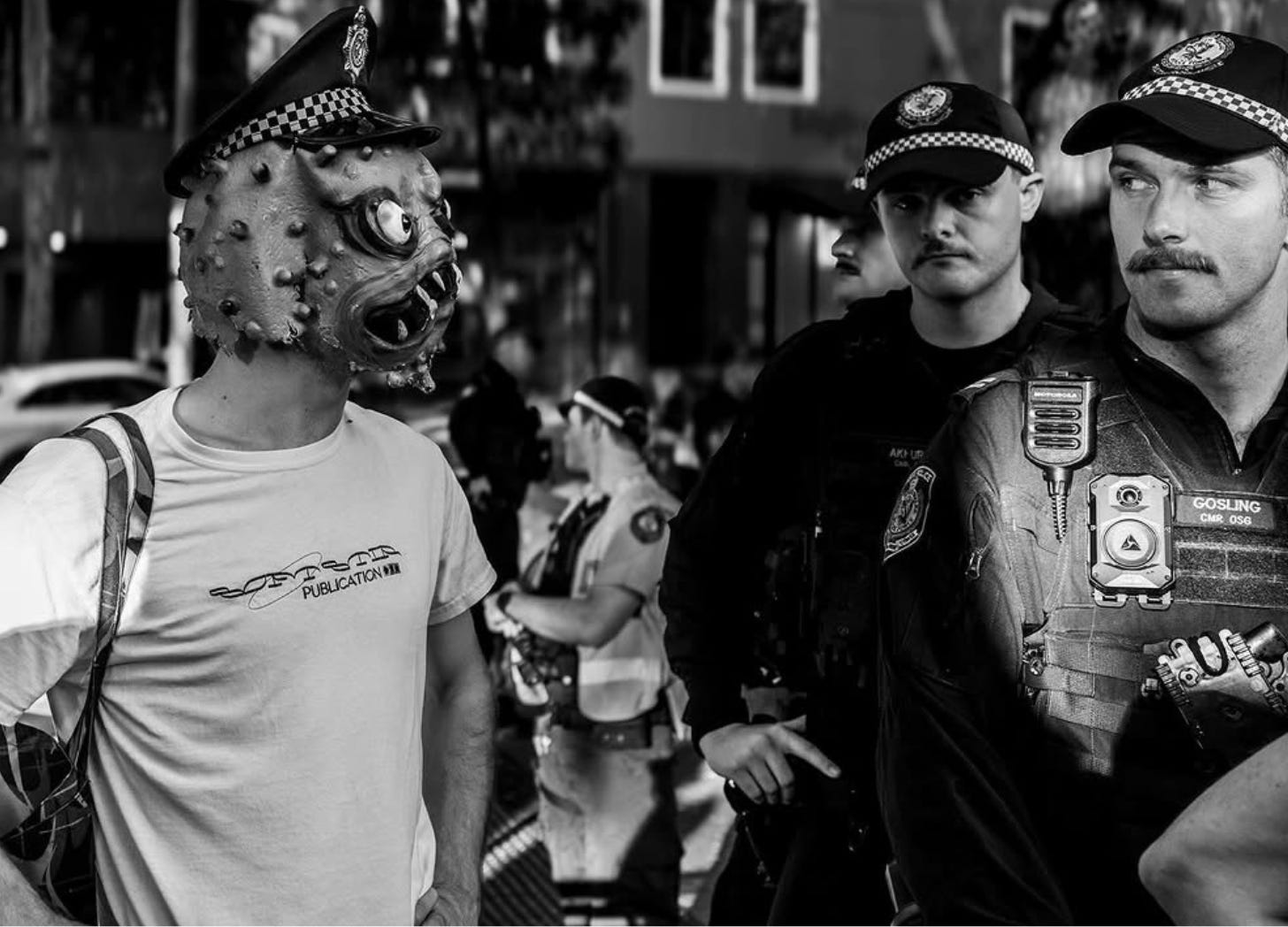
Tom Raue is the founder of anticop, an educational resource about police weapons, history and tactics. Opinions expressed are those of the author alone.
Last Monday night, dozens of people were arrested at the Sydney rally against Isaac Herzog. I was one of them. After tackling me to the ground, officers claimed they arrested me for “assaulting police”. Since I had done no such thing, I was soon released without charge.
While I didn’t assault anyone, the same can’t be said of the cops. We’ve all seen the footage of people being punched, tackled and pepper-sprayed for the crime of peacefully standing against an ongoing genocide. Women, children, the elderly and even members of parliament were victims of the cop riot.
I recently founded anticop, an online educational resource on policing and protest, to help contextualise how something like Monday night could happen – and how to protect yourself if it happens again.
As governments and police crack down on democratic rights, Deepcut is unafraid to start important conversations.
Monday night’s terrifying violence has made many people question their assumptions about police. If the role of police is to prevent violence, they have a funny way of showing it.
While the Herzog rally was certainly a recent peak in Australian police brutality, it’s hardly an aberration. In the United States, ICE has conducted a terror campaign in Minneapolis, kidnapping and killing people in the street. US police have been murdering Black people at an alarming rate for decades. And if you think it’s just an American problem, familiarise yourself with the ever-growing list of First Nations deaths in custody.
I’ve witnessed plenty of police violence myself, having been arrested previously at union and refugee protests. I have PTSD from being choked by a cop, and I’ve witnessed cops breaking bones.
People of colour, queer people, homeless people and people undergoing mental health crises don’t need to protest to experience police violence.
The case for abolishing the police
If you’re unfamiliar with the idea it might sound odd, even outrageous. But a look at police history can help understand the true function of police, and how we can do things differently.
For most of history we didn’t have police as we know them today. In pre-industrial England, volunteer magistrates and constables worked with militias to settle disputes and capture violent offenders. Some towns had informal night watches, and the rich could afford private security.
The Industrial Revolution saw rapid social change. Peasants were turned into landless workers, unable to vote and living in slums.
Poverty led to petty theft and revolutionary movements. To keep the working class in line, a police force was established in London in 1829. Unlike previous law enforcement, they were uniformed, professional and responsible for a designated area at all hours of the day.
As natural as the police might seem today, there was widespread opposition to the establishment of London’s Metropolitan Police Force, with many viewing it as an occupying army. To counter this image, their uniforms were blue instead of military red, and they carried batons instead of firearms.
This model of policing naturally spread to the penal colony of Australia. While urban police wouldn’t carry firearms (yet), this was not the case on the frontier. The main functions of 19th-century Australian police were capturing escaped convicts and murdering Aboriginal people. When we talk about the frontier wars and genocide, we’re talking about the same policing institution that recently ran riot in Sydney.
The other big influence on world policing is the US. In the American North, night watches evolved into police similar to the British experience, while in the South police forces evolved out of patrols to catch runaway slaves.
Since their inception, the police have been used to suppress suffragettes fighting for women’s rights, unionists fighting for the eight-hour day, anti-war and climate protesters, and now opponents of the genocide in Palestine. As we face down climate catastrophe and increasing inequality, whose side do you think the cops will be on?
So when police bash anti-genocide protesters, target Aboriginal people and protect the rich, it’s not an accident. That’s what the police are for.
But don’t police still keep people safe?
Not really. Of course there are individual instances of cops helping people, but if we zoom out we can see that there are much better ways to prevent harm. A Washington Post analysis of more than 60 years of public spending on US police departments showed no correlation between greater police budgets and crime going down. Time and again, studies have shown that anti-violence education and reducing inequality do more to reduce harm than policing.
This extends to prisons, with longer sentences failing to reduce crime, and in many cases increasing recidivism. Shockingly, traumatising somebody, cutting them off from their support networks and job prospects doesn’t typically make them a productive member of society. Every dollar taken away from police and prisons and instead spent on public housing, education and healthcare reduces crime.
One area where progressives might support policing is domestic and family violence. The police genuinely do help some people experiencing domestic violence, but they also harm many victims. Police routinely misidentify the primary aggressor, pursuing legal action against victims. More research is needed in this area, but studies from the 1990s suggest 40 per cent of police families experience domestic violence.
NSW Police have a well-documented culture of “protecting mates”, meaning officers who commit domestic violence are significantly less likely to be charged and convicted than the general public. Domestic violence is best prevented by anti-violence and anti-patriarchy education, and by providing proper jobs and housing so people aren’t forced to stay with abusive partners. Feminist police abolitionists have done a lot of work thinking through alternatives to police.
Police abolition isn’t something we can do in isolation; it has to be part of a broader dismantling of capitalism to create a more free and equal society. I’m under no illusions that billionaires will willingly give away their power in the economy, or disband their foot soldiers in the police. It will take a revolution, but there are incremental steps we can take along the way.
New York mayor Zohran Mamdani has hired Alex Vitale, a sociology professor and leader in the US police abolition movement, to scale back the power of the NYPD who run that city like a gang. The NSW government is reviewing how they respond to mental health emergencies, sending out mental health professionals instead of armed police who often kill people who just need help. We could legalise and regulate illicit drugs, fund proper youth services instead of the PCYC (which was based on the Hitler Youth, but that’s another story) and transfer rescue and traffic management to an agency without guns.
We’re seeing a global turn towards authoritarianism, fully embraced by Labor just in time to potentially hand the reins of their police state to One Nation. We should all learn how to handle the police, and work towards a less brutal future.
Got a tip? Send an email to tips@deepcutnews.com or send an anonymous Signal to @deepcut.25.

“People of colour, queer people, homeless people and people undergoing mental health crises don’t need to protest to experience police violence”
I’m 60. I’ve never been “helped” by police and would never approach them for help. I’ve witnessed and been harmed by police violence too many times.
It’s a force of systemic, state sanctioned violence. They show again and again, that even if they receive training (I doubt that) they are unable to control themselves in real life situations. Their only approach is violence.
I do worry this is institutional building work set to be handed to future One Nation governments.