


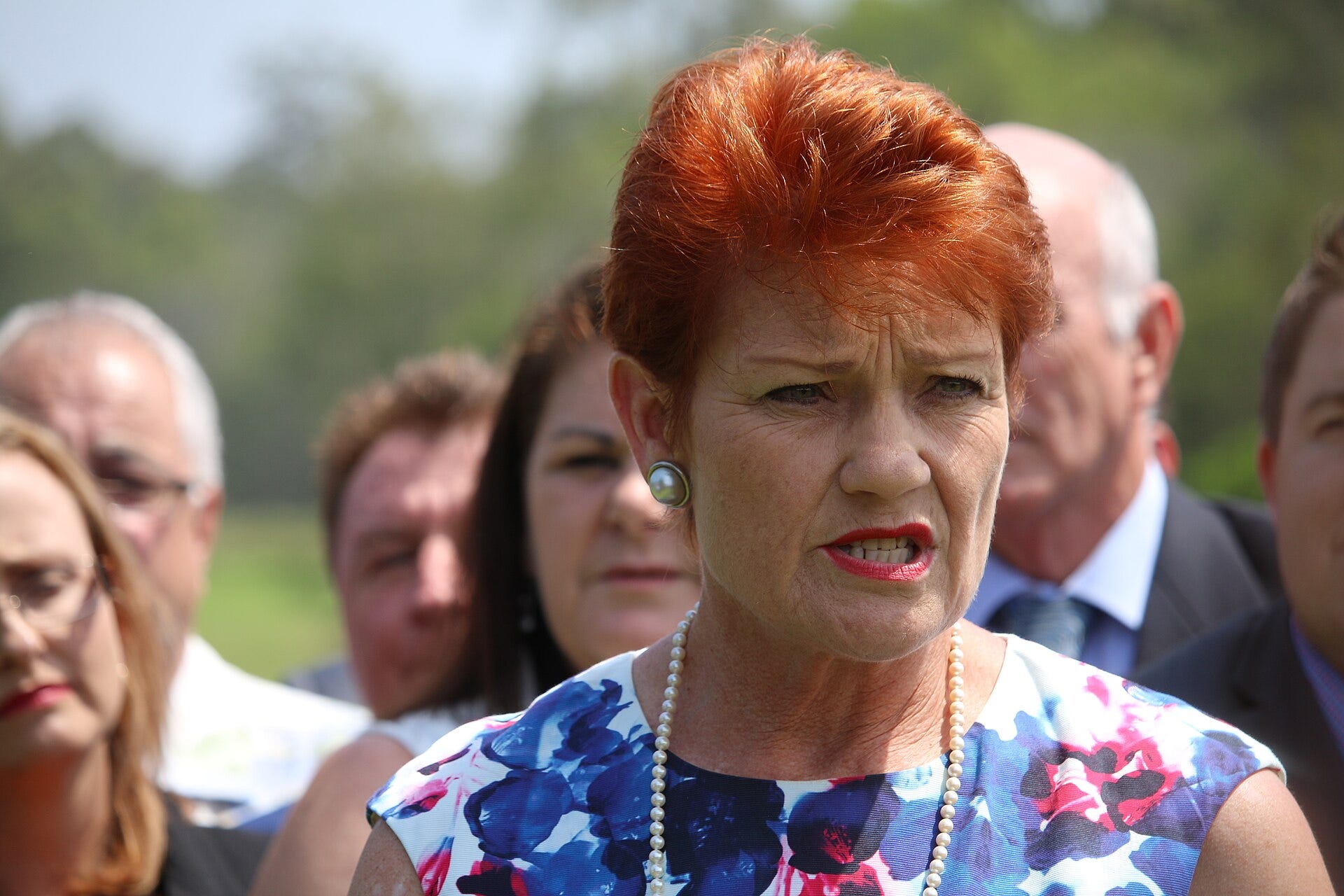
We took a look at the figures and associations helping the One Nation surge, and the results are unsurprising. Various powerful corporate sectors, including banking, hotels, mining and fossil fuels, all get a mention in the One Nation space, alongside Liberal powerbrokers and figures connected to far-right campaign group, Advance Australia.
Here’s a breakdown.
Who has been donating to One Nation?
We know Pauline Hanson has an unhealthy obsession with immigrants. Her other bone is climate change. In an appearance before the National Press Club in June, Hanson declared climate change a “hoax” saying it “has produced an increase in energy costs which has taken Australia into energy poverty”. Her party wants to pull Australia out of the Paris Agreement and build new coal power plants.
None of this is surprising given what is known to date about the party’s donors and financial supporters. One Nation’s latest donations for the 2025-2026 financial year have not yet been published – the next batch will be released on 1 February 2027 – but current Australian Electoral Commission data records the Minerals Council of Australia giving One Nation $6,000 in May 2025.
Other corporate donors include the Australian Hotels Association gifting $2,271 in September 2024 and two $4,000 payments in February and March 2025. Australian political culture differs to the United States where these sorts of donations can run into the hundreds of thousands or beyond. The amounts here are small but there is no requirement or obligation on an organisation to make them, meaning they often serve as a signal to the recipient about who should be listened to.
And it does appear favourable support from industry lobby groups can translate into official Hanson positions. For example, the Australian Hotels Association has long advocated against pokies reform, an issue that Hanson has consistently voted against.
Other donations include a $100,000 sum from William Henderson, a $27,000 donation from Adgile Investments, a $15,000 from David Davies and two payments totalling $25,400 from Jennifer Parsons. It is not immediately clear who these individuals are, but a “David Davies” appears in ministerial diaries recording a stakeholder meeting held 16 December 2025 with the Queensland Minister for Natural Resources and Mines, the Minister for Manufacturing and the Minister for Regional and Rural Development. This person is recorded as being associated with Hancock Prospecting, a Gina Rinehart company.
Company records show Adgile Investments was formed in June 2017 and is operated by former Northern Territory chief minister and News24 (formerly Sky News) personality Adam Giles and his wife Phoebe Stewart. AEC records show the company’s first donation to One Nation occurred on 9 January 2025 – well before Nationals MP Barnaby Joyce defected to One Nation in December last year and Rinehart became publicly associated with the party.
What about Rinehart?
Most of what is currently known about One Nation’s financiers has trickled out in media reporting as former Coalition supporters have switched teams with Rinehart one of the biggest names. The 72-year-old billionaire is famously hostile to the idea that the world must respond to climate change – so much so that she hired Australia’s most famous climate denier Ian Plimer to oversee one of her companies and once ranted in a video recorded for school girls in Perth that all talk of climate change was “propaganda”.
Rinehart’s ideological opposition is predictable. One of the most comprehensive studies to date found that should the world do what is required to address climate change, it would hit the wealthiest the hardest. In the US alone, four-fifths of oil, gas and coal assets at risk of being stranded were owned by the richest 10 per cent of the population. Rinehart is symbolic of this material reality in Australia. There is no way to know for sure what shares she holds, and most of Rinehart’s physical assets in Australia are associated with iron ore and critical minerals, but her companies have been pursuing new coal projects as far afield as Alberta, Canada. She is also a personal supporter of nuclear power, which One Nation has pledged to support.
One Nation has found itself a recipient of Rinehart’s largesse in recent times, as the billionaire has showered Hanson with expensive gifts including Wagyu steak, couture, flights, and holidays.
Among the bigger gifts was a $2.1m Cirrus G7 light airplane announced in a video posted to social media. The aircraft came with a $1m donation from stockbroker Angus Aitken and his wife Sarah, $500,000 from Adam Giles and another $500,000 from Ian Plimer. Aitken reportedly coined the phrase “big dick syndrome” in management strategy, is a major shareholder in ARN Media that once employed Kyle Sandilands and a donor to Advance Australia.
Aviation diplomacy has long played a role in Rinehart’s political lobbying, and the billionaire has continued the habit with Hanson, flying the Queensland senator to Mar-a-Lago to hold court with Donald Trump’s MAGA movement, holidaying in Sicily, and in one instance, giving over use of Rinehart’s private jet to help Hanson pry away Liberal Party financiers with a $5,000 a head dinner circling over Sydney Harbour.
Banking and fossil fuel lobbies join the party
Other, less publicly recognisable figures to flirt with defection include hard-right Liberal Party powerbroker Andrew Abercrombie, who sits on the board of the Menzies Research Centre and has been a previous donor to Advance Australia. Some former Coalition apparatchiks, such as Chris Taylor, have been less coy. The former senior adviser to Liberal Prime Minister Scott Morrison left his job as chief policy officer with the Australian Banking Association in August to join One Nation.
Investment banker Mike Newman has been enlisted to run the New South Wales division of the party, and former Young Liberals directors Mark and Shani Jones whose firm, Camelot Consulting, will help run One Nation’s campaign strategy in the NSW and Victorian state elections. Newman’s involvement with the party is significant given the pivotal role his father, Maurice Newman, has played at critical times in Australian political history. The elder Newman helped create the Centre for Independent Studies and brought neoliberalism to Australia. He previously served as advisor to former Prime Minister Tony Abbott, and was previously chairman of both the Australian Stock Exchange and the ABC. The elder Newman has also previously claimed climate change is a “socialist plot” and has targeted offshore windfarms in his personal activism.
There has also been growing interest among industry. Australian Energy Producers, the country’s oldest enduring oil and gas lobby group, gave Hanson the opportunity to address its national conference in 2026, including an in-conversation event hosted by former ABC political editor Chris Uhlmann – himself an anti-renewables activist.
Naturally, One Nation’s policies echo the positions of corporate lobbyists. The party has pledged as part of its policy proposals outlined on its website to support the fossil fuel industry by slashing “red, green, blue and black tape” on new gas approvals, limiting the approvals process to six months and dropping any Australian commitment to achieving Net Zero, including pulling any funding for new large-scale or commercial renewables projects.
What about One Nation itself?
One Nation has been spending a heap of money but it is not clear where it is coming from – and the party itself has been lax about disclosing its financials.
In September, the party was told by the Queensland Electoral Commission about 138 undisclosed transactions totalling $255,155.24 from the Queensland state election. Hanson is personally and legally responsible for complying with disclosure and electoral laws within the state.
According to the latest AEC disclosure records, One Nation owes Pauline Hanson $93,652 and $20,000 to its Queensland Senator Malcolm Roberts – a pattern that has continued at least since 2019. Roberts donated $60,000 to the party last financial year, with Hanson giving $275,000.
The corporate structure of One Nation is similarly bizarre. There are several entities associated with the party and its leader, but the one named “One National Queensland Division Inc” is treated by the party as “the national division”. The party’s state branches all appear to be trading names registered to a post office box in Queensland near the Brisbane Airport.
Former One Nation candidates and members have frequently complained that the party appeared to be structured for profit, with one former political consultant calling it a “money-spinning exercise”. Former Hanson chief of staff James Ashby was captured on video in 2017 explaining how One Nation could make money off its candidates.
By far the biggest revenue stream, however, comes in the form of public money. In Australia, a first preference vote is currently worth $3.583. Based on current levels of support, one forecast puts the party’s projected income at $219m.
What does this all mean?
One Nation is commonly referred to as an anti-establishment populist party, but in reality it looks more like a clutch of mining and corporate lobbies in a trenchcoat. Its very structure can best be described as unconventional and what information Australia’s lacklustre disclosure laws currently record shows the party has been spending a considerable amount of other people’s money.
This corporate backing has acted as start-up capital that will potentially allow One Nation to reap as much as $219m in taxpayer funding should it perform as well as current polling suggests. In effect, corporate power and media have aligned to help One Nation harvest first preference votes, which will give it the resources to function as a significant political actor and expand its operations in future elections. By contrast, the Labor Party received $37m in electoral funding after the last federal election.
All of this suggests the sudden popularity of the far-right party owes less to mass politics and more to a keen interest from extractivist businesses who have spotted an opportunity to seek a return on investment by helping One Nation find some measure of power.
Outstanding journalism.
Bank rolled by corporate Australia, convincing the people she’ll represent the “battlers”. The only pickets she’ll be long are those of her boss, Gina and her friends.
Degrades woman by supporting jokes about war injuries.
Had former convicted rapists working for her party staying “everyone deserves another chance”, while supporting laws to lock up children as young as ten.