


As the One Nation vote surges, conventional discourse has focused on the implosion of the Liberal Party and the split in the Coalition. But the mainstream chatter is missing a far deeper, more fundamental hollowing out of Australia’s political system, and it should be a wakeup call for the Greens.
This hollowing out – defined by declining membership of civil society organisations like trade unions – underpins the growing distrust and hostility toward establishment politics, creating fertile ground for parties like One Nation.
As the cost of living and housing crises worsen, restricting immigration – as proposed by One Nation – has emerged as a popular policy among a portion of the population who no longer believe broader structural change to the economy, like significant wealth redistribution, is possible.
One Nation is taking advantage of a void – left not just by the declining establishment political parties and mass civil society organisations, but also by the Greens. The Greens have been unable to offer a popular critique of the political system and articulate an economic narrative and platform that counters the one offered by the far-right.
A political collapse years in the making
The late Irish political scientist Peter Mair described in his 2013 book – Ruling the Void: The Hollowing of Western Democracy – the collapse of civil society’s formal organisational connection to politics at a mass scale. It drew on data around declining membership of political parties and civil society institutions like trade unions as a primary example. Mair argued this collapse manifested into voter volatility, a fall in establishment party votes and general voter apathy.
This is exactly the process that has occurred in Australia. The recent federal election saw the two major parties record the lowest share of the vote since World War II. According to the Australian National University’s election study, the share of lifelong Labor and Liberal voters has gradually fallen from 68% in 1967 to just 24% in 2025.
This is underpinned by a massive decline in membership of civil society institutions that once gave the major parties social weight. For instance, trade union membership has collapsed from 51% in 1976 to 13% today.
The experience of that membership matters as well. In the seven years between 1985 and 1992, 6.7 million Australian workers (79% of the 1992 workforce) participated in industrial action. But over the last seven years, just 550,000 workers (4% of the 2025 workforce) have participated in a strike.
Now Australians experience politics as powerless individuals, often mediated through screens, rather than as something susceptible to collective influence in the workplace, community or ballot box.

From Labor v Liberal to an establishment duopoly
Not only are both Labor and the Liberals completely detached from the public, but neither party offers any meaningful difference in policy. Instead, both act as mere administrators of a national economy hopelessly exposed to international markets and dominated by unelected state institutions.
As I have written previously, both parties ultimately represent the interests of the state and the corporate establishment – even if there are minor differences in how those interests are served.
Labor and the Liberals vainly attempt to compensate for this shrinking policy differentiation with heightened political rhetoric and distracting culture wars. But just 32% of respondents to the ANU study said there was a “good deal of difference” between the parties.
Overlap of financial stress and extreme politics
If these structural shifts are the fuel, then the match is the sharp decline in living standards. Real wages are below 2011 levels. As household finances worsen, a passive disconnect from politics becomes a more proactive desire to break with politics as usual.
That has been constant for some time. In 2019, the Scanlon Foundation’s ‘Mapping Social Cohesion’ survey found that 65% of people who indicated they were ‘struggling to pay the bills’ or ‘poor’, said that the political system needs ‘major change’ or ‘should be replaced’.
Among One Nation voters today, 75% think the political system is completely broken. Unsurprisingly, One Nation voters are consistently found to report some of the highest rates of financial stress. In a November poll, One Nation outpolled everyone else among Gen X and Baby Boomers experiencing a great deal of financial stress. Alarmingly for the Greens, One Nation is also outpolling them among Millennials in this key demographic – 18% to 16% respectively.
This is why the Greens’ pivot in the last federal election towards a strategy to “keep Dutton out, and get Labor to act” was such a mistake. Rather than offering a hopeful break with the status quo in the middle of a historic housing and cost of living crisis, a vote for the Greens became a vote for a Labor government and a deeply unpopular political establishment.
In the end, the underlying political message of the Greens’ “keep Dutton out” was that change comes through Labor.
One Nation’s shallow support
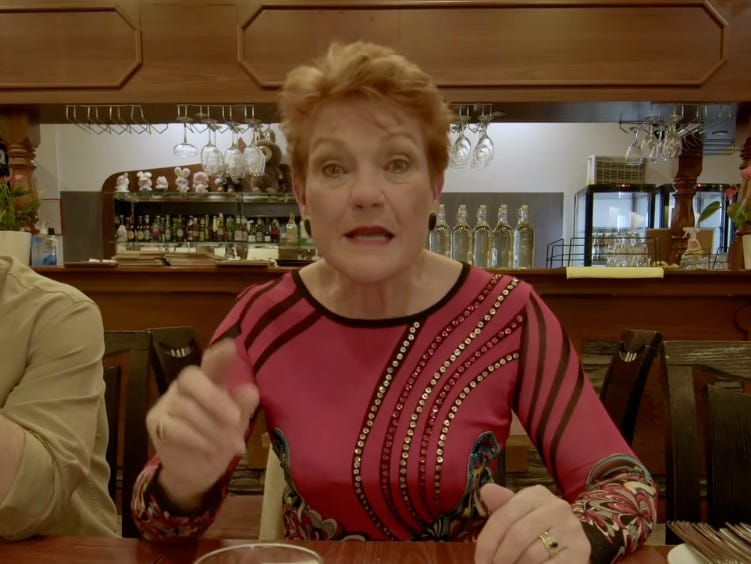
What One Nation offers is a break with the status quo; a rejection of the political establishment. When Pauline Hanson is kicked out of the Senate, people see someone loathed by a political class that has treated them like shit.
This is not people ‘voting against their own interests’. Per this analysis by political theorists Jeremy Gilbert and Alex Williams, people conceive of their interests on two axes. The first is how policies will materially affect their lives. But the second, crucially, is temporal: how long it would take to implement these policies, and whether it would even be possible. Seventy-two percent of the country may believe that big business has too much power, but given that the vast majority of people have never experienced any sense of collective power, it’s reasonable that most don’t believe we can do much about it.
Rising concern around immigration is in part an expression of demoralisation about the possibility of meaningful change. At the very least, people can cast their vote against the status quo, and for some perceived short-term benefit of restricting immigration. After all, borders are one of the few sovereign powers that states haven’t handed over to finance capital or unelected institutions.
The good news is that support for One Nation is shallow, because it is not based on meaningful organisation in civil society. Meanwhile, both major parties are unstable political formations, no longer connected to an organised social class, relying on polling and focus groups to corral an atomised civil society into ever shrinking voting blocs.
Can the Greens fill the void?
For the Greens, filling the void left by a hollowed out political system will require a major strategic pivot in the organisational and political orientation of the party.
The Greens need to stop conceiving of change as something that is negotiated in parliament with Labor. People already disconnected from politics will never believe anything good can come through backroom deals with the political establishment.
And they’re right. Labor and the Liberals are part of the same political establishment, tied to the same corporate and billionaire donors. As long as either is in charge, nothing is going to meaningfully change for the better.
As leader of the UK Greens, Zack Polanski, said of UK Labour, “we are not here to be disappointed by you … we are here to replace you”. The UK Greens are now on the verge of overtaking Labour in the polls.
Ultimately, there is an emerging contest over what replaces decaying establishment parties and politics across western democracies. In simple terms, will it be a politics that taxes the ultra rich, nationalises essential services and puts wealth and power back in the hands of ordinary people; or will it be a politics that persecutes migrants and uses racist rhetoric to justify massive expansions in state violence, as we’re seeing with ICE in the United States and threatening in Australia with new anti-protest and anti-speech laws?
Critically, you deal yourself out of that contest if you aren’t prepared to build a movement that is entirely independent of the establishment you hope to replace.
If you have a story tip, drop an email to tips@deepcutnews.com or send an anonymous Signal to @deepcut.25.

Great article by Max. Playing the game by Labor/LNP's rules means you will never ever, ever win, because they'll just change the rules if you get too close (see the various bills where they restrict money or staff from the third parties).
It seems plain as day, watching overseas countries go through the similar hallowing out, that capitulation and "status quo but ❤️" doesn't work. In fact, things get much, much worse. I understand upsetting the apple cart, even a little, is a risk, but a little upset now can prevent a huge upset later. That sounds like lunacy in a world where every political move is purely a short-term action, but if a party breaks itself out of that broken mindset, they can really clean up and make some real changes... and the people will follow. As ONP and other far right populists are seeing, and as Max said, people are hungry for a real representative. The left needs to fill that gap before the right gets comfortable there.
I worry that Minneapolis is coming to Melbourne.