


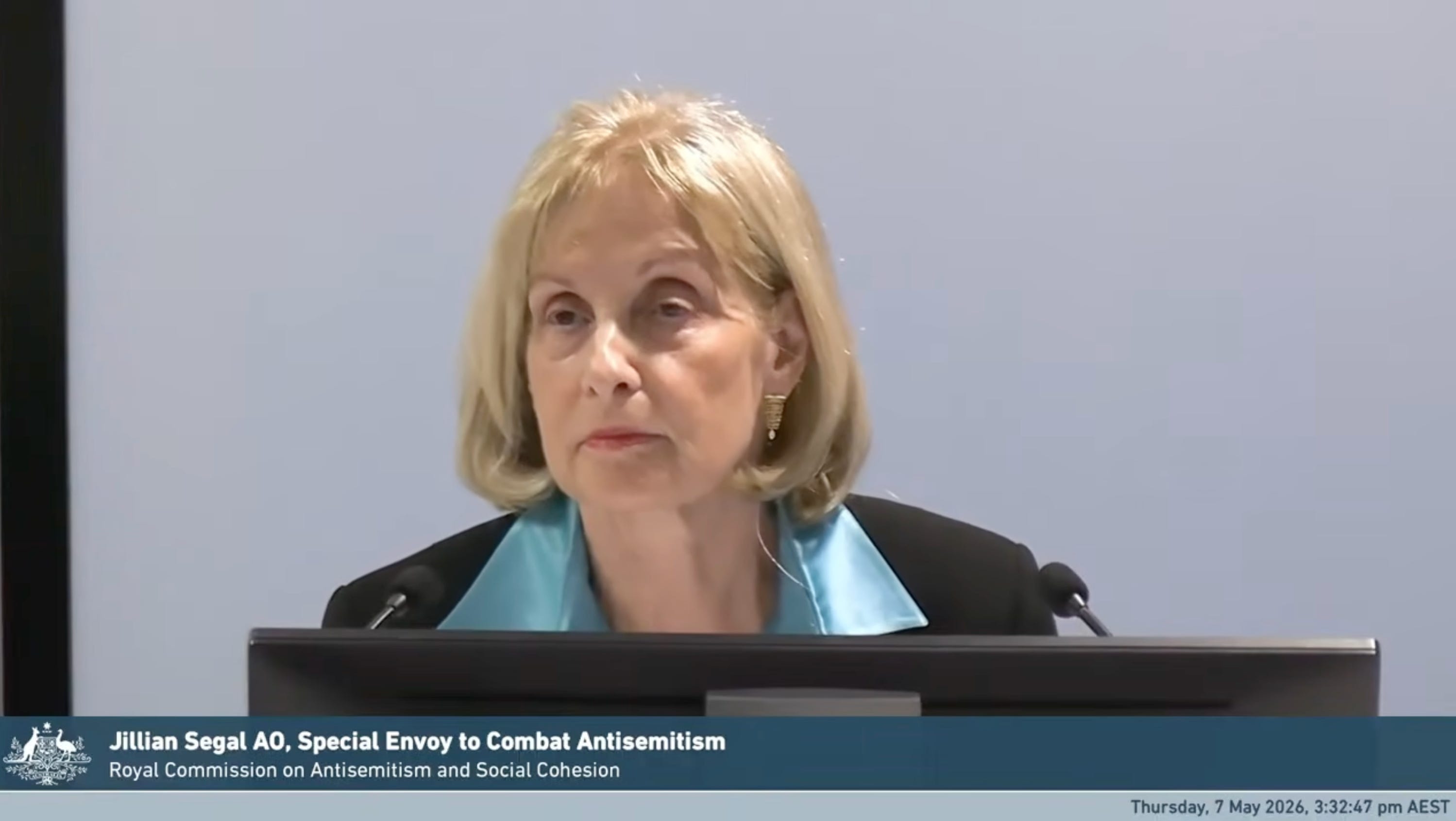
The Royal Commission on Antisemitism and Social Cohesion kicked off last week, with numerous complaints heard over keffiyehs, Palestinian bake sales, displays of the Palestinian flag, ‘free Palestine’ chants and criticism of Israel.
The Commission heard 57 witnesses, including figures from prominent pro-Israel lobby groups such as the Executive Council of Australian Jewry (ECAJ) and the Zionist Federation of Australia (ZFA).
Also among the witnesses were Dr Vic Alhadeff – a prominent pro-Israel voice and SBS board member – and former Age editor Michael Gawenda.
The witnesses were listed as sharing the “lived experience” of antisemitism in Australia. However, our analysis shows a recurring pattern in many of the testimonies: framing political disagreements over Zionism, Israel and Palestinian advocacy as ‘antisemitism’.
Setting the tone were the heavyweights of the pro-Israel groups.
“And, when you have for two and a half years the incitement against the Jewish community, the characterisation of ordinary Jewish Australians as child killers, as supporters of genocide, of course people will act against us and think they’re doing something noble and righteous. So that’s where you have this progression from behaviour which is normal to behaviour which is actually viewed as noble.” – Alex Ryvchin, co-CEO of ECAJ – May 4, Day 1, p74, line 45
“”Zio” is a slang and generally abusive term. Although it is shorthand for Zionist, it is usually used as a codeword for “Jew”. In this context I regarded the word “Zios” as being a reference to Jews.” – Peter Wertheim, co-CEO of ECAJ – para 56 of written witness statement
“Antisemitism, unlike other forms of hatred, now arrives wearing the language of human rights. The accusations levelled at Israel and, through Israel, at Jews, are framed in the vocabulary of progressive values: genocide, apartheid, colonialism, ethnic cleansing.” – Jeremy Liebler, president of the ZFA – written personal submission
“I think [antisemitism is] a very important issue and it’s not completely without complexity, because, as you would have heard and I’m sure others have stated, antisemitism is a virus. It’s an illness that has morphed and mutated over time. And I know - I think I heard Peter Wertheim say this, we started off as being very much based on religion, on the deicide, Jews killing Christ. Then it morphed into race, which we saw in Nazi Germany and now, of course, it is much more concerned with the State of Israel.” – Jillian Segal, former president of ECAJ and Special Envoy to Combat Antisemitism – May 7, Day 4, p414, line 20

Other witnesses echoed a similar theme of equating antisemitism to anti-Zionism or criticism of Israel. Of the 36 witnesses heard over the first three days, 23 explicitly characterised criticism of Israel and Zionism or Palestinian advocacy as antisemitic.
“The chant, it was a recently produced chant at the time, ‘Free Palestinian’ and ‘Globalise the intifada’, all troubling chants because I know what ‘Free Palestinian’ means now that my parents live in Israel.” – Ben – May 4, Day 1, p54, line 15
“So we had that far-right crazy conspiracy theory and then we had the left anti-Zionism, genocide, apartheid, the delegitimisation of Israel and the equation of the delegitimisation with the delegitimisation of a human being who believes that Israel has the right to exist.” – Anthony Halas – May 4, Day 1, p106, line 45
“Yes, I believe there are two layers of antisemitism here. One is that the singular focus on Israel, that, you know, campuses - my university is not - it’s better than others. So campuses throughout Australia are full of posters and ads and, you know, call for actions about the Palestinian issue. And this is - it’s true that there is actual concern but it’s also true that the actual data does not support that Palestine is the worst humanitarian crisis today in the world, or that Israel’s actions in Gaza are worse than any other conflict in the world today or even in conflicts led by democratic countries in recent years. So this is already a double standard, which I’m not a lawyer, obviously, but I conceive this as antisemitism.” – Tali Pinsky – May 5, Day 2, p142, line 25
“I mean, just walking around the CBD, it’s hard to avoid the Palestinian flag or, for example, my friend told me she recently went to a concert. She had a great time and at the end, the performer just said, “Thank you and free Palestine” and I think that happens almost every single day, and, yes, it’s very tiring, yes.” – Léa Levy – May 5, Day 2, p154, line 25
“I understand anti-Zionism is a hate movement that spreads the libels that Israel is a coloniser, apartheid and genocidal. This movement clearly disavows classic antisemitism while denying indigeneity of Jews to Israel and Jewish sovereignty. It creates an imaginary Zionist (Jew) based on libel and inversion of the truth (eg, said to be a ‘baby killer’) and real Jews suffer the consequence. I consider that this form of anti-Zionism undermines social cohesion and is antisemitic at heart.” – ‘AAT’ – May 6, Day 3, p286, line 30
“I think in high school, you could kind of dodge it if you didn’t tell people you were Jewish. Whereas, at uni, because it’s a more politically active climate, it’s a lot more in your face. So whenever I leave the library, there’s a table right bang in front of me as soon as I leave that’s basically anti-Israel, pro-Palestine in which you will have a bunch of people with Arabic words on their shirts and they’re, like, having their signs, like, chanting. And it’s not normally anything specifically antisemitic. Like, I think it’s a bit of a stretch to say 100 per cent they don’t like Jewish people. But they don’t like Israel and they’re anti-Zionist, which in my mind, if you are anti-Zionist, you are anti us deserving a country to be safe in, which I felt when I actually went over there. In my mind, that is antisemitism.” – ‘AAF’ – May 6, Day 3, p240, line 30
“I think coming to university in a post-7 October world was a, very much a bubble pop, in the sense that we really were sheltered at a Jewish school, and for some reason, post-7 October, wide-scale antisemitism hasn’t just been there; it’s been tolerated and normalised. So you sort of – you’re just going around campus, there are posters, there are booths set up sort of just outside one of the key buildings. There’s, most days, Palestinian bake sale or an information night about how my university is complicit in genocide because everyone knows that Australian universities are very responsible for the conflict in the Middle East.” – Blake Shaw – May 6, Day 3, p255, line 40
“I don’t actually have [the emails] because I’ve left that job, but the substance of them was the way Israel is described, and so I say in my statement that, for me, when I think about Israel, I think about the beauty of the country. I think about the old city. I think about civil society and all the good people, Israeli, Palestinians, others working for a world of equality. I think about friends and family there. And, yes, the regime but that’s not all of it. And so in these emails, just like the stickers I pass on the way to work, the word Israel is used as a demonised word and it’s the way that the word Israel was used that made me feel offended, humiliated.” – Stephanie Cunio – May 7, Day 4, p342, line 5
“It made me feel very targeted. At times very disempowered. I probably should also mention there were staff at that time who were wearing ‘Free Palestine’ pins and – not at work but arriving into work with keffiyehs on, so, for me, that was a real stab at me, a statement to make it clear that I wasn’t welcome.” – ‘AAV’ – May 7, Day 4, p350, line 45)
The Royal Commission was announced by the Albanese government after pressure from pro-Israel groups and media in the wake of the Bondi shootings.
Progressive Jewish voices, such as the Jewish Council of Australia (JCA), warn that “genuine concerns” of antisemitism “are being manipulated by the right wing pro-Israel lobby to silence criticism of Israel’s genocide in Gaza and annexation of the West Bank”.
It said in January, shortly after the Commission was announced, that: “A credible inquiry must be independent, compassionate and evidence-based, not turned into a platform to attack the Palestine solidarity movement, universities, migrants or human rights institutions.”
The Commission is in its second week of hearings.
Got a tip? Send an email to tips@deepcutnews.com or send an anonymous Signal to @deepcut.25.
Absolutley shameful. If it weren’t so serious, it would be a comedy. But the testimony included here about the shock of University after Jewish school is very revealing, and should be seen as evidence of the dangers of insulating students from the reality of the world. Jewish only schools (like most private schools) and surrounding social infrastructure clearly fail to prepare their students for a broader world of political disagreement, instead teaching them that any challenge to their world view is tantamount to violence. Anything to keep the Zionist indoctrination at full bore I guess.
The statements sound like desperate jokes. The commission and absolute farcical.waste of tax payers money. It's also reassuring for the Palestinian movement. Because they have nothing of any substance to say. Desperate act really