


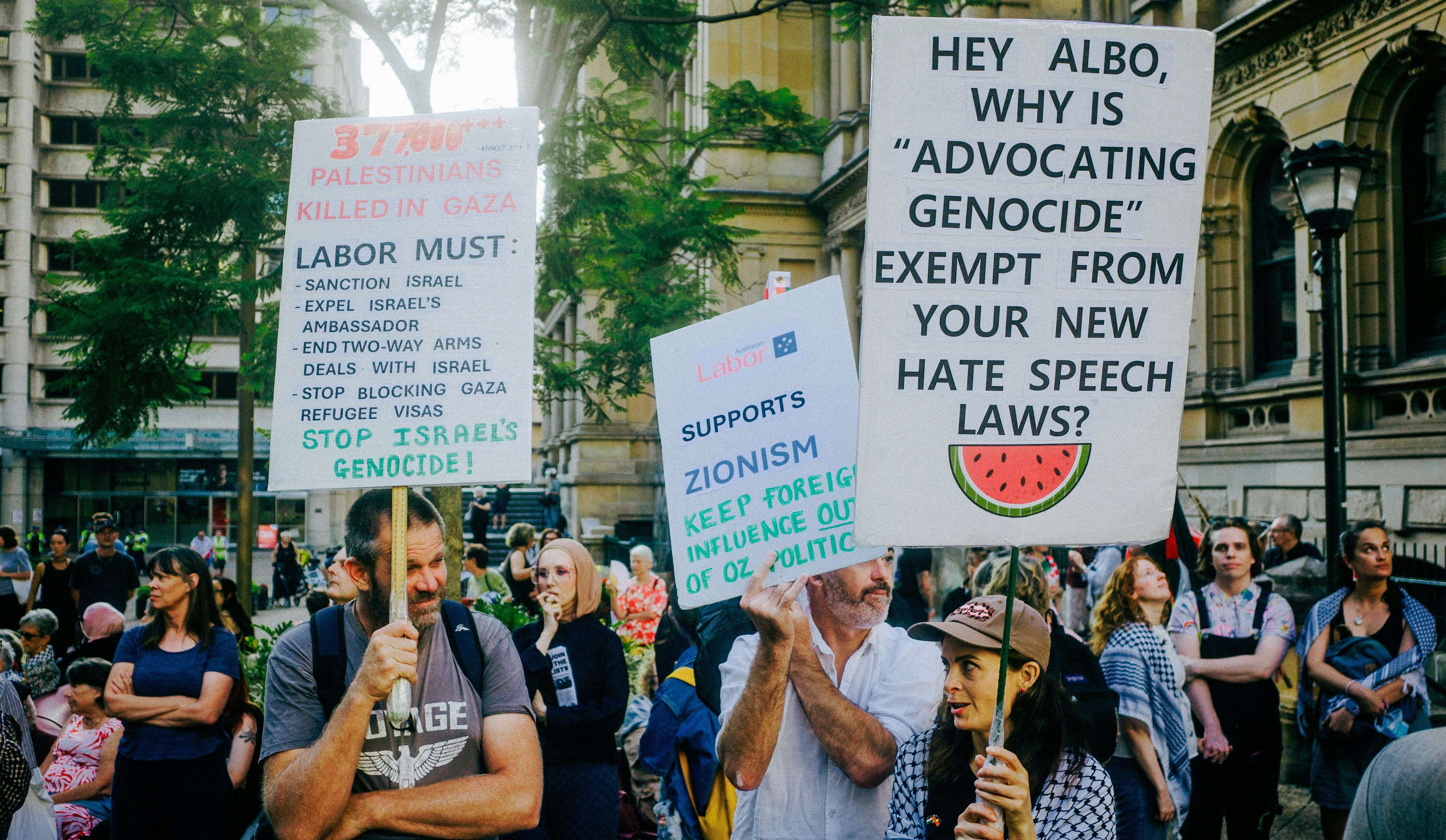
Australian politics is full of vague euphemisms. One of those is “the lobby”. Whether it’s the gambling lobby, the gun lobby or the fossil fuel lobby, this language is used to describe a vague and ill-defined group working to shape government and bureaucratic opinion, often in a way that is self-interested, anti-democratic and against the broader public interest.
Sometimes this vague fuzziness, however, can become conspiratorial or even harmful. In the case of the Israel lobby, for example, Bart Shteinman of the Jewish Council of Australia says people can inadvertently begin to repeat anti-Semitic tropes about the Jewish community.
“Globally, most Zionists are not Jewish,” Shteinman said. “Organisations within what would be considered the Israel lobby include a range of people from different faiths and backgrounds. They’re by no means restricted to Jewish people.”
To help cut through the confusion, Deepcut has put together this short explainer on what lobbying is and how it works.
What exactly is lobbying?
The official definition is narrow and only captures the most direct and obvious efforts to shape the thinking and decision of officials, usually within the halls of parliament.
The Lobbying Code of Conduct defines lobbying in Australia as “communications with Australian Government representatives in an effort to influence federal government decision-making”.
Under the code, anyone who “acts on behalf of third-party clients” to lobby Australian government officials must register. This entitles them to an orange identification badge to enter Parliament House and move freely.
There are 716 registered lobbyists in Australia in what is considered to be a growing industry.
Outside this definition, there is a whole range of informal activity that could be considered lobbying as it seeks to influence the reasoning and decision making of Australian bureaucrats, political leadership and even public opinion.
Tell me about ‘the Israel lobby’
What is commonly referred to as ‘the Israel lobby’ in Australia is distinct from its well-known counterpart in the US – the American Israel Public Affairs Committee (AIPAC).
Whereas AIPAC tends to operate as a single, top-down organisation with significant financial resources that are deployed to promote specific candidates and swing campaigns, Shteinman says that in Australia there is a wider ecosystem of groups filling this role that act in more “decentralised” ways.
“You can define the Israel lobby by looking at organisations who see it as part of their role to publicly advocate for the state of Israel and political Zionism,” Shteinman says.

Which organisations belong to this ecosystem?
Much of the campaigning by Zionist groups originates outside parliament, among broadly aligned, but separate organisations.
Larger, peak groups such as the Executive Council of Australian Jewry (ECAJ), the Zionist Federation of Australia (ZFA) and the Australia Israel and Jewish Affairs Council (AIJAC) tend to set the general direction with their public statements.
At the state level, there are groups such as the New South Wales Board of Deputies, the Queensland Jewish Board of Deputies and the Jewish Community Council of Victoria. There’s also the Community Security Group, a volunteer-based Jewish security group that receives training in Israel and is permitted to carry firearms. CSG was allegedly founded decades ago with help of a former CIA agent.
Smaller, more explicitly activist organisations, such as the Australian Jewish Association (AJA), J-United and the Australian Union of Jewish Students – an organisation affiliated to ZFA – will often take their cues from these core organisations but will still pursue their own agendas.
There are also several active Zionist groups that are not explicitly Jewish organisations and have support among Christian Zionists, including Advance, Better Australia and Never Again is Now, each pursuing their own agendas and strategies. In addition, there are some international organisations with a large Australian presence, such as Stand With Us and Combating Anti-Semitism.
“Australia is not America,” Shteinman says. “In terms of how the Israel lobby works, to some extent I think, like other lobbies, it’s the product of long-standing relationships.”
“But a lot of the way in which the Israel lobby acts [in Australia] is not through shadowy secret engagements, it’s through these very public, open pressure campaigns. No one’s hiding it.”
What do you mean by long-standing relationships?
These organisations often have overlapping memberships and officials involved with multiple groups. These same individuals have their own networks, thanks to the businesses they operate, the boards they sit on and the institutions they engage with.
Better Australia, for instance, is an organisation that grew out of Better Council and was created specifically to attack Greens and Teal political figures, ostensibly over their criticism of Israel.
Headed by Labor Party member Sophie Calland, it also included Yaron Finkelstein, former advisor to Scott Morrison, Alex Polson, a former Liberal staffer, and former NSW Labor Treasurer Eric Roozendall – a figure associated with the Labor right.
Finkelstein today serves as a director of the right-wing Menzies Research Centre and operates his own advisory firm, Society Advisory. Polson is CEO of DBK Advisory. These consultancy arrangements allow former political advisors to maintain their access to the corridors of power, even when they’re out of office.
Both Finkelstein and Roozendall have previously served on the NSW Jewish Board of Deputies. Similarly, anti-Semitism envoy Jillian Segal previously served as the president of ECAJ. Her husband, John Roth, donated $50,000 to support right-wing pressure group Advance.
In other cases, ZFA President Jeremy Leibler’s law firm offered regular, ongoing free legal advice to former Coalition leader Peter Dutton. Along with ECAJ, Leibler’s ZFA “frequently communicates” with Foreign Minister Penny Wong and her staff as part of a long-term effort to cultivate a relationship.
How do they operate?
The activities of these groups tend to depart from what would be considered traditional “lobbying”, with the focus of recent campaigns more about compelling certain action or deterring criticism.
Many of these groups, or individuals associated with them, have been active in lobbying on hate speech and anti-protest laws through submissions to Bills or parliamentary inquiries, and in some cases direct consultation with those in power. This is where access – cultivated over years of relationship building within both Labor and the Coalition – becomes useful.
Other campaigns may involve SLAPP suits or the weaponisation of internal complaints processes to force critics to spend time defending their actions, and some involve nakedly political manoeuvring.
During the recent visit by Israeli President Isaac Herzog in the wake of the Bondi massacre, Shteinman alleges ZFA extended the invitation as a strategy to wedge Prime Minister Anthony Albanese.
Another focus has been the media and cultural institutions, such as writers’ festivals and art exhibitions, where ideas are discussed. Pressure campaigns – such as those recently targeting Randa Abdel-Fattah and Grace Tame – appear aimed at generating negative media coverage that spooks decision makers with bad press and panic financial backers.
Whatever the activity, the perception is often that the Israel lobby is a vast and powerful machine. But as the backlash against the Adelaide and Bendigo writers festivals, and Antoinette Lattouf’s court win against the ABC show, the reality is these groups are far from invincible.
“It’s really important to make people aware and not feed an agenda of fear, because that is what they’re seeking to achieve,” Shteinman says “They want to make people feel as if they no longer have the power or the right to resist it. They want people to think that it’s all lost.”
“It is by no means a lobby that has unstoppable and omni-present influence.”
Got a tip? Send an email to tips@deepcutnews.com or send an anonymous Signal to @deepcut.25.
If the Israel lobby is not well funded and highly organised, how do they control the ABC? Why is it that SBS constantly run WW2/Holocaust documentaries but nothing on the Nakba or the Zionist invasion of Palestine?
In terms of harm being done we should be highlighting not only Aust organisations that lobby / advocate direct to govt & media here in Aust but also the local organisations (overwhelmingly organised by people of jewish heritage) that send money to Israel - including violent "settlers" currently performing pogroms in "West Bank".
Also those groups who promote /fund young Australians visiting Israel for brainwashing, and numerous other "community groups" who may not openly call themselves "zionist" but who all have "support for Israel" there in all their mission statements / website docs etc etc