


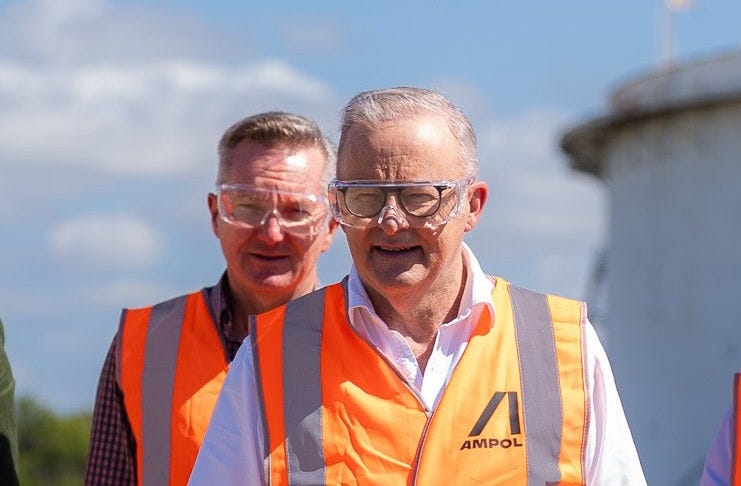
In late April, Prime Minister Anthony Albanese flew 3,000 km from Canberra to Perth to deliver a message in person ahead of the budget.
At least six oil and gas companies had kicked in $1m each to a fund operated by Australian Energy Producers (AEP) – the country’s oldest oil and gas industry association – to savage the government over any attempt to impose a tax on crisis profits earned by the industry since the US and Israel attacked Iran.
The prime minister was there to say they didn’t need to bother. The speech would be Albanese’s only major address before budget day, organised by the WA Chamber of Minerals and Energy, and what he had to say was simple: there would be no gas tax.
Ahead of his appearance, three protesters associated with Disrupt Burrup Hub took to the stage in opposition to Australia’s ongoing expansion of gas infrastructure, in particular Woodside Energy’s Browse development just off the ecologically sensitive Scott Reef.
It was a fleeting moment for those in attendance who ignored the disruption while police issued move-on notices. When asked about the protest afterwards, the prime minister suggested the protest was “inappropriate”.
“We need to turn the temperature down on public debate, there is no need for some of the positions that are put forward, in the manner which they are forwarded as well.”
It was a symbolic moment not just for how the conversation about climate change continues to be carried out in Australia, but for the power dynamics it revealed that dictate who is heard and who gets ignored.
How we got here
Canadian author Naomi Klein once pointed out in 2015 that it’s hard to tell where the Australian government ends and the coal industry begins – ten years, and a change of government later, this still holds true, especially for the gas industry.
The result of this knotty mess of relationships has been a deep inertia that is difficult to overcome to effect any sort of change, with the result that industry can often set the direction of public policy.
What is commonly referred to today as the “revolving door” between politics and industry began as a formal strategy in the 1990s when former federal government bureaucrat Richard “Dick” Wells was hired to head the Australian Petroleum Exploration Association (APEA) and lead a rebrand.
Under his watch, APEA was rebranded into the Australian Petroleum Production and Exploration Association (APPEA), and is today known as Australian Energy Producers.
Part of his work involved explicitly hiring from within the public service, a practice that helped industry buy not just the people who understood how to speak the language of power, but also their contact books and corporate memory.
Friends in high places
The fossil fuel industry has since turned this practice into an artform, with former ministers, staffers and bureaucratic officials all valuable assets.
In one recent example, Georgia Tree, a staffer for Federal Resources Minister Madeleine King – herself the daughter of a refinery worker – announced in April that after three years in her current role she was taking a job working with Australian energy giant Woodside.
Tree is among the more recent hires but is not the most notable. Tony Abbott’s sister, Christine Forster, serves as Woodside’s Global Media Manager and allegedly has her own political ambitions.
Other significant hires have included figures such as former foreign minister, Alexander Downer, who acted as a consultant for the company after politics. Downer had been the responsible minister at the time of the oil-for-wheat scandal and the bugging of Timor-Leste’s embassy to help Woodside in negotiations over an offshore oil and gas deal. Former Coalition MP Ian “Chainsaw” Macfarlane has also served as a non-executive director at Woodside.
Similar patterns persist beyond Woodside. In one example, former Labor MP Joel Fitzgibbon, a staunch supporter of the coal industry, is currently competing with former Western Australian Labor Premier Mark McGowan to run the Minerals Council of Australia. The industry association represents the country’s resources sector and has aggressively fought to protect the coal industry from climate and environmental regulation.
Fitzgibbon – who currently operates his own consulting firm, Fitzgibbon Advisory, and that boasts oil and gas explorer Emperor Energy as a client – is also listed as a “special advisor” to CMAX Advisory on the federal lobbyist register.
CMAX has been a popular lobby firm among the country’s bigger oil and gas companies, including Woodside Energy, Senex and AEP.
Others like Ashley Wells previously served as a former advisor to Kevin Rudd and Labor minister Stephen Smith. After politics, Wells joined lobbying firm Hawker Britton, which has also represented Woodside at times, before rotating through the Federal Chamber of Automotive Industries (FCAI) and then to APPEA as Director, Government Relations.
Wells today operates A.GR Advisors with a client list that includes Advent Energy, Beach Energy, Japanese Energy Giant JERA and Exxon-subsidiary, Esso, as clients.
But the pressure on the Australian government has not just been coming from inside the house, with Japanese government and corporations repeatedly attempting to intervene in domestic Australia climate, environment and energy policy.
Avoiding a gas tax
All of this has contributed to the dispiriting spectacle of a democratically-elected prime minister seeking to reassure private interests that there will be no attempt to redistribute super-profits earned during a time of war and crisis.
Between the overwhelming sense that both fossil fuel producers are taking advantage of the country’s resources, and the perception that public officials have one eye on a private-sector gig, the pressure on Australia’s leaders is unlikely to go away.
This is true even within Labor’s ranks, with the Australian Manufacturing Workers Union inviting Independent ACT Senator David Pocock and Greens Senator Penny Allman-Payne to speak at Labor Day marches in Gladstone, the heart of Queensland’s gas industry.
The government’s announcement of a gas reservation policy and the creation of a sovereign fuel reserve – initiatives that should have been taken at any point over the last five decades – may prove insufficient.
With living costs rising amid the existential threat of climate change and a war of aggression initiated by Australia’s chief ally, public patience over a gas tax may soon wear out.
Got a tip? Send an email to tips@deepcutnews.com or send an anonymous Signal to @deepcut.25.

I find it “ inappropriate “ that our paid servant ( yes Anthony, you are the paid servant of the people) shuts down peaceful protest in obesience to private corporations pillaging our resources.
Also, I read that doorstop the pm did after that protest and saw those comments about turning the temperature down. The journalist who asked the question didn’t highlight the message of the protestors so one could have no idea what they were talking about.