


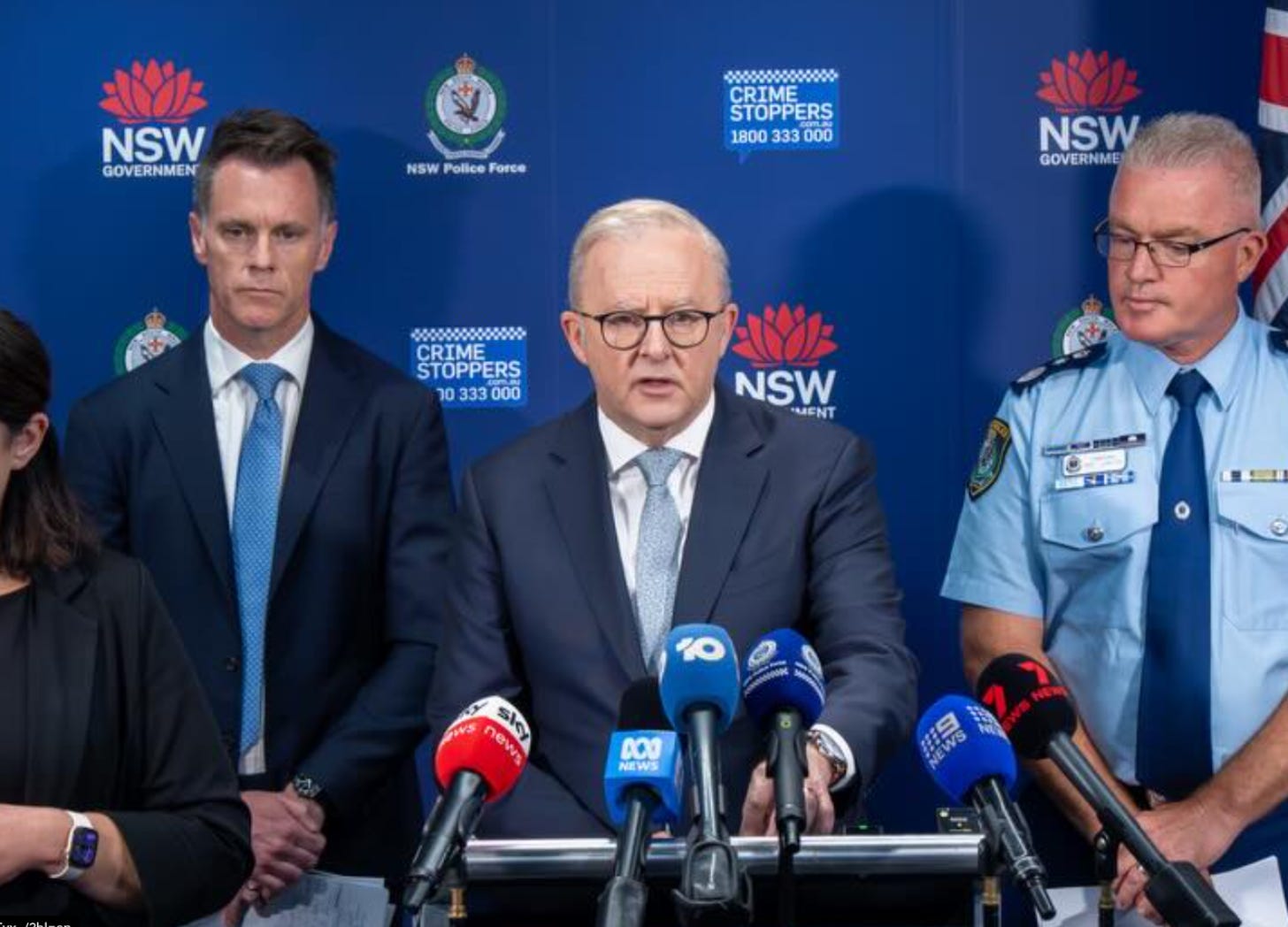
A contentious plan to “combat antisemitism” that human rights organisations have denounced as “an outrageous and blatant act of repression” has been adopted by the federal government.
Speaking on Thursday, the prime minister announced the government would adopt the Special Envoy’s Plan to Combat Antisemitism – a sweeping set of proposals that would proscribe criticism of Israel as antisemitic.
If the recommendations are implemented in full, the Albanese government will have handed Jillian Segal – the Special Envoy to Combat Antisemitism and an unelected appointee – wide-ranging powers to monitor media outlets, school and university curricula, cultural institutions and the public service.
The Australia Palestine Advocacy Network (APAN) condemned the government’s adoption of the plan, calling it “a profound threat to Australian democracy, civil liberties, and the right to peaceful protest”.
“This report does not deliver safety. It delivers sweeping new state powers that undermine democratic freedoms and silence dissent, particularly opposition to Israel’s ongoing genocide in Gaza,” APAN president Nasser Mashni said on Thursday.
“By adopting this report, the Albanese Government has chosen control over conscience, censorship over accountability, and political expediency over human rights.”
As freedom of speech and political expression increasingly come under attack, fearless independent journalism is more vital than ever. Support Deepcut News by buying a discounted subscription this month.
Special Envoy to gain broad powers
The plan’s adoption will see the controversial International Holocaust Remembrance Alliance (IHRA) working definition of antisemitism embedded as policy “across all levels of government and public institutions”. The IHRA definition – which lists “claiming that the existence of a State of Israel is a racist endeavour” and “drawing comparisons of contemporary Israeli policy to that of the Nazis” as examples of antisemitic speech – was denounced by its lead drafter, Kenneth Stern, in 2019 as “an attack on academic freedom and free speech”.
By adopting the IHRA definition, “the government has entrenched a framework that conflates legitimate criticism of Israel with racism,” Mashni said. “This risks criminalising political speech, chilling protest, and silencing Palestinians and their allies.”
The plan’s recommendations include:
giving Segal the power to withhold government funding from universities and arts organisations that “fail to act against antisemitism”;
mandating the promotion of the IHRA definition of antisemitism in school curricula;
allowing Segal to “monitor media organisations” to ensure they “avoid accepting false or distorted narratives”;
monitoring and moderating content on social media; and
allowing Home Affairs and Australian Border Force staff to deport or deny entry to migrants who criticise Israel.
Originally released in July, the plan was roundly criticised by human rights groups, Palestinian advocacy organisations and some Jewish bodies for proposing crackdowns on freedom of speech and conflating criticism of Israel with antisemitism.
Amnesty International Australia warned at the time that Segal’s proposals would “undermine fundamental civil and political rights, stifle protest, and risk deepening community divisions”. The Jewish Council of Australia (JCA) described the plan’s “emphasis on surveillance, censorship and punitive control” as “straight out of Trump’s authoritarian playbook”.
In addition to the plan’s 13 recommendations, the government flagged on Thursday that Segal would work with the eSafety Commissioner to “address online antisemitism”; a 12-month Antisemitism Education Taskforce covering “early childhood education and care, schools and universities”; a legislative “crackdown on people who spread hate, division and radicalisation”; and expanded powers for Home Affairs Minister Tony Burke to reject the visas of “those who spread hate and division”.
While the Business Council of Australia, Universities Australia and pro-Israel lobby group the Executive Council of Australian Jewry welcomed Thursday’s announcement, the JCA warned that “elements of today’s announcement resemble long-standing proposals from the pro-Israel lobby which have nothing to do with addressing violent extremism”.
“Policy which points towards universities, the protest movement and migration as the problem will only lead to more demonisation,” Max Kaiser, JCA executive officer, said.
“Our Muslim and Palestinian allies are now facing extreme abuse and threats. The government must act immediately to head off this dangerous path.”
Crackdowns on protests, civil liberties and opponents of genocide are getting worse. Deepcut holds the power to account – but we rely on our readers to do it.
Minns moves to ban mass protests
The adoption of the plan came a day after NSW Premier Chris Minns announced that state parliament would sit in the Christmas week to pass legislation banning mass protests in the wake of the Bondi massacre.
Speaking on Wednesday, Minns said the laws were necessary to ensure “slogans or protests or marches don’t tip into hate speech and further exacerbate an already combustible and difficult environment”.
“Multicultural Australia is something that I believe in. But the truth of the matter is you need strict rules in place to ensure that our society is successful,” Minns said.
“No one can promise a group of people meeting on the street won’t go ahead, but what we can promise is that the streets won’t be taken over with a mass demonstration that could lead to community disharmony and divisions that are very difficult to pull back together.”
“I know that there are concerns about issues around the world, but I’m worried about what’s happening in Sydney right now.”
The Palestine Action Group, the protest group that has organised pro-Palestinian marches in Sydney for more than two years, said the announcement “poses a serious danger to our democratic rights in NSW”.
“Whether or not we have the right to protest should not be up to the government of the day,” the group said in a press release. “History shows that moments of fear are often used to justify the greatest attacks on democracy and civil liberties.”
Minns also pledged to reintroduce laws giving police the power to shut down protests “in or near” a place of worship. The NSW Supreme Court struck down similar laws as unconstitutional in October, following a legal challenge from the Palestine Action Group.
The NSW Council of Civil Liberties (NSWCCL) hit out at the Minns government, saying the move showed “great disrespect to democracy, the people of NSW and also to the Supreme Court”.
“Religious institutions exercise significant and overt political power in Australian politics and this makes them a legitimate site of protest in a democratic society,” NSWCCL president Timothy Roberts said. “So are the many civic places, like town halls, local councils and parks, of which the right to protest in or near may be eroded by these laws.”
The announcement follows Minns’ revelation on Tuesday that the state government is in talks with the Community Security Group – a private organisation with deep ties to Israeli intelligence agencies – to allow its members to carry weapons at “Jewish events”.

This is an abomination
If you’re in Melbourne please turn up to the Speak Out at Parliament House 5 pm Monday 22.