


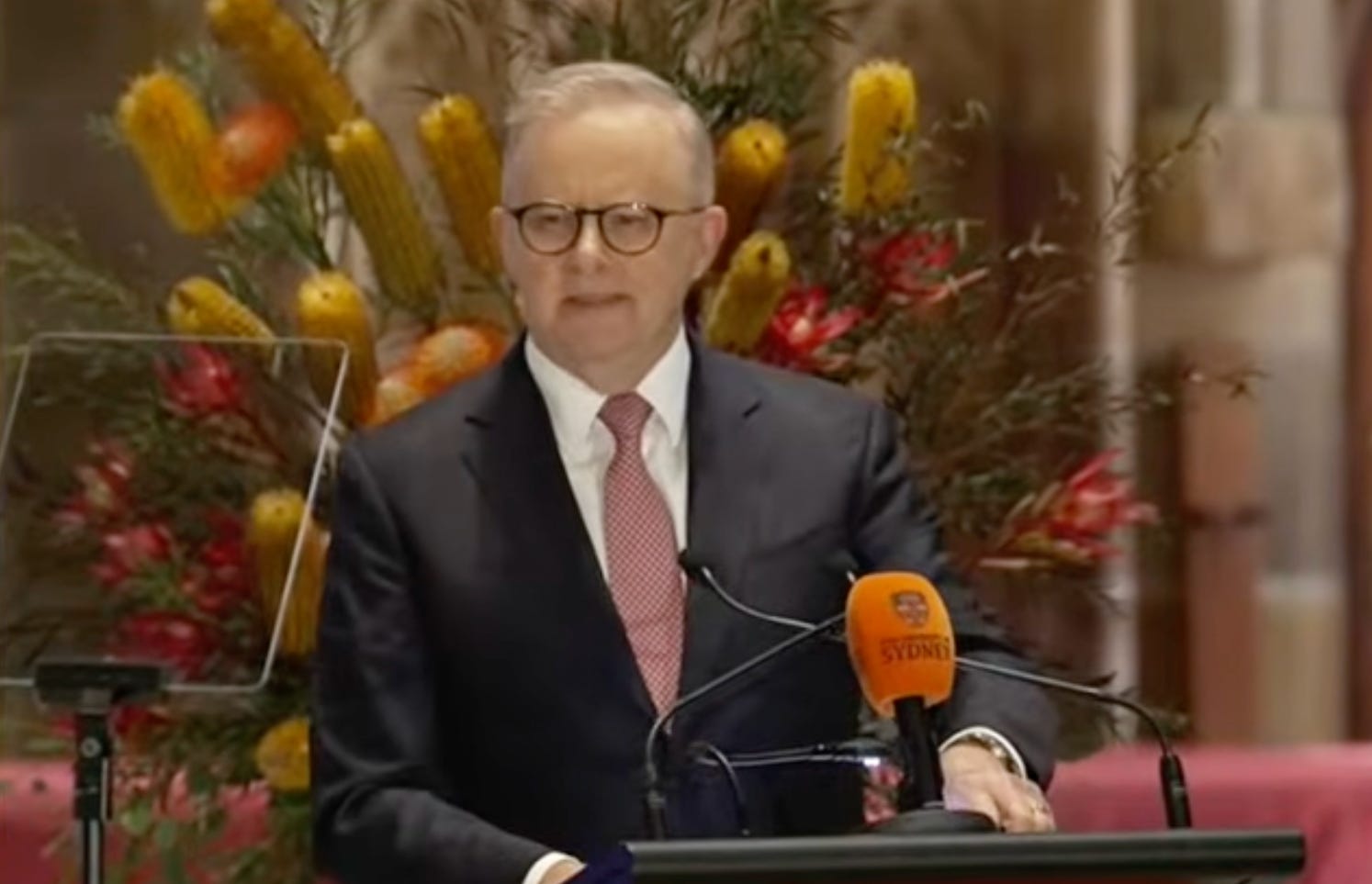
The prime minister’s speech on AI on Wednesday began by boasting of banning social media for those under 14. He was unable to point to any actual success other than it had “sent a signal and set a standard” and started “conversations within families and friendship groups”.
He suggested it showed “what Australia can do, when we back ourselves”.
The lack of actual evidence of success or meaningful change in company behaviour made it a perfect example to lead off a speech on the government’s AI policy framework.
It was a speech that was quickly welcomed by the AI sector.
Data Centres Australia (seriously, there is a lobby group for absolutely every parasitical industry in this country) told Guardian Australia that “it was great to hear him really outline that Australia wants this investment, that we’re leaning into it, that he wants to make sure we don’t miss this opportunity”.
Ok, but what is that “opportunity”?
What actual good for Australians are we to get from this “investment”?
Consider what Albanese touts as the benefits of AI:
“It’s changing the way our universities teach and the way students learn.”
Ok, but is that a change for the better? How do they improve the way students learn? Give me one fricken example.
“It’s helping small business owners cut the time they spend on paperwork.”
Give me strength. Is it ensuring they don’t underpay their workers?
“It’s driving productivity and it’s driving discovery.”
Any evidence of this productivity boom? Nope. Probably for the best given the propensity of LLMs to fabricate that we are not after facts.
“It’s building new screening tools for cancer and disease.”
OK good – but is this what these data centres are geared towards being used? And if this is the best thing, then why do we need to allow AI companies to strip mine the world’s literary and artistic output for free?
“It is a critical – and urgent – innovation priority for our defence force and security agencies.”
Mostly what he’s talking about is cyber security threats that come from AI. Sure, you can use it for some strategic planning, but let’s not pretend we are all going to be safer because our army uses AI to wargame how to defend ourselves from an invasion.
And that’s it. That is the big deal that we are talking about.
Would you buy a product based on that pitch? It reads like an email from a company that somehow got through your spam folder.
It’s not that much worse than Danielle Wood’s – the head of the Productivity Commission – recent speech spruiking AI.
“AI is a general-purpose technology – something that can be put to a wide range of uses, from medical research to graphic design – with the potential to transform our economy,” she said.
Wood seemed utterly ignorant that using AI to generate “graphic design” means devaluing an artist’s skills and using a machine that derives its images based on the theft of millions of artists’ work.
Pfft, smell the “new era of productivity growth and abundance”.
OK, but what about all that “frontier AI investment” Albanese is so “serious about attracting”?
It’s mostly GPU chips, cooling equipment and other imported machinery rather than job-creating construction:
And while there is an expectation of more construction to come, the increase is hardly anything that is going to lead to a mass of work, let alone comparable to the mining boom:
The biggest expected boost remains for machinery and equipment – essentially imports to plug into the datacentre:
But hey the “investment” will all make the GDP look better.
Is that enough of a reason?
At this point, we are still searching for the actual benefits – other than medical research – which is making companies suck up the entirety of human knowledge and creation for free.
Albanese made it clear in the speech that he wants to protect Australian authors and artists, which is a good thing. I suspect it’s the result of some serious pressure after Senator David Pocock raised the prospect that the government was going to do a deal on copyright laws in exchange for more funding for the arts.
But Australians have already had their works stolen, and what will be done to ensure recompense or to avoid it happening again?
And what does “the best way to secure the strongest copyright protections for Australian artists is for Australia to be active and involved” mean? That sounds rather like those copyright protections remain up for negotiation.
Then there is the small matter of energy.
Albanese said that the government “will create a legal obligation for the next generation of large-scale data centres to underwrite new power supply” and that they will need to “put at least as much energy into our grid as they take out of it”.
Ok, but what type of energy?
He suggested he wants these companies to build “new renewable generation – and firming – to strengthen our national energy resilience”.
Anyone who has spent more than a minute looking at energy policy over the past 20 years knows “firming” means fossil fuels – likely gas-generated energy.
The Climate Council has estimated that in NSW and Victoria alone there are 74 data centres in the pipeline that would need a combined level of energy equivalent to just over nine Loy Yang A coal-fired power stations. Even if all of that was generated through new renewable energy, does anyone think we have the capacity to build that – and also increase renewable use by other industries?
That’s if the AI industry doesn’t pop given it is clearly an absurd bubble based mostly on being able to ‘train’ itself on ‘free’ (stolen) work and for which turning a profit remains rather elusive.
But in a world where boasts are made of policies without actual achievement, I guess such worries are irrelevant.
Listen to the latest episode of Deepthink – an hour-long talk with Palestinian scholar and author Tareq Baconi on the trauma of ethnic cleansing, growing up queer in Amman and why the Palestinian struggle is feminist.
Great summary Greg. I find the issue with the AI discourse is that it groups together a diverse set of technologies and processes under one brand that is vaguely ascribed magical properties that conveniently align with making capitalisn great again.
It feels like 21st century alchemy - a futile attempt to turn lead into gold.
Thanks Greg, great summary. The AI hype really is incredible. An absolute explosion, which has come almost from nowhere. With massive costs in resources and the prospect of massive societal harm. Yet as you so eloquently say, for what? WTF do these data centres actually do for us???
Note that the use of large data sets is of course helpful - not just in medicine - meteorology for example. But that is not AI. And that is orders of magnitude smaller than the incomprehensible activity taking place in the mushrooming data centres.
Some of the most dysfunctional men on the planet want data centres in Australia because this is a safe, stable place - so far with less pushback than in America. Has Albo has stopped even for a moment to wonder if this might not be "a good thing"?