


On paper democracy is meant to represent the will of the people, but in practice it’s the interests of the few who tend to win out.
Deepcut has reviewed instances where the Albanese government has engaged with lobbying campaigns. Our analysis shows a pattern of Labor consistently siding with powerful lobbyists against the public and national interest.
The following is a non-inclusive selection of significant moments when the Albanese government, for better or worse, appeared to give way to lobbying on a particular issue.
And these decisions are often against the public will – on almost every issue listed below, the Albanese government has gone against public opinion. For example, more than three-in-five Australians support a gas tax, 83% say the supermarkets deserve some blame for the cost-of-living crisis, three-in-four Australians want a ban on gambling ads and 79% hold a negative view of Israel. On these big issues, the vast majority – from left to right – are in agreement. Yet, as we show below, the prime minister has repeatedly stood with powerful interests.
AI and datacentres
Public opposition to datacentre construction is widespread worldwide and growing in Australia. There are already at least 162 datacentres operating in Australia with another 90 in the works. Internationally, there are questions about the financial stability of major AI companies and individual projects given the trillions of dollars AI companies have borrowed. There is evidence AI use leads to deskilling, undermines the integrity of scientific research and makes it harder to deal with climate change. Datacentres are said to increase the physical temperature in host neighbourhoods, guzzle water in some builds and have a short working lifespan.
Despite it all, Australia is embracing AI. The prime minister announced the decision in a significant speech mid-July following a sustained lobbying blitz by OpenAI, Anthropic and other tech companies looking for a favourable outcome on copyright. Albanese’s speech appeared to adopt the idea of “sovereign AI”, a concept that has been promoted by tech CEOs and consulting firms that relies on the language of national sovereignty to encourage individual governments to develop their own indigenous AI systems. It has also been criticised by some commentators as “nonsense” and financial analysts as a convenient way for chip makers to boost sales.
Compare the quotes:
“This Industrial Revolution is about the production not of energy, not of food, but the production of intelligence and every country needs to own the production of their own intelligence which is the reason why there’s this idea called Sovereign AI. You own your own data. Nobody owns it.” – Jensen Huang, Nvidia Founder, 12 February 2024.
“This is our time to decide what AI looks like here in Australia. It is not a question of ‘if’ or ‘when’ AI will transform our economy, we are past that. The question that matters, the choice that we have – is how. How we apply our enduring values of fairness and opportunity to make this technology work for us.” – Prime Minister Anthony Albanese, 15 July 2026.
Gas tax
It is a well-known problem: Australia exports a lot of gas at bargain-basement prices despite the companies that produce it having made massive windfall profits as the result of the Russian war in Ukraine ($100bn according to the Australia Institute) and the US/Israeli war on Iran. Early reports suggest Australian oil and gas companies have been quick to cash-in on the Iran war, selling their cargoes at a premium.
Despite mammoth profits, the government earns more in HECS repayments than from the Petroleum Resources Rent Tax. Not to mention the climate costs – methane gas is a fossil fuel that is 80 times more potent than CO2 over a 20-year period.
Momentum to tax Australia’s gas properly drew threats of a multi-million dollar campaign from the fossil fuel industry targeting the government, reminiscent of the mining tax campaign over a decade ago, prompting the prime minister to fly to Perth and reassure the resource sector that that wasn’t the case. Albanese has since consistently sought to kill off the idea whenever it crops up. This is thanks in part to direct lobbying by the Western Australian Premier, Roger Cooke, whose home state is a focal point in production, and decades of overlap between the resources sector and governments.
Compare the quotes:
“It shouldn’t need to be said that this would be the worst possible time to impose an investment-destroying tax on an essential energy sector and put Australia’s energy security at risk.”- Samantha McCulloch, chief executive of Australian Energy Producers, 23 April 2026.
“The middle of a global fuel crisis is the worst possible time to jeopardise these partnerships, or the investment that underpins them,” – Anthony Albanese, 29 April 2026.
Supermarkets
It’s almost as if Australia has always had Coles and Woolies. The ACCC estimates that Coles holds a 29% market share, Woolworths 38%. It’s not a stretch to suggest this level of market power is ripe for abuse – the ACCC illustrated how in legal action against the duopoly alleging they had engaged in secret pricing schemes. There have been repeated calls over the years, including from the Nationals and the Greens, to break up this arrangement. So far the Labor government has not been interested, despite massive public relations failings leaving these companies vulnerable, instead preferring “proper” competition measures. The government’s preference has been to wait for the ACCC review, but the regulator’s conclusions have blunted any momentum for change when it decided against divestiture and even suggested a duopoly did not exist.
Economic power like this tends to go beyond lobbying in the sense that it has its own gravity, with both retailers squeezing their suppliers, throwing their weight around in negotiations and engaging in a practice known as “landbanking”. Despite the supermarket giants coming under tighter scrutiny amid a cost-of-living crisis, the Albanese government has refused to break the duopoly’s apparent stranglehold on the nation’s food supply.
Compare the quotes:
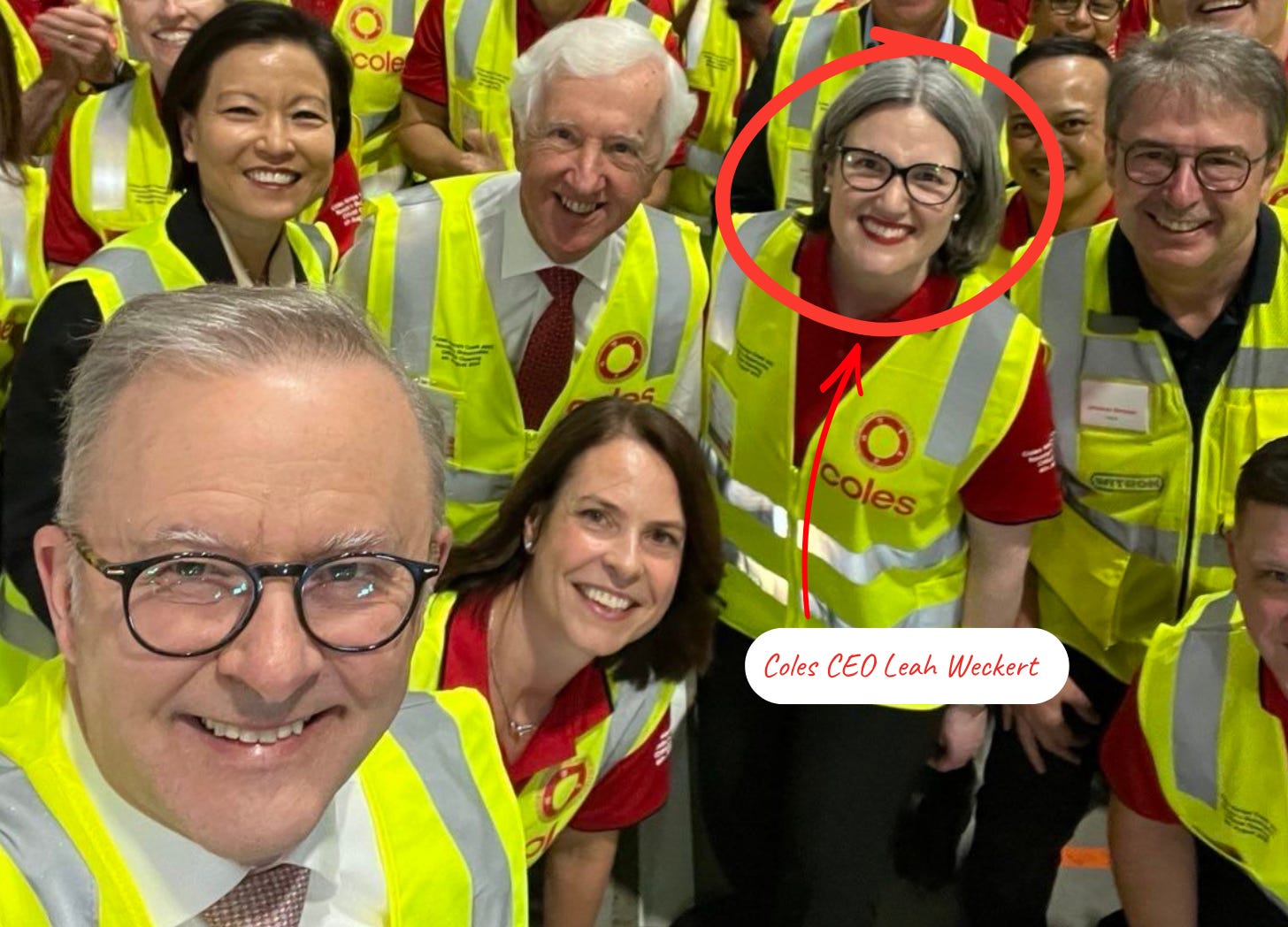
“... what we would have some concerns around is what the unintended consequences could be through a divestiture law to impact the grocery space. Our view would be there are a number of things that would be potential unintended consequences – higher prices for customers, potential lower investment in the grocery sector within Australia, potential poorer outcomes for regional outcomes and maybe job losses.” – Coles CEO Leah Weckert, 16 April 2024.
“We have a private sector economy in Australia and not a command and control economy. We’re not the old Soviet Union. So, we need to be very careful about the language that we use.”– Anthony Albanese, 22 February 2024.
North West Shelf extension
The North West Shelf is one of the largest gas projects in Australia. The field’s operation was expected to draw to a close in 2030, but Woodside applied to extend the project’s operational life out to 2070 – two decades beyond the 2050 target set under the Paris Climate Agreement. Murray Watt, as one of his first acts as incoming environment minister, pushed through the approval, announcing his decision in May 2025 but only releasing the full detail in September after protracted negotiations with the company. This decision swept aside concerns about the catastrophic effect of climate change, and objections from Mardudhunera woman and the former chair of the Murujuga Aboriginal Corporation, Raelene Cooper, about the potential effect on ancient rock art on the Burrup Peninsula. The approval is currently before the courts.
Compare the quotes:
“Since the minister announced the proposed approval in May, we’ve been working very closely with the government to try to get a final approval that supports the government’s future gas strategy. We’re pretty frustrated that we don’t have that yet. And with discussion under way in Canberra on how to improve Australia’s productivity, I think this is a great test case.” – Meg O’Neill, former Woodside CEO and chair of national oil and gas industry association, Australian Energy Producers, 19 August 2025.
“What we’ll continue to do is act in Australia’s interests but also in the interests of engaging in action on climate change. We know that gas has an important role to play in the transition. We’ll continue to make decisions based upon our domestic law and the Environment Minister will be making a decision in the coming period.” – Anthony Albanese, 11 September 2025.
Gambling ads
Most seem to agree that, to date, Labor has “capitulated” to the gambling industry on the question of advertising. The idea for a total ban on gambling advertising itself began within Labor, but when it came to the crunch, the Albanese government chose to limit the frequency of these ads rather than ban it outright. This is despite evidence suggesting one in five young women and one in seven young men were likely to start betting for the first time after seeing an ad, and half of those at risk of gambling harm reporting that they were likely to increase their bets.
The gambling industry is a big donor to the Labor Party – $4m in the last five years – and has powerful allies. Gambling ads, although demonstrably harmful to society, are big business for the AFL and NRL, as well as media companies. Instead of opting for better mental health outcomes by banning gambling ads, the Albanese government sided with the big end of town.
Compare the quotes:
“Look, it’s entertainment. You don’t gamble to win money. You don’t do it to become rich. You do it to entertain yourself. (It’s) just like you go to a restaurant and you buy a meal – that’s entertainment. As long as you’re responsible with what you’re spending on that entertainment, it’s no different than anything else. I’m encouraging entertainment.” – NRL CEO Peter V’landys, 6 May 2023.
“We’re getting the balance right here, letting adults have a punt if they want to but also making sure Australian children don’t see betting ads everywhere they look.” – Anthony Albanese, 2 April 2026.
Hate speech laws
Over the last two decades, the pro-Israel lobby has actively lobbied to criminalise elements of political speech with vague definitions of what is considered ‘hate’. With anti-Israel sentiment rising in Australia as a result of Israel’s genocide in Gaza, the lobby has succeeded since October 2023 in pushing the Albanese government to adopt a raft – though not all – of its recommendations on hate speech.
Compare the quotes:
“For more than 15 years, spurious civil liberties arguments have been used to justify burdening hate speech laws with unnecessary additional elements that for all practical purposes have been impossible to prove.” – ECAJ co-CEO Peter Wertheim, 13 January 2026.
“We engaged very deliberately and collaboratively with the members and leaders of the Jewish community on developing the draft legislation, just as we did on developing the terms of reference for the Royal Commission. And I thank those members, such as Peter Wertheim and Daniel Aghion and others who spent many hours before the release of the draft legislation, engaging.” – Anthony Albanese, 21 January 2026.
Salmon farming
The salmon farming industry in Tasmania has long been a flashpoint between community and industry. What started as a community campaign was given prominence with the publication of a book by Australian author Richard Flanagan. Despite community objections over the health, animal welfare and environmental impact from the floating fish pens, the federal Labor government sided with capital.
The Albanese government chose to ignore advice that it should protect the Maugean skate, an endangered fish species, but the PM wrote to the salmon industry to say that environmental laws will be changed to allow the industry’s continuation. Albanese’s steadfast support for salmon producers owes much to the lobbying effort of the Labor Right-aligned Australian Workers Union, which worked with industry to defend it against various grassroots campaigns.
Compare the quotes:
“For years the AWU has had to defend the salmon industry against unhinged attacks and misinformation. It’s striking how inner-city activists are flexible about their own environmental impact, such as frequent air travel, but have no qualms about demanding extreme measures that put blue-collar jobs at risk.” – AWU Secretary Paul Farrow, 3 December 2024.
“We think this is an important industry. A Labor Government will always defend jobs.” Anthony Albanese, 15 January 2025.
Reading this certainly places Albanese as an absolute pushover and definitely not looking at long term outcomes for the Australian population or the environment, but rather his own and Labor’s survival. Let us not be fooled however. Would the Coalition do anything differently? Of course not and that such a depressing fact.
The very concept of democracy in a capitalist state is questionable.
We vote every 3 years and the Albanese's and managers at his level do as they are told.
The rebel Albanese of the 90s, visited Palestine and refugee camps, called out Keating for mixing with millionaires just as Turnbull called out Shorten for mixing with the Pratt's, disagreed with the Australia/US alliance. Such people never become PM, the establishment would never permit that.
It was a real test of the man, Class Traitor, or glory and a cushy consultancy for Woodside or similar, for life after politics.
No matter who you vote for, you get a politician.