


We’re back after a break that offered no reprieve from the news. Authoritarian fascism is no longer a warning sign but an increasing reality in the United States, evident in the illegal attack on Venezuela and the killing of an American woman in Minneapolis by ICE. Australia is hardly immune: the political and media establishment is exploiting the Bondi tragedy to stifle political expression, while the hard right stirs up anti-immigration sentiment. Across West Asia, crises continue to compound: a violent Saudi-UAE rupture in Yemen, repeated Israeli attacks on Gaza, the West Bank and Lebanon, and the spectre of renewed war hanging over protests in Iran.
This is the terrain in which independent journalism must operate. Our commitment this year is to expose power, centre communities in our journalism and build an uncensored space of critical intellectualism beyond algorithmic control. If you have the means, support our work by becoming a paid subscriber.
“... military states are safe only while they are at war, but fall when they have acquired their empire; like unused iron they lose their temper in time of peace. And for this the legislator is to blame, he never having taught them how to lead the life of peace.” - Aristotle, 4th century BC
It’s hard to see what the US gained from its attack on Venezuela. But subsequent threats toward Greenland, Mexico, Colombia and Cuba suggest a puerile US leadership intoxicated by military might and inclined to treat the world map like a game of Risk.
Yet what the Venezuela attack portends was already ahead of us – a world drifting into a period of upheaval, ending a relatively stable era in global affairs. The January 3 abduction of Venezuelan President Nicolás Maduro may come to be seen as a turning point in history, when imperial chaos returned to the world stage.
As Mexican President Claudia Sheinbaum said after the attack, “Unilateral action, invasion, cannot be the basis for international relations in the 21st century.” But this is precisely the standard the Trump administration is forging. A United States willing to use its force frenetically and recklessly now presents the most imminent danger to the global order.
Trump’s 19th century worldview
There’s no denying the impressive optics of a night mission to kidnap a foreign leader, but geopolitical analysis cares little for optics and requires a more thorough examination.
The Trump administration’s National Security Strategy, released in November 2025, lists the Western Hemisphere – America’s backyard – as the region of its primary focus. It calls for “a readjustment of our global military presence” to the region and warns it will discourage “through various means” Latin American states from collaborating “with others” (read China).
The Trump administration has also revived the Monroe Doctrine – a 19th century foreign policy position designed to warn other great powers against establishing a military presence in the Western Hemisphere. It helps explain the mindset of Trump officials who see the world through ‘spheres of influence’ and believe the US has an indisputable claim to dominate the entire Americas – which also underpins its current arrogant proclamations regarding Greenland.
For some scholars, Trump’s behaviour is more akin to 16th century European monarchical politics, which “centres on ruling cliques, networks of political, capital, and military elites devoted to individual sovereigns”. In other words, belligerent, unhinged ruling elites engaging in endless military adventures and economic exploitation in service of their own interests – as European monarchs did for centuries before the rise of the nation-state and, eventually, norms and laws that regulate relations between states.
Venezuela – all for show?
Beyond a demonstration of military power, it’s unclear what objectives the US achieved by kidnapping Maduro.
It removed the figurehead but kept the regime in place. Contrary to Donald Trump’s claim that the US is “running” the country, the Venezuelan government – led by Maduro’s deputy Delcy Rodriguez and security strongmen Diosdado Cabello and Vladimir Padrino López – is still in control in Caracas.
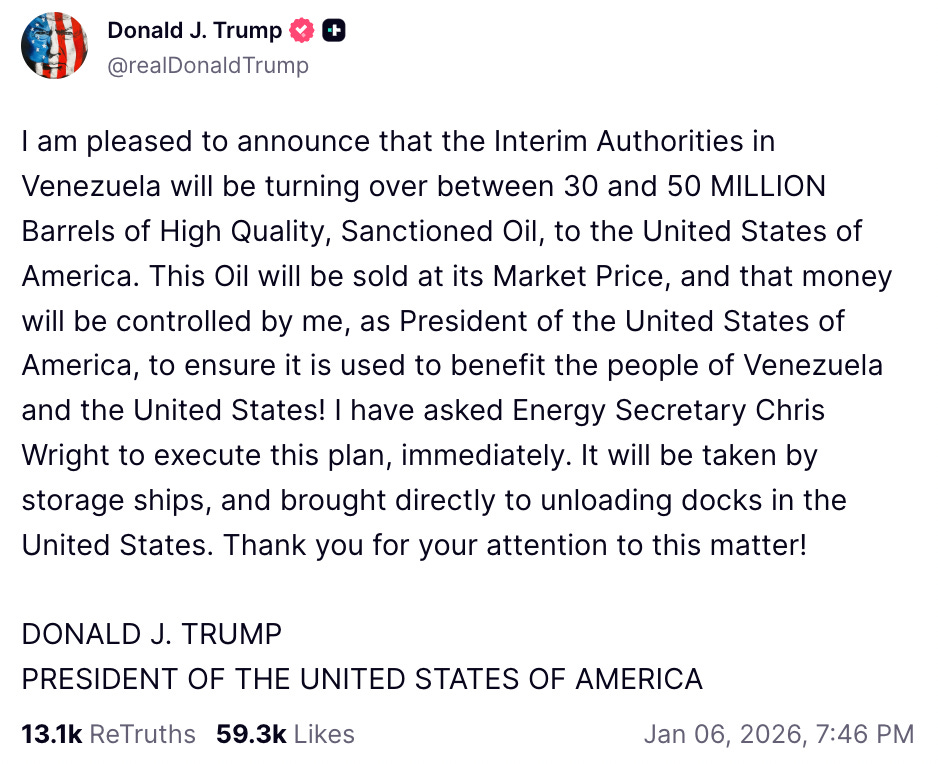
Trump also openly stated the goal of claiming Venezuela’s oil – the largest oil reserves in the world with more than 300 billion barrels. He even went so far as to claim that “Interim Authorities in Venezuela will be turning over between 30 and 50 MILLION Barrels” to the US, which will be sold at “Market Price”.
But as with everything Trump says, it’s worth taking his claims with a grain of salt. Even if they were true, as economist Paul Krugman writes, “that amount of oil has a market value in the range of US$2 billion, which is not a big number for the United States. In fact, it’s less than 0.01 percent of GDP”.
The reality is that Venezuela’s oil industry is dilapidated, with its output significantly curtailed since 2017, when US sanctions came into effect. In 2025, Venezuela exported an average of 1.1 million barrels per day (bpd), or about 1% of global production, with roughly 95% of exports going to China.
Even if US oil companies were permitted to take control of Venezuela’s oil industry, repairing its facilities could cost up to US$60bn (A$89bn). That’s a reality even China understood. In August, a Chinese firm began developing two oil refineries in Venezuela as part of a 20-year deal, but that still would have only marginally increased output by another 60,000 bpd.
The most optimistic analysis from Wall Street suggests oil output from Venezuela could rise to 2.5 million bpd and help depress oil prices by as much as US$4 per barrel – but gradually over the next decade, and assuming the US gets full control of its industry.
Venezuela is also rich in rare earths and minerals used for AI chips, AI data centres, smartphones, laptops and electric vehicles. Yet, as far as we can tell, the US has not secured control of Venezuela’s oil sector or reliable access to its critical minerals.
As of yet, the US has not enacted regime change in Venezuela. And if it were to pursue regime change, it would be a far less spectacular endeavour, involving tens of thousands of ground troops and years of costly nation-building – a replica of the failed Iraq and Afghanistan models.

A world heading for upheaval
The world has been on the path toward global upheaval for some time, as the era of unipolarity – where the US dominated the world unchallenged after the Cold War – gave way last decade to multipolarity – a world dominated by several great powers. Today, the three main great powers are the US, China and in a distant third but still extremely capable, Russia.
It’s a reality the Trump administration acknowledged as soon as it took office for a second time last year. The last time the world lived in a multipolar configuration was before World War I.
But multipolarity does not automatically condemn the world to a fate akin to the two world wars of the 20th century. The world understood that in 1945 and invested in international institutions, norms and laws that set standards for global relations. It was not quite Dante’s universal supreme judge, but it was the closest the world had come.
This is the opportunity squandered during the years of unrivalled US dominance. With no peer competitor between the 1990s and 2020s, the US had ample opportunity to entrench a global order of enduring stability. Doing so would have required a humble acknowledgement of a universal set of laws and principles that shaped state behaviour – including that of the US itself. International law was an American interest too, another potential check on the abuse of its political system.
Instead, the US rejected the very order it had helped build and saw its own political system decay to the point of neo-royalism. It tore at international law and norms with its invasion of Iraq in 2003 and its two-decade occupation of Afghanistan. It snubbed international treaties, from the International Criminal Court to the Law of the Sea.
In its years of dominance, the US chose not to pursue peace but to continue fighting wars. It imposed a set of rules upon all nation-states save for itself and, as we’ve witnessed with the genocide in Gaza, Israel.
The attack on Venezuela was not an anomaly; it was the inevitable step on a trajectory long established by US administrations that, to paraphrase Aristotle, have appeared addicted to military force and unable to imagine a world at peace. Now, nations must prepare for a period of upheaval few have sought.
If you have a story tip, drop an email to tips@deepcutnews.com or send an anonymous Signal to @deepcut.25.
Trump made the comment that Venezuela will only buy American products (impossible)…so back to creating imperial/colonial markets for domestic goods….and protecting trade with force or…Mercantilism.
The 'rules based order' was effectively created by the US, but in recent years has been deserted by the US. We fear that China will respond to the imperial gangster behaviour of the US with similar tactics, but that may not be the case. We may hope that China will see an opportunity to step in as the international stabilizing force, in the space vacated by today's America.