


Deepcut’s journalism is free to read because our readers choose to fund our work. If you want to support fearless Australian reporting, consider becoming a paid subscriber or making a donation today.
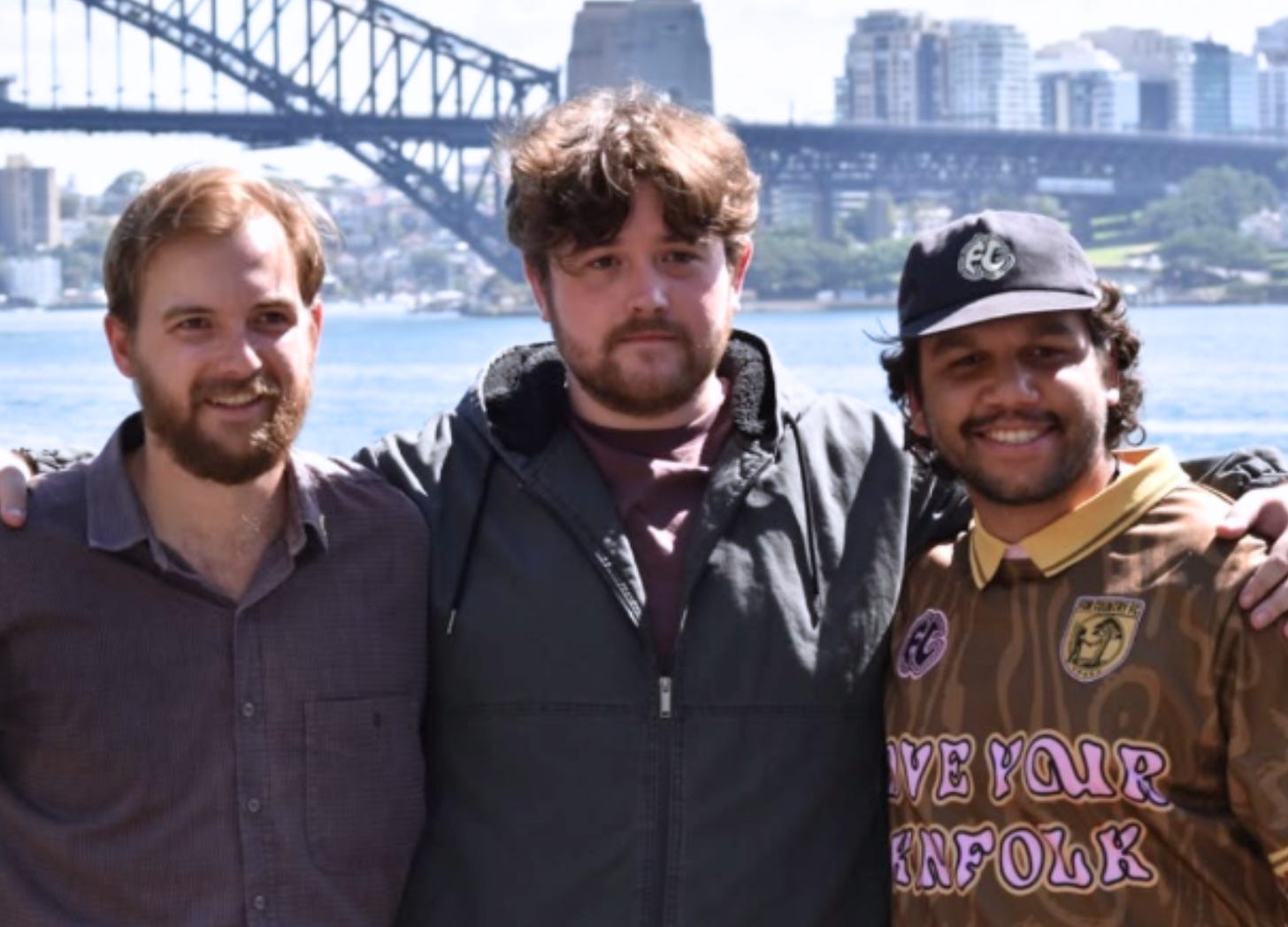
A law student, a musician and a frontline climate activist are among the 17 Australians sailing in the latest maritime convoy attempting to break Israel’s naval siege of Gaza.
The Global Sumud Flotilla, a fleet of more than 100 ships seeking to bring food, medical supplies and construction material to the Gaza Strip, is setting sail from numerous Mediterranean ports this week. More than 3,000 activists from 51 countries have joined the flotilla, dwarfing the convoy that sailed in August and September 2025.
“We believe that we’ve got the best chance yet of any flotilla that’s ever attempted to reach Gazan shores because of our size and scale,” said Zach Schofield, a climate activist and Flotilla participant at a press conference last week.
Ethan Floyd, a Wiradjuri, Ngiyampaa and Wailwan man, is a student and community organiser. He decided to sail to Gaza after hearing crew members of last year’s convoy speak at a rally for Palestine.
“When the last flotilla was in the headlines, just seeing people taking concrete action was really exciting,” he told Deepcut. “There’s often a feeling in organising spaces that just speaking up isn’t enough anymore. If you’ve got the time and capacity and ability to put your body on the line and take a physical stand against Israel, that’s something I think is really important to do.”
Also sailing on the flotilla is Jayden Kitchener-Waters, a Gomeroi and Ngiyampaa man who was fired from the NSW Premier’s Department after he displayed pro-Palestinian slogans on his guitar ahead of a scheduled performance at a departmental event.
“We’ve all watched this genocide from the comfort of our phones. We’ve all shared this feeling of hopelessness,” Kitchener-Waters said on social media.
“It’s important we harness these feelings so we can use them to continue pressuring our governments, decision-makers and ‘leaders’.”
The last Australian cohort of Sumud activists returned with allegations of torture, abuse and sexual assault at the hands of Israeli soldiers and prison guards. After being intercepted in international waters by the Israeli navy in September, they were held for more than a week in Ktzi’ot – an Israeli prison in the Negev desert notorious for its human rights abuses. They also claimed that Itamar Ben-Gvir, Israel’s far-right national security minister, told them in front of TV cameras, ‘Shut the fuck up or we’ll gas you’.
Israeli human rights bodies have exhaustively detailed cases of Palestinian prisoners in Ktzi’ot dying of starvation, internal injuries, and the denial of medical treatment for easily treatable conditions, as well as Israeli prison guards routinely raping and sexually assaulting Palestinians.
Floyd says the new group of Sumud activists have made a conscious choice not to be deterred by the “horror stories” of Ktzi’ot.
“Every time a flotilla makes it in sight of Gaza and is intercepted by the Israelis, the political goal is always to deter future participants – to make people think that it’s far too dangerous to do,” he says.
“They want us to come back to Australia and tell this tale of horror so people don’t do it again. But if we are to meaningfully commit ourselves to the liberation of Palestinians, the end of the genocide and the end of the apartheid system, we cannot let ourselves be frightened or deterred by these stories.
“Our experience will be awful, but it will be the five-star version of what Palestinians face every day in those prisons. Because we carry certain privileges – western passports, citizenship of a country that’s an ally of Israel – we can use those privileges for the benefit of people who don’t have them.”
An additional risk factor for this flotilla is that Australia’s consular services in Israel have been largely suspended due to the ongoing war with Iran. Sumud activists say the Department of Foreign Affairs and Trade (DFAT) has warned them they should not expect Australian consular officials to visit them in person while they are held in Ktzi’ot.
“Their sort of wry advice to us was that we should still be able to get through to the Embassy via the phone lines,” Floyd told Deepcut.
“We asked them, ‘Are you seriously telling us that the Israelis are going to let us use a phone?’ And one of the DFAT officials leaned back in their chair and said, ‘Well, I’m not saying that, but try if you can’.”
Amnesty International Australia has urged the government to “do everything in its power to ensure the safety of the 17 Australians on board”.
“The Australian government, together with other states and Israeli authorities, must ensure safe passage and protection for these peaceful activists and human rights defenders,” said Mohamed Duar, Amnesty International Australia’s spokesperson for the occupied Palestinian territories. “There must be no repeat of Israel’s unlawful interceptions, arbitrary detentions, and inhumane treatment seen in 2025, nor the abuse inflicted on activists last October.”
In lieu of consular support, Floyd believes the next best way to ensure the safety of Sumud activists is by the Australian public “heaping pressure” on the government to advocate on their behalf.
“If people are ringing DFAT, their local MPs, the foreign minister’s office, that creates pressure,” he says. “Not only on our behalf, but on behalf of the people of Gaza who are still under siege.”
Check out our new podcast, Deepthink. We speak with Senator David Shoebridge on the Iran war, the Australia-US alliance and the surging UK Greens. Listen on Spotify, Apple, Deezer or watch on YouTube.