


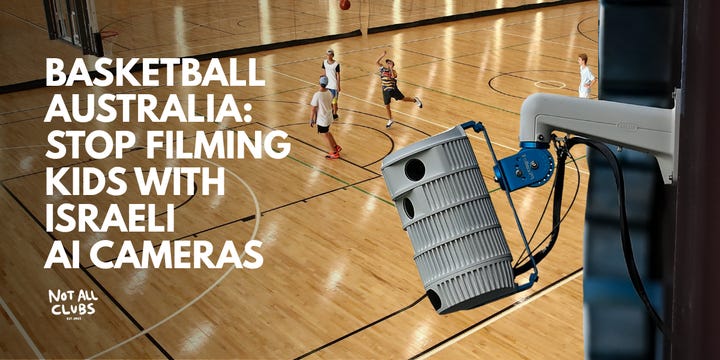
Basketball Australia’s decision to sign a national deal with Israeli sports technology company Pixellot is facing growing scrutiny, with 10,000 people signing a petition opposing the roll-out and confidential sources questioning how the company secured the contract.
The agreement will bring AI-powered cameras and video services to community basketball through a new platform, HoopsTV, expected to launch in November. But strong concerns have been raised about the protection of children and vulnerable players, and how the substantial amount of data generated by the cameras might eventually be used.
A petition organised by grassroots campaigners Not All Clubs and hosted by GetUp calls on Basketball Australia to stop the rollout. The group argues that children as young as six should not be filmed without meaningful consultation and informed consent.
The controversy follows Deepcut’s investigation into allegations that two Ballarat basketball players who had sought protection from filming, were subsequently exposed to unwanted contact after games were streamed. One woman was allegedly contacted by a person subject to a family violence intervention order. Pixellot pulled their Australian livestreaming websites following the revelations but continue to record games where its technology is installed.
Questions over the tender
Four people familiar with the procurement process, but not authorised to speak publicly, told Deepcut that an Australian-New Zealand company, Glory League, had reached contract stage late last year and looked set to sign as the preferred video partner, before a private request-for-proposal process was hastily introduced.
The position of the home-grown company appeared to weaken further as Pixellot appointed several former senior Australian basketball administrative figures in executive roles earlier this year.
This is despite Glory League having its technology already deployed at venues and capturing around 30 per cent of games across Australia. Unlike Pixellot’s system, it does not ordinarily livestream games or use artificial intelligence. Venue administrators can also take cameras offline within minutes, should a request be made.
A Basketball Australia spokesperson told Deepcut that Pixellot was selected through a competitive request-for-proposals process overseen by its Digital Steering Committee. But they declined to answer questions about the reported change in standing of Glory League, the evaluation criteria or the reasons for the final decision.
The governing body has also refused to clarify if the executive appointments had any bearing on the procurement decision, or whether potential conflicts of interest were identified and managed.
IDF links deepen
Pixellot’s founders have backgrounds in Israeli Defence Force research and military intelligence, raising questions about the technology underpinning a system that will record thousands of Australian children playing community sport.
Co-founder Miky Tamir previously headed electro-optics at defence contractor Elbit Systems, working on computer vision technologies for night vision, target detection and recognition. He has described developing systems capable of tracking objects, including missiles, before applying similar computer vision principles to sport.
In a 2022 interview, Tamir told Sports Business Journal: “In Elbit, I did computer vision for night vision, targets detection, target recognition, things like that.”
“And it’s very natural to apply these technologies to other markets like sports. I like sports.”
Elbit is a major supplier of military equipment to Israel and has faced allegations of complicity in abuses against Palestinians during Israel’s war in Gaza, which a UN Commission of Inquiry found constituted genocide. More than 20,000 Palestinian children have been slaughtered by Israeli forces since October 2023, with the assistance of AI technology.
Pixellot’s co-founder and chief technology officer, Gal Oz, spent about a decade in an Israeli military intelligence unit working with visual intelligence technologies, including satellites and drones.
In it for the money
An attractive feature of the HoopsTV platform is that it can potentially generate commercially valuable data through footage, player statistics and derived analytics. Deepcut asked whether Basketball Australia intended to seek revenue from advertising, sponsorship or other commercial uses, including the potential use of footage to train artificial intelligence systems, with three sources claiming that had been tabled by Basketball Australia. It would not outline its plans.
Nor has the governing body disclosed who will own the footage and associated data, where it will be stored or processed, which third parties will have access, or how long recordings will be retained. Questions about whether families can secure permanent deletion of footage and data derived from it also remain unanswered. Policies available online do not provide definitive answers.
These issues are of significance as the cameras will record community games involving children as young as six.
One well-placed source said participants would be slugged $100 for a highlights package, as Pixellot attempted to “gameify” grassroots sports, adding that Pixellot was “definitely not built for grassroots competitions” and “offers no protections for vulnerable participants”. That’s on top of some participants being charged $15 per season for the technology, even if they opt-out.
Two sources told Deepcut that other technology providers had been disadvantaged in separate “questionable” RFP processes by Basketball Australia and were concerned the push for financial gain was coming at the cost of safety of participants.
Not All Clubs challenges the rollout
Not All Clubs says its campaign reflects concerns about the direction of community sport and the extent to which families have been consulted.
“There has been a serious failure to put safeguarding first. Parents and players cannot make informed decisions without clear, accessible information about what is being recorded, who can access it, where the footage goes and how it will be used,” they said.
The campaign calls for stronger consent requirements and protections for children and vulnerable participants, alongside limits on commercial use and clearer accountability for recordings and personal information.
Deepcut asked Basketball Australia if it would pause implementation pending an independent review of procurement, consent, safeguarding and data use. No comment was provided.
“Community sport should be a place where people feel safe to participate, not another place where their safety is compromised because the people making decisions failed to consider the consequences,” Not All Clubs said.
Where is this petition. I'll sign for sure. Nothing like the imperial Boomerang.
The Imperial Boomerang effect means surveillance, repression, and AI violence developed by Israel's IDF to control foreign populations will eventually "boomerang" back and be used against its own citizens (like ICE and Flock cameras).
Aussies don't want to be like the USA!
Like the morons watching themselves on Google Box say..."Anyone not on TV only has themselves to blame"
apologies to Jackson Browne.