


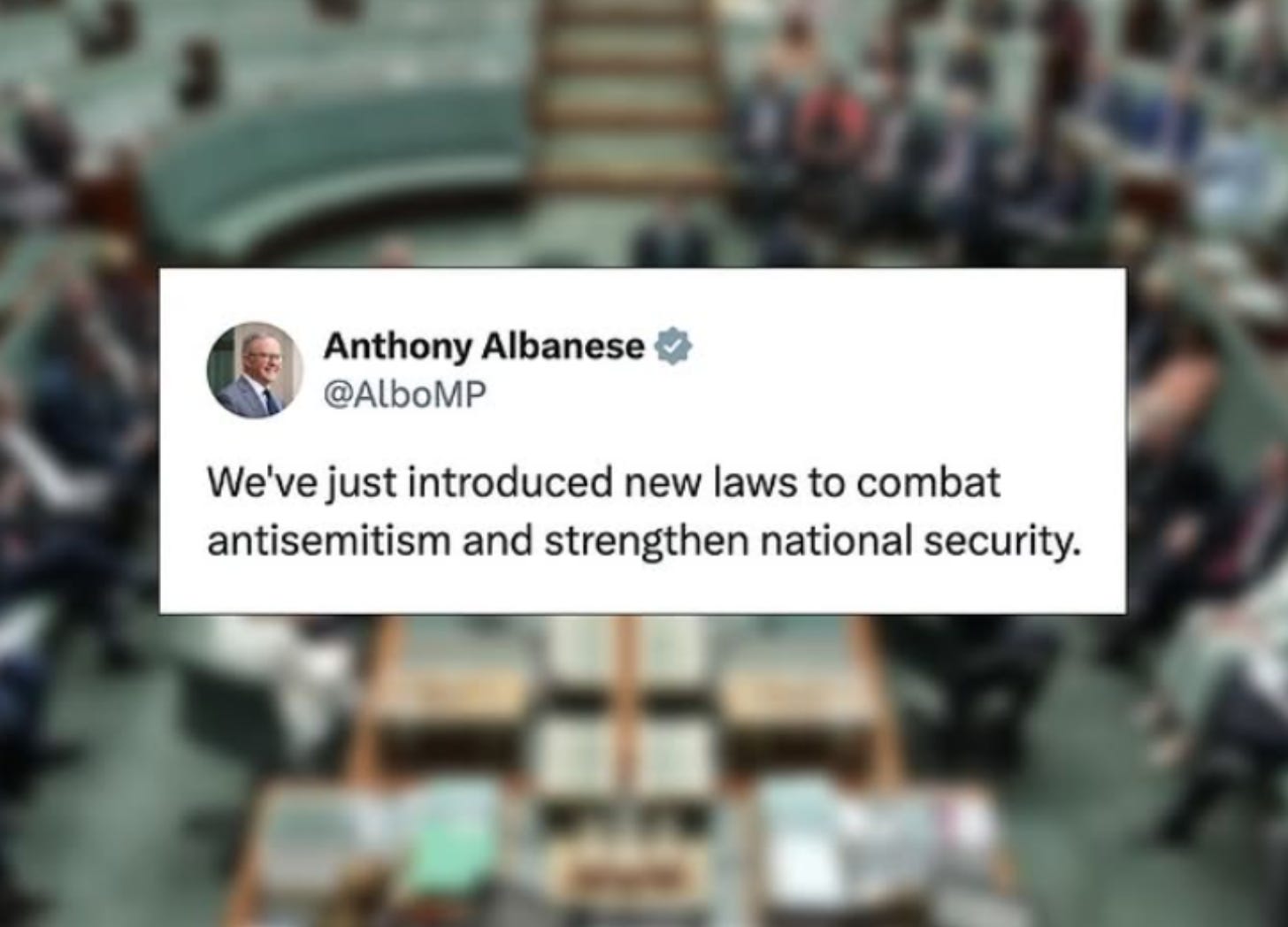
Human rights groups, multicultural organisations and crossbench politicians have warned that the new federal ‘hate speech’ laws effectively criminalise speech, protest and criticism of Israel.
The new laws – passed on Tuesday night after the Labor and Liberal parties voted to guillotine debate in both houses of parliament – give the federal government sweeping powers to:
proscribe organisations as “hate groups” based on whether their conduct would “cause a reasonable person… to be intimidated, to fear harassment or violence, or fear for their safety”;
jail people who are members of, or who are in “association” with proscribed “hate groups” for up to 15 years;
deport or deny visas to migrants associated with organisations designated as “hate groups” or on concern that they “might” commit an offence; and
criminalise political communication deemed to be “violent extremist material”.
Israel is committing a genocide in Gaza. We’re one of the few media organisations that’s not afraid to say so — no matter what the law says. Help us keep the lights on.
Organisations listed as hate groups will have no right to dispute or appeal their designation before their listing, due to provisions in the law explicitly exempting the Home Affairs Minister and the Australian Security Intelligence Organisation (ASIO) from procedural fairness.
Appearing on the ABC’s 7.30 on Tuesday, Attorney-General Michelle Rowland appeared to confirm that an organisation could be listed as as an illegal hate group for publicly stating that Israel was committing a genocide in Gaza, is an apartheid state or should not exist, if those comments made Jewish Australians “feel harassed or intimidated”.
Speaking at a press conference in Sydney on Wednesday, Palestine Action Group Sydney spokesperson Josh Lees said the new laws were “the kinds of laws that get passed in dictatorships”.
“Not supporting the state of Israel is not some fringe or extremist position. The position that Israel has committed a genocide in Gaza is held by 58 per cent of Australians. It’s the position that millions of Australians have taken when we marched around this country to say we oppose the genocide that Israel is committing in the Gaza Strip,” Lees said.
Laws represent ‘unprecedented curtailment of our rights’
Civil liberties groups and Muslim and Palestinian advocacy organisations reacted with alarm to the bill’s passage, with Liberty Victoria president Gemma Cafarella labelling the laws “a radical and unprecedented curtailment of our rights and liberties”.
“These laws create real uncertainty and make it very difficult for people to understand whether they are complying with the law,” Cafarella said. “Such complex changes to our laws – potentially limiting expression and association rights, attracting criminal penalties, affecting citizenship, or impacting rights to hold a visa – should have been subject to greater care and scrutiny.”
The Australian Muslim Advocacy Network (AMAN) called the bill’s passage “a devastating day for human rights”, warning that the provisions around “violent extremist material” were “intensely terrifying for marginalised and overpoliced communities”.
“No one knows what this material includes or excludes,” AMAN stated in a press release on Wednesday.
Australia Palestine Advocacy Network (APAN) president Nasser Mashni warned the new laws would “expand state power in vague and dangerous ways that will chill protest, suppress political speech, and disproportionately target Palestinians and those who stand with them”.
“Under these laws, protesters may face arrest and imprisonment. Advocates risk surveillance and criminal penalties for legitimate political expression. Refugees and visa applicants fleeing genocide may be denied entry based on past criticism of Israeli state violence and their association with organisations which are banned in Australia,” Mashni said.
“These outcomes are not speculative – they mirror developments already seen in the United Kingdom, where anti-genocide protesters have been arrested and jailed under similar legislative frameworks.”
Major parties team up to ram bill through parliament
The Liberal party voted with the government to defeat a series of amendments to the bill proposed by the crossbench, including a clarification that “a person’s conduct is not taken to be motivated by hatred solely because it involves criticism of the policies, actions or institutions of a foreign state, or discussion of matters of international law”.
A similar amendment moved by independent Senator Fatima Payman that sought to uphold a 2025 Federal Court judgement that criticism of Israel and Zionism is not inherently antisemitic was also voted down by the major party duopoly.
A threatened democracy needs courageous media more than ever. Support news that speaks the truth.
A third defeated amendment, moved by independent MP Kate Chaney, would have made new provisions criminalising association with banned groups and organisations subject to regular review.
“Banning organisations is a typical strategy of authoritarian figures, and frequently associated with democratic backsliding, so we need to ensure that power like this has sufficient safeguards,” Chaney said. “[This law] explicitly exempts the application of procedural fairness, so there is no right to be heard.”
Independent senator Fatima Payman told Deepcut the laws “were rushed with no due process or scrutiny”.
“I am deeply concerned by the extraordinary powers granted to Ministers to cancel visas and weaken protections for peaceful protest,” Payman said. “I hope the government is prepared to deal with the unintended consequences of this hasty lawmaking and the results of the much-delayed Royal Commission.”
While the laws are subject to a statutory requirement to be reviewed after two years, Jewish Council of Australia executive member Ohad Kozminsky warned that the new provisions “will not make Jewish people or other racialised groups safer”.
“The Jewish community, and all racialised communities, deserve better than rushed laws that have been legislated without proper evidence, consultation or consideration of unintended consequences.”
We are now hurtling down the slippery slope. The major parties have betrayed their people playing politics. Didn’t think it would happen here. Stupid me.
Is there a chance that the laws could be struck down as unconstitutional, on the grounds that it restricts the right to political communication?