


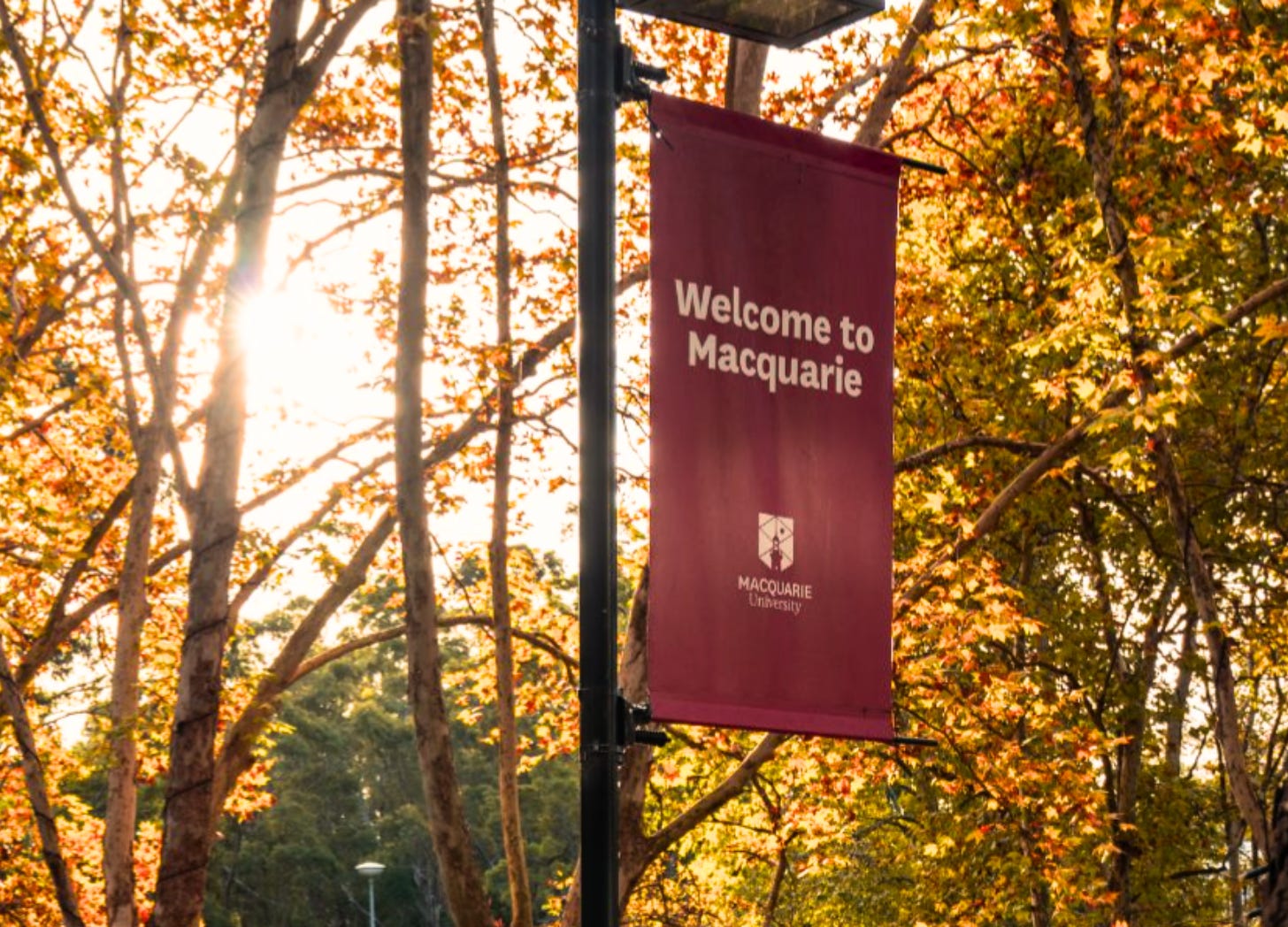
A Macquarie University lecturer in Middle East politics who has been the target of a pro-Israel media campaign claims to have been filmed, followed and threatened on campus.
Dr Jumana Bayeh — an associate professor specialising in postcolonial and Middle East studies at Macquarie University — said a man recorded her without her consent in a May lecture, became aggressive toward another student when confronted and followed her when she left the building, forcing her to call campus security and prompting her students to form a protective circle around her.
“At one point, he said, ‘I can find you’,” Bayeh told Deepcut.
“That gave me the chills. I felt sickened by it.”
To celebrate our first birthday, we’re taking 25% off our annual subscription. Support independent journalism.
‘Mind your own f***ing business’
Bayeh first noticed the man — who was not one of her regular students — toward the back of one of her Middle East studies lectures.
“He looked a bit older than the cohort, maybe in his early 30s, so he looked a bit distinguishable from the rest,” Bayeh told Deepcut. “One student told me that they remembered him walking in earlier in the semester, standing in the corner, and then leaving the room.”
Macquarie lectures are audio-recorded, but private filming is generally prohibited. Bayeh says the trouble began when she noticed the man seemingly filming her on his phone.
“It seemed like he was filming me because he was holding his phone up to his face,” Bayeh said. “I said to him, ‘Are you recording me?’ He said, ‘No, I’m not. I’m looking at my phone’.”
Bayeh asked that the man not film her and reminded her students that the lecture’s audio was being recorded. A few minutes later, she looked up and saw he was filming her again.
“I said to him, ‘I just told you no one is to film me in this class’,” Bayeh said. “He said, ‘I’m not filming you, I’m looking at the lecture slides for the unit on his phone’, which seemed odd as the lecture slides were on four big screens behind me.”
At that point, Bayeh felt the situation was getting “tense” and decided to end the lecture. The man then became verbally abusive.
“I said to the students, ‘I’m really sorry, I’m not obliged to give a lecture where I don’t feel safe, I’m ending this lecture, I’ll post notes for you’,” Bayeh said. “At that point he said to me, ‘Why don’t you mind your own fucking business?’”
“One of the other students, sitting towards the front, said to him, ‘Why don’t you get over yourself?’ He then marched down to the student and got in his face,” Bayeh said.
“It looked like it was going to get violent. He’s bigger than me; I’m quite short. If there was going to be physical altercation, there’s no way I could have stopped it.”
At that point, Bayeh rang security on the lecture theatre’s internal phone, prompting the man to “stomp out”. Bayeh lingered in the lecture room to check on her other students, who were “quite upset”.
When security didn’t arrive, Bayeh’s students offered to walk her out of the building.
“When we got downstairs, I could see him waiting outside,” Bayeh said. “We took a different exit, but he found us as we were walking out. He started following us and pointing at me, saying, ‘You have to talk to me. I’ve done nothing wrong, Jumana. You have to talk to me’.”
“I called security again, and the students had physically formed like a ring around me, telling him to go away. At one point, he said, ‘I can find you’. That gave me the chills. I felt sickened by it.”
Eventually campus security arrived and escorted Bayeh to her car, after which she left campus. Bayeh then called one of her tutors to warn them about the man.
“I said, ‘Listen, this has happened. If this guy turns up to the class, just call security straight away’. And apparently he was waiting outside the tutorial room,” Bayeh said. “My colleague called security, and he wasn’t seen after that.”
Bayeh and several of her students filed an incident report with Macquarie’s internal complaints portal, as well as her Head of School.
“In this instance, the University has jumped on it very quickly and dealt with it.,” she said.
One of Bayeh’s students, who first contacted Deepcut and wished to remain anonymous, corroborated Bayeh’s telling of the incident.
Campaign of targeting
It’s not the first time Bayeh’s lectures have been targeted by students or members of the public with pro-Israel views.
“In 2024 I had a student in my class. For several lectures, whenever I mentioned the 1948 Nakba or the war on Gaza or any Israeli attack on Lebanon, he would start fist-pumping and cheering and clapping,” Bayeh said.
“Once there was an altercation between him and some of my other students in which they got very angry. I found out later he had filmed me and sent a text message in some group chat, where he said, ‘call in border control, she needs to be deported back to Lebanon’.”
Bayeh says she made complaints about the student to her Head of School and to the university’s student misconduct team, but never heard back. As far as she is aware, the student was never contacted or disciplined.
Like fellow Macquarie academic Dr Randa Abdel-Fattah, Bayeh has been repeatedly targeted by pro-Israel lobby groups and conservative media outlets over her criticism of Israel in the classroom. In April, Sky News ran an ‘exclusive’ revealing that Macquarie was investigating Bayeh regarding a lecture she gave in a Middle East studies class in March.
The complaint cited Bayeh’s referring to Hezbollah as a “resistance group” and describing Israel’s actions in Lebanon as “ethnic cleansing”, audio recordings of which were included in the Sky report.
The complaint was officially lodged by Michael Gencher, a former CEO of the NSW Jewish Board of Deputies and the executive director of StandWithUs Australia, an “Israel education organisation” with branches in nine countries.
Speaking to Sky, Gencher claimed the complaint also included Bayeh’s quoting of UN Special Rapporteur Francesca Albanese, using terms like “genocide” and “land grab”, and claimed it was “wholly irresponsible” of Bayeh “to go down this path without context and without balance”.
While StandWithUs bills itself as a “non-political organisation”, Gencher himself has been the president of the Northern Beaches branch of the Liberal Party since November 2025.
Sky host Caroline Marcus, who presented the report, cited the Bondi terror attack during her interview with Gencher, saying “we’ve seen how the rise of antisemitism and anti-Israel rhetoric and anti-Zionism, as it’s often cloaked as… what that’s led to in Australia”.
“I’m not calling this academic antisemitic or that what she did is antisemitism, but I think it contributes to an environment in which Jewish students can feel unsafe at university,” Marcus said.
Bayeh said the targeting by Sky and others had had serious ramifications in her workplace.
“As a result of the [Sky News] complaint, I was put on a three-month teaching performance review, which I believe is the maximum period the university can apply,” Bayeh said.
“I have no idea what’s involved in that process — whether one of my managers is listening to my lectures or is talking to my students.”
Bayeh was one of nine academics made redundant from Macquarie’s Arts faculty in December, seven of whom were female and two of whom were Arab women. While Bayeh fought her redundancy for six months, Macquarie recently decided to uphold the redundancy despite an independent review panel unanimously finding in Bayeh’s favour.
In April, Bayeh also gave evidence before the NSW parliamentary inquiry into university governance, testifying on what she called Macquarie’s “brutal approach to change management”.
“As a member of the faculty’s Diversity, Equity and Inclusion committee and as one of a few Arab women, or possibly the only Arab woman, teaching Middle East politics units in Australia, and as the first in my family to go to university, I felt an extra responsibility to highlight these issues to management,” Bayeh told the inquiry.
“The shocking thing about the last three-odd years is that not one member of management at Macquarie — not one — has bothered to ask me or anyone at the university who’s got family in Lebanon how we’re feeling,” Bayeh told Deepcut.
“There’s been nothing. We’ve just been treated as people to control, to be aggressive with, or to silence. Half of my family lives in Lebanon.”
Listen to the latest episode of Deepthink, where Antoun Issa discusses his new book, Rebirth: A Love Story from the Depths of War, with Readings Books. The wide-ranging conversation delves into Beirut’s history, enduring Arab resistance, and interpreting Kahlil Gibran and the purpose of life.