


In 2002, one of the architects of neoliberalism, Milton Friedman, updated his definitive work, Capitalism and Freedom, for its fortieth anniversary.
Introducing his work, Friedman made the point Naomi Klein later used as the foundation for her book, Shock Doctrine:
Only a crisis – actual or perceived – produces real change. When that crisis occurs, the actions that are taken depend on the ideas that are laying around. That, I believe, is our basic function: to develop alternatives to existing policies, to keep them alive and available until the politically impossible becomes politically inevitable.
Klein expanded on what she considered the shock doctrine formula in 2017:
Shock tactics follow a clear pattern: wait for a crisis (or even, in some instances, as in Chile or Russia, help foment one), declare a moment of what is sometimes called ‘extraordinary politics’, suspend some or all democratic norms – and then ram the corporate wishlist through as quickly as possible. The research showed that virtually any tumultuous situation, if framed with sufficient hysteria by political leaders, could serve this softening-up function.
In a recent Vanity Fair profile, US president Donald Trump’s chief of staff Susie Wiles put it more bluntly while talking about some of health secretary Robert F Kennedy Junior’s more insane ideas: “He pushes the envelope — some would say too far. But I say in order to get back to the middle, you have to push it too far.”
It’s rare to see power speak so plainly about how the right brings about change – push the envelope too far, and then bring it back to the “middle”, which of course has shifted right with the envelope.
As governments crack down on free speech and basic human rights, fearless independent journalism is needed more than ever. Support Deepcut News with a paid subscription today.
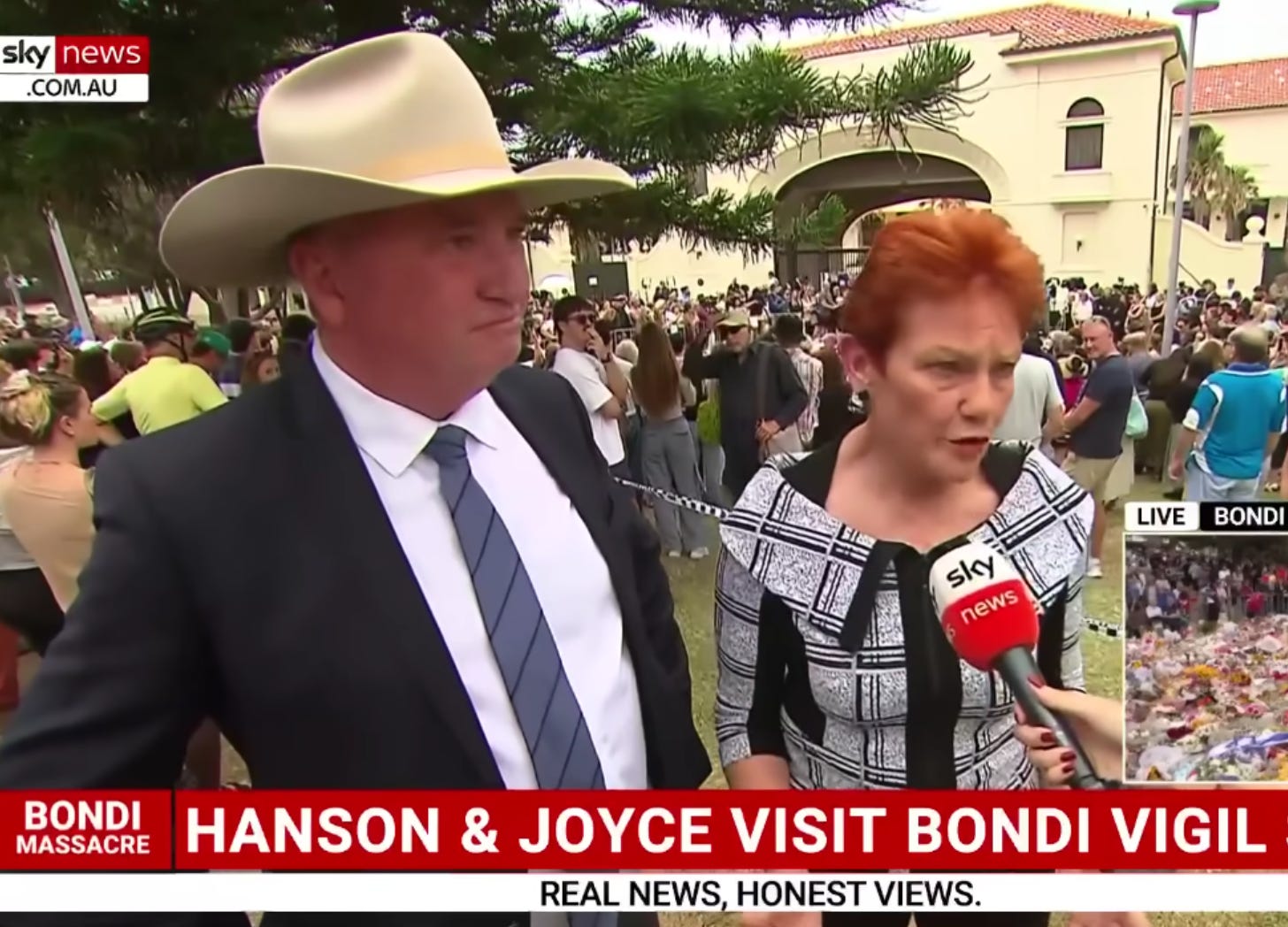
We have witnessed some of the rawest and most blatant politics in response to the Bondi tragedy. Never before have Australians witnessed their alternative government blame their current government for a terrorist attack. In the midst of that, we have seen what the Jewish Council of Australia has called a “divisive pro-Israel wishlist” adopted as the only answer.
NSW premier Chris Minns has used the massacre to announce his government will adopt gun reform discussed at national cabinet as part of a major crackdown on protests. Neither Minns or his Liberal counterpart Kelly Sloane, who is in wholehearted agreement, have managed to explain how further limiting protest would make anyone safer or improve social cohesion.
In this environment, that doesn’t seem to matter. It also doesn’t seem to matter that until very recently, Minns had been pushing to make NSW’s gun laws even looser in a sweetheart deal with the Shooters and Fishers party, designed to make winning their vote in the upper chamber easier.
Queensland premier David Crisafulli won plaudits for coming out and criticising the immediate focus on gun laws — one of the only practical solutions a government could enact quickly — despite his government just a week earlier having to defend multiple meetings with representatives from the gun lobby, while it delayed implementing gun reform recommendations in the wake of the Wieambilla tragedy.
It doesn’t seem to matter that there is no evidence the men accused of the Bondi murders had any contact with the Palestine movement, or that no one can say how changing the definition of antisemitism to include criticism of Israel would have prevented the attack or made the Jewish community safer.
It only seems to matter what those who wanted those changes now think. They are the answers “lying around”, as Friedman put it; the answers which had been kept “alive and available” and have now become a political inevitability.
But at what cost?
Australia’s Jewish community had their worst fears realised and Australia has been shocked out of the idea that ‘these things don’t happen here’ in six minutes of terror, which targeted Jewish people celebrating one of their most sacred ceremonies. Two hate-filled men killed 15 people who had been honouring life, including a 10-year-old child, before they were stopped.
Strangers ran towards the sound of bullets to save strangers. Strangers shielded each other and unknown children, while frantic about their own loved ones. People saw their loved ones die. The fracture to the nation’s sense of safety will never truly heal. But unlike Port Arthur, the Lindt Cafe siege, the Bali bombings, or even the Cronulla riots, there was no political unity for the sake of the nation.
For the first time, Australia’s unspoken bipartisanship that the nation’s needs are more important than politics has fractured. Sussan Ley and other senior members of the Coalition blamed the Albanese government and anyone who had protested against a genocide for a terror attack, while simultaneously using it to demonise migrants.
By and large, Australia’s media immediately jumped on the comments that anti-genocide protesters must also share in the blame for the attack. The groupthink appears largely unexamined, given the lack of evidence and the multitude of voices urging caution. For some, it appears a way of clawing back some cultural relevancy, but it can also not be discounted that the loudest voices in this blame game were also among the most criticised for how they have handled coverage of the Palestinian protests.
It seems lost to these outlets and journalists that they are accusing their own audiences of sharing blame for the actions of two radicalised men. Equating the hundreds of thousands of people who have protested for a stronger stand against a genocide — a finding supported by legal experts, genocide scholars, and every major humanitarian organisation — with supporting a massacre is just as insane as using the massacre for political point-scoring and to set up a fight about migration.
Protest is being banned. Chants are being outlawed. Communities are being demonised — and most media outlets are cheering it on.
We’re not.
Help us hold power to account. Support Deepcut with a paid subscription.
And lest there be criticisms that this is just reporting the views of the Jewish community — who of course should be listened to — the voices within the Jewish community who have been urging calm, or expressing discomfort with how their grief is being weaponised are not receiving the same prominence.
“We share the government’s goal of confronting antisemitism and racism wherever they appear. This is a responsibility that belongs to all of us – government, institutions and communities”, said Sarah Schwartz, executive officer of the Jewish Council of Australia, late last week.
“Our grief should not be used as a political weapon, nor as an excuse to pursue agendas that divide communities. We urge the Prime Minister to reject voices which seek to use this response to divide us and pursue anti-immigration or pro-Israel agendas, and instead focus on what is needed to keep us, and all racialised communities, safe from violent acts of racism.”
John Howard’s comments that the Albanese government’s announcement of stricter gun laws was a “distraction” — despite admitting he had not seen the national cabinet plan beyond a few dot points relayed to him as he left the Sky News studios — were splashed across headlines and thinkpieces, using his authority as a ‘former prime minister’ to conclude Albanese was lost.
Another former prime minister, Malcolm Turnbull, who had pushed back against Israeli prime minister Benjamin Netanyahu’s statement that Australia’s recognition of Palestine had contributed to the terror attack (a charge without evidence, which also ignores that most of the world has recognised Palestine and had before October 7), and spoke of the difficulty in predicting ‘lone wolf’-style terror attacks, was not given the same prominence.
Declarative statements have abounded in media analysis without the need for evidence, a liberty rarely afforded to those outside the accepted opinion.
This way of thinking assumes that you cannot care about the loss of Jewish life if you care about the loss of Palestinian life, which is like saying you must choose between air and water. It assumes that people see life in binary terms, rather than feeling compassion and justice for all. It assumes most people hate. And while Australia has always struggled with acknowledging the hate that dwells in its society, antisemitism included, hate is not the default.
The ‘debate’ we have seen in the last week largely assumes it is. Pushing back against that assumption will take all of us.

It’s funny how it’s only the ideas lying around on the right which get picked up in a time of crisis…
This is giving some of the worst people a chance to capitalise on this tragedy, and they're going at it full force.
I wonder what the fix is... Labor, besides sprinting to the right all in its own, is very reactionary and weak when attacked from the right, so expecting them to do the correct thing is not an option. Every act of antisemitism, real or not (thinking of the fake Sydney caravan), linked to an organised resistance to Israel's genocide is Palestine or not, just gives the government more excuses to become Zionism supporters in their own right. This makes things worse for everyone, including Jews, unless you're a select few right wing shitheads that are in charge. The gun lobby is working overtime to prevent any changes, and the Zionism lobby is working overtime to make things worse and more fascist. How do we stop this?