


Part Two – A list of state laws in Australia targeting protests and free speech
Part Three – How the pro-Israel lobby pushes for anti-democratic laws in Australia
Democracy in Australia is facing one of its greatest challenges in its short history. Recently passed hate laws – which gives the federal government extraordinary powers to target dissent – and extreme anti-protest measures across various states are leading the nation down a slippery authoritarian slope.
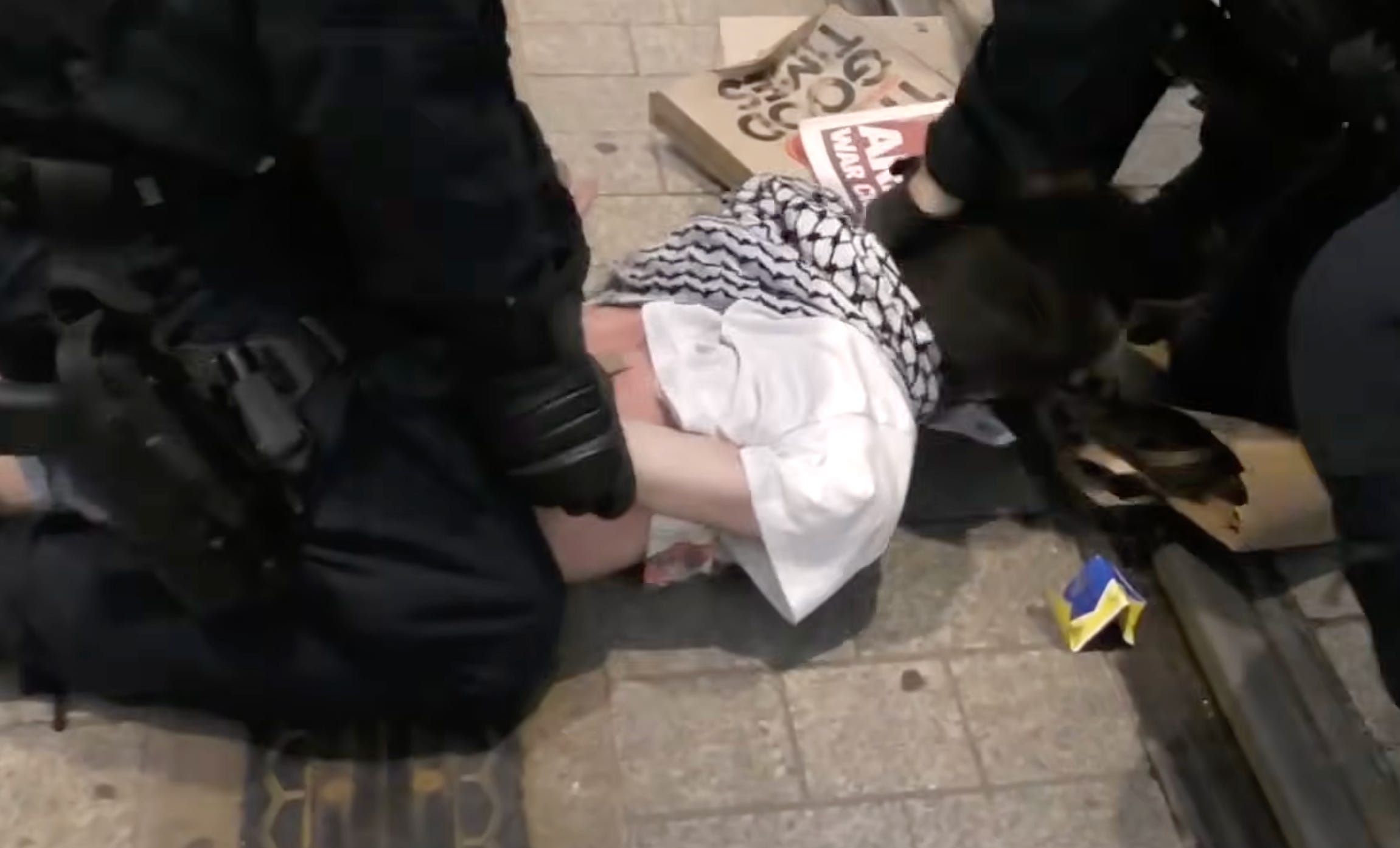
Western Australia is the latest Labor-run state to introduce draconian anti-protest laws that empower police to refuse a permit to protest – a fundamental democratic right. The announcement by the Cook government came less than a week after the shocking displays of police violence in Sydney targeting peaceful protesters.
But the erosion of civil liberties in Australia did not begin in the wake of the Gaza genocide, nor the Bondi attack. For more than two decades, Labor and the Coalition have worked together to gradually expand police and surveillance powers at the expense of freedoms of speech, assembly and association.
This is a three-part series that will list the key reforms this century thus far that have led Australia to its current predicament. Part One will list key Commonwealth laws, Part Two state laws, and Part Three will look at the pro-Israel lobby’s role in shaping a growing surveillance and police state.
June 2002
The law: Security Legislation Amendment (Terrorism) Act 2002
Who passed it? The Howard government with Labor support
What does it do? Established special legal definitions of “terrorism” and “terrorist acts”, which have since formed the basis of Australia’s counter-terrorism legal framework. The definitions are broad and expose individuals or groups to prosecution for activities as minor as unknowingly funding, associating or communicating with proscribed groups. The low threshold for “association” drew particular concern from parliamentary committees and human rights advocates.
The law defines terrorist acts as: “engaging… providing or receiving training… directing organisations concerned with… possessing things connected with… collecting or making documents likely to facilitate… and acts in preparation for, or planning, a terrorist act.” Crucially, a person can be charged with many of these offences without a terrorist act actually occurring, marking a step away from traditional criminal law that tends to focus on acts of violence.
How has it been used? It has been invoked every time terrorism charges have been laid, but of note is the case of Zaky Mallah, the first person to be tried under these laws in 2003. Mallah, then 19, was found not guilty of two counts of “committing an act in preparation for or in the planning of a terrorist act” after recording a video expressing anger at the Australian government for denying his passport application. Mallah was, however, sentenced to two and a half years in jail for threatening an undercover police officer attempting to entrap him into carrying out a terrorist act.
December 2003
The law: ASIO Legislation Amendment (Terrorism) Act 2003
Who passed it? The Howard government with Labor support
What does it do? Grants ASIO the power to obtain special warrants to detain and question individuals who aren’t suspects in a terrorism or criminal inquiry. It’s based on whether “there are reasonable grounds for believing that the warrant will substantially assist the collection of intelligence that is important in relation to a terrorism offence”. This was a significant expansion of ASIO’s remit: it allowed the agency to act in ways akin to law enforcement without being bound by the same judicial safeguards, and effectively waived the rights that individuals would normally have if they were detained by law enforcement.
Former High Court chief justice Gerard Brennan summarised the Act as: “a person may be detained in custody, virtually incommunicado, without even being accused of involvement in terrorist activity, on grounds which are kept secret and without effective opportunity to challenge the basis of his or her detention.”
How has it been used? Specific instances of these powers being used remain confidential by law, but warrants have been sought and issued 20 times from 2003 to 2025. Although introduced with a sunset clause set to expire in 2006, the legislation has been repeatedly renewed. A current Bill that would make these powers permanent and expand the scope to include, among other offences, “inciting communal violence”, has passed the lower house and will become law if it clears the Senate.
June 2004
The law: Anti‑Terrorism Act 2004
Who passed it? The Howard government with Labor support
What does it do? Broadens police powers of detention, allowing suspects to be held and questioned without charge for up to 24 hours. Except this 24-hour limit isn’t absolute. The AFP are permitted ‘dead time’, meaning the timer on an individual’s detention can be stopped for meals, sleeping and when contacting a lawyer among other instances. Rights groups raised concerns that the powers could allow for arbitrary detention of individuals. Strict bail conditions included in the Act also create the risk that individuals charged on weak evidence could remain in custody while awaiting trial.
How has it been used? On 2 July 2007, Dr. Mohamed Haneef, an Indian doctor working in Australia, was arrested at Brisbane airport on suspicion of involvement with the June 2007 Glasgow airport terrorist attack. Under the powers created by the Act, he was held for 12 days under ‘dead time’ before being charged. Queensland authorities attempted to revoke his application for bail, but this was overturned by a magistrate who claimed that the case rested on extremely weak evidence. The charges were withdrawn and Haneef later won compensation.
December 2005
The law: Anti‑Terrorism Act (No. 2) 2005
Who passed it? The Howard government with Labor support
What does it do? Building on earlier legislation, this Act introduced several major changes. It expanded the definition of a terrorist organisation to include groups that merely advocate ‘terrorism’. Except this was a broad and ambiguous framing which opened the possibility for legitimate political expression and protest to be targeted and prosecuted. The Rudd government tightened the law, inadequately, in 2010 to “circumstances where there is a substantial risk that such praise” may cause a person to commit another terrorist act.
The Act also created severe consequences for groups that fell under this broad terrorist definition, including restricting the freedom of movement, communication and association of Australians suspected of links to proscribed groups. These ‘control orders’ can mandate house arrest, electronic monitoring or the surrender of digital devices, without formal charges or the evidentiary standard of ‘beyond reasonable doubt’. It also introduced preventative detention, allowing any police force acting on behalf of the AFP to detain Australians for up to 48 hours if they suspect they may be planning a terrorist act.
How has it been used? In March 2006, Joseph Thomas, an Australian citizen, was sentenced to five years imprisonment for alleged terrorism offences, but had his conviction overturned after the evidence used against him was ruled to be inadmissible. Upon his release, he was issued a 12-month control order under the Act, which included a curfew and restrictions on phone and internet communications. He was later retried and found not guilty of terrorist offences.
March 2006
The law: Telecommunications (Interception) Amendment Bill 2006
Who passed it? The Howard government with Labor support
What does it do? Allows warrants to be issued for law enforcement agencies and ASIO to access and intercept emails, text messages and voicemail recordings, as well as phones and computers. It grants them access to electronic devices belonging to anybody, not just suspects in an investigation, so long as they have reason to believe the evidence will aid in an investigation.
How has it been used? Countless times, as it applies to any major criminal investigation. The ability for government agencies to spy on innocent people has been widely criticised.
October 2014
The law: National Security Legislation Amendment Act (No. 1) 2014
Who passed it? The Abbott government with Labor support
What does it do? Introduced a new classification of ASIO operation (Special Intelligence Operation or ‘SIO’) with penalties of up to 10 years in jail for anyone who publicly discloses a SIO. This was condemned by the Greens at the time as “draconian” a measure targeting whistleblowers and journalists. Under the SIO classification, ASIO agents are also immune from a broad range of criminal and civil offences.
The law also gives ASIO far-reaching powers to monitor every device on the internet and hack computer networks.
How has it been used? The very nature of the law prohibits public disclosure about its use, but many critics have voiced concerns about the chilling effect on national security reporting.
March 2015
The law: Telecommunications (Interception and Access) Amendment (Data Retention) Act 2015
Who passed it? The Abbott government with Labor support
What does it do? Greatly expanded the surveillance regime in Australia by mandating telecommunications providers to store all user metadata (that’s right, your internet and phone usage data) for two years. The stored metadata does not include content (i.e. messages or files) but does include information such as the location, duration and participants of a phone call, IP addresses, and the time, date and email addresses of email exchanges.
How has it been used? Despite then-Attorney General George Brandis claiming that the regime will only apply to the most serious crime and terrorism investigations, this is arguably the most exercised law listed here. Government agencies have requested access to Australians’ metadata millions of times since the law was passed. In 2022-2023 there were 331,739 requests alone, and in 2023-2024 there were 359,921. Critics say government bodies are abusing the metadata to surveil Australians. A 2019 ombudsman report said that “all agencies investigated were found to have accessed Australians’ metadata without the proper authorisation”.
December 2018
The law: Telecommunications and Other Legislation Amendment (Assistance and Access) Act 2018
Who passed it? The Morrison government with Labor support
What does it do? Grants law enforcement, Border Force and security agencies sweeping access to encrypted messages, phones and laptops. It empowers them to obtain assistance from telecommunications providers and device manufacturers, as well as to obtain remote search warrants to hack into devices. It also legally requires Australians under ASIO investigation to provide access to their devices.
How has it been used? Instances of ASIO using these powers are classified and there is no public information about specific cases.
December 2023
The law: Counter‑Terrorism Legislation Amendment (Prohibited Hate Symbols and Other Measures) Act 2023
Who passed it? The Albanese government with Coalition support
What does it do? Proscribes certain hate symbols, particularly the Nazi flag and salute and the Islamic State flag, and also creates new offences for accessing, possessing or distributing violent extremist material online. While it was already an offence to share material relating to a terrorist act, this amendment places the offence on the material itself, regardless of whether a terrorist act occurs. This represents another troubling shift in counter-terrorism legislation away from violent acts, and toward the policing of symbols and language.

How has it been used? There have been multiple instances already of charges being laid against individuals performing the Nazi salute and displaying the swastika. What is concerning for peaceful religious expression, however, is that the Act bans the display of the IS flag which prominently features the shahada, or the sacred Islamic creed which every practicing Muslim recites daily. Besides its plain black background, the IS flag does not have any other distinguishing features, and Islamic community groups have expressed fear that the Act effectively bans the peaceful expression of Islamic tenets.
February 2025
The law: Criminal Code Amendment (Hate Crimes) Act 2025
Who passed it? The Albanese government with Coalition support
What does it do? Dramatically expands the definition of hate crimes to cover advocacy of violence against protected groups, even in cases where no intention to incite violence is proven. It also criminalised “conduct that is likely to offend, insult, humiliate or intimidate a person”, increased penalties, added new protected groups, and unified inconsistent state- and territory-level sentencing guidelines under the federal criminal code.
How has it been used? While it is not clear whether anyone has been charged under the new provisions, parallel laws offer a preview of how it might look. Melbourne restaurateur Hash Tayeh was charged under similar Victorian state laws in March 2025 for stating that “all Zionists are terrorists”, suggesting prosecutors could interpret these laws to target critics of political ideologies like Zionism.
January 2026
The law: Combatting Antisemitism, Hate and Extremism (Criminal and Migration Laws) Act 2026
Who passed it? The Albanese government with Liberal support
What does it do? Introduces draconian new offences surrounding hate speech with penalties of up to 10 years jail. It reduced the threshold for prosecuting hate speech from inciting violence to merely ‘promoting hatred’ – a phrase so vague it leaves the window open for highly politicised and selective application. It also provided the federal government extraordinary powers to proscribe local organisations as ‘hate groups’ without procedural fairness, meaning groups cannot appeal or provide evidence against the proscription. The powers were condemned as akin to a dictatorship.
How has it been used? It’s too soon to tell, but human rights and community groups expressed alarm at the fact that the law seems implicitly designed to suppress criticism of Israel and the genocide in Palestine by conflating these political positions with antisemitism.
Cumulatively, these laws have built an expansive web of police and security agency powers. Over the years the laws have been tweaked to shift criminal activity away from violent acts and toward speech, symbols and language – all the while increasing powers for security agencies to surveil Australians. The resulting system of surveillance, preventive enforcement, prosecutorial discretion and vaguely defined offences has already been weaponised against protest and free speech.
Every law listed has something in common: they were all passed with bipartisan support. Both sides of the aisle have sought to empower the state at the expense of civil liberties, with seemingly no concern for the freedoms and protections residents in a democratic nation should enjoy.
Stay tuned for Part Two.
Tom Lazaroo holds a Masters of International Relations from the University of Western Australia. He is particularly focused on the global political economy, religion in foreign policy, migration and the rise of surveillance tech.
Got a tip? Send an email to tips@deepcutnews.com or send an anonymous Signal to @deepcut.25.

Excellent and important work, thank you. Validates that persistent feeling over decades now that ordinary civilian rights to privacy and public expression are being continuously, incrementally eroded. They are.
This is a valuable document of a slide towards outright authoritarian government.