


By Jeffrey Loewenstein LL.B - Jeffrey was a member of the Victorian Bar and a one-time Chairman of the Anti-Defamation Commission and member of the Jewish Community Council of Victoria
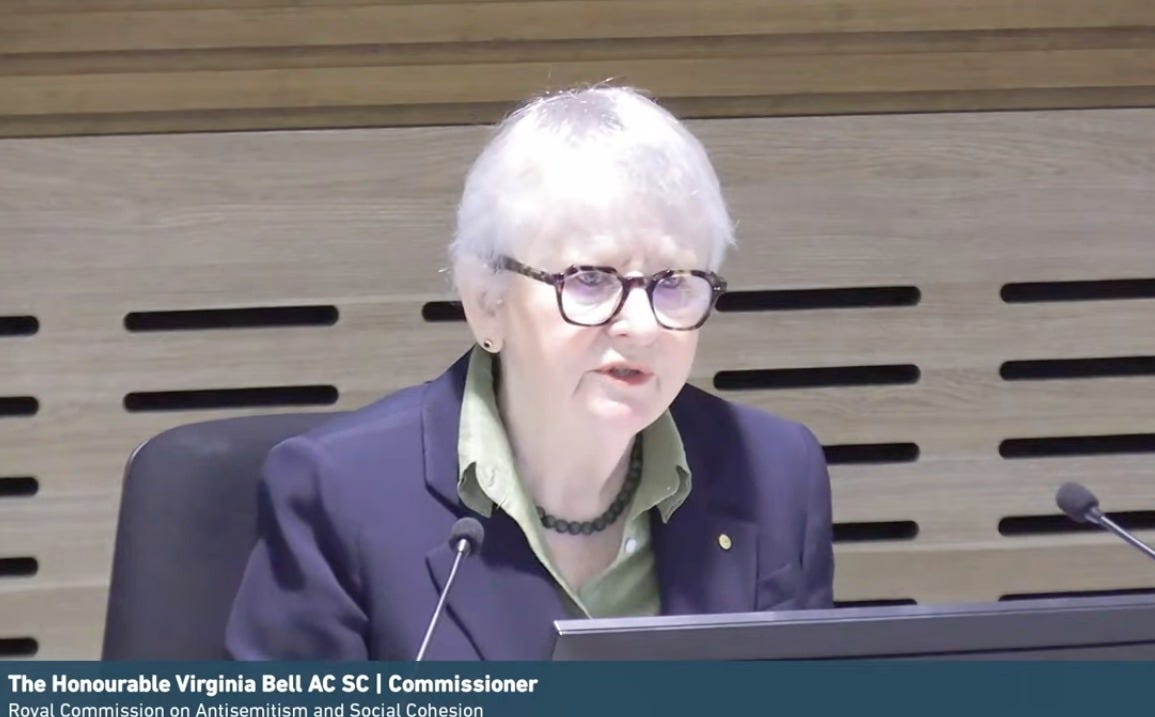
On day one, before any evidence had been led or produced to the Royal Commission, Commissioner Virginia Bell pronounced that she was going to follow the IHRA definition of antisemitism
Bell did acknowledge that at least some parts of the definition were “contentious”.
The IHRA states:
“Antisemitism is a certain perception of
Jews, which may be expressed as hatred toward Jews. Rhetorical and physical manifestations of antisemitism are directed toward Jewish or non-Jewish individuals and/or their property, toward Jewish community institutions and religious facilities.”
One need not be a lawyer to see that this so-called definition is so wide that it is possible to drive a truck through it. It is noteworthy that the principal draftsman of the definition has expressed his concern about the “McCarthy-like” use of the definition and that it has been “weaponised” by right-wing Jews “to suppress – rather than answer – political speech”.
World-renowned human rights lawyer, Geoffrey Robertson KC, says this of the IHRA definition:
“The definition of antisemitism adopted by the government is not fit for purpose. The definition does not cover the most insidious forms of hostility to Jewish people and the looseness of the definition is liable to chill legitimate criticisms of the state of Israel and coverage of human rights abuses against Palestinians.”
It is of grave concern that as a lawyer, and ultimately a justice of the High Court, Commissioner Bell – without having heard any evidence or submissions (or even, seemingly, without consulting known experts on antisemitism) – from the get-go so readily adopted the IHRA definition.
An alternative antisemitism definition
Some 200 world-wide renowned scholars on the Holocaust and antisemitism have trenchantly criticised the IHRA definition and put forward their own, the Jerusalem Declaration of Antisemitism (JDA).
So far as relevant here, the JDA definition is very simply:
“Antisemitism is discrimination, prejudice, hostility or violence against Jews as Jews (or Jewish institutions as Jewish).”
One would have hoped – nay, expected! – Commissioner Bell to have been made aware of JDA. In fact, it would have been incumbent on Jillian Segal, the antisemitism envoy, to have brought it to the attention of the Royal Commission. One has to conclude that she did not.
Counsel assisting the Commission would also have been remiss (negligent?) if they did not bring the JDA to Bell’s attention. With the appointment of Segal – a person with absolutely no background in the study of antisemitism – the federal government put in place a former president of the Executive Council of Australian Jewry (ECAJ), a one-time chairwoman of the Australia-Israel Chamber of Commerce and member of pro-Israel lobby groups, whose views are openly and clear pro-Israeli.
ECAJ is the shrillest voice advocating for Israel, no-matter-what. One might even deduce from what is known of Segal and her background, and what she says, writes and advises the federal government, that her views are to the far right.
Public opinion can’t be ignored
What antisemitism is as distinct from speaking out against Israel – a distinction which the larger part of the Australian Jewish community either wilfully ignores or simply doesn’t understand – becomes relevant especially in the context of the ongoing Royal Commission.
The renowned and highly regarded Pew Research Center this year determined that:
“Across the 36 countries, a median of 67% of adults have an unfavourable view of Israel, whilst 25% have a favourable view.”
As the Jewish Independent reported:
“Australians rank among the world’s most critical populations when it comes to views of Israel and Israeli Prime Minister Benjamin Netanyahu … Australia sits towards the most critical end of the spectrum with 79 per cent of respondents expressing an unfavourable view.”
Commissioner Bell will, one hopes, need to consider how Australians view Israel as she assesses what true antisemitism as distinct from being anti-Israel is. Contrary to what ECAJ asserts, a daubing of “Free Palestine” is not antisemitic. Nor is a march across Sydney Harbour Bridge by some 300,000 people under the banner “March for Humanity” – even if Segal falsely claims it is.
It’s troubling that the Commission has determined that people who have attended weekly marches outraged by Israel’s atrocities in Gaza, and could give authoritative evidence about said marches, have been deemed “not relevant” to the Commission’s considerations.
Segal’s IHRA war-path
As the Royal Commission has unfolded, a number of things have emerged. Many Jews are said to feel “uncomfortable” and threatened by seeing things like posters or daubings saying “Free Palestine” – or even seeing news footage from Gaza in an elevator showing TV News.
Significantly, and obviously, the usual, and now tiresome, communal Jewish leaders have clearly gone on the front foot by highlighting what is claimed to be widespread antisemitism in Australia (ridiculously, Segal even describes it as “rampant”) as a means of deflecting from any discussion about Israel’s actions in Gaza, the “war” in Lebanon and the Israeli government’s sanctioning of violence in the West Bank.
Leaving to one side whether it is even part of Segal’s remit, emboldened by Commissioner’s Bell’s adoption of the IHRA definition, Segal, in conjunction with many in the Jewish community has embarked on ensuring that the IHRA definition is readily adopted Australia-wide and that Israel is not viewed as negative by Aussies.
For example, Segal has recommended the definition be adopted by “all levels of government, public institutions and regulatory bodies”.
Without the Royal Commissioner having made any pronouncement about what she regards as antisemitism, Segal’s actions are troubling in this space when seen in the context, for example, of the Gandel Foundation’s (yes, that well known very vocal and substantial financial supporter of Israel) sponsoring The Yad Vashem Holocaust Studies Teacher Training Program for Australian Educators.
It is “no more than a tool used to indoctrinate educators and students under the guise of Holocaust Studies in what is clearly a state vision”.
If support exists for the Commission to duly and appropriately considering what constitutes antisemitism and how, as it should, the JDA defines it, a very recent decision by Justice Fagan in the NSW Supreme Court is a good example of the care which needs to be taken in establishing what antisemitism actually is.
The judge rejected a bid to place a young Sydney man under a terrorism supervision order, finding prosecutors wrongly conflated hostility towards Israel with hatred of Jewish people in assessing whether he posed a future terrorism risk. As reported by Deepcut:
‘The prosecution argued that Farhat’s attendance at a pro-Palestine march was evidence of nefarious intent.
“You do realise that hundreds of thousands of Australian people have attended protests against Israel’s bombing and destruction of Gaza,” Fagan replied.
‘The prosecutor submitted that targeting areas with large Jewish populations transformed the offending from political protest into antisemitic conduct. Justice Fagan challenged that, urging the state to distinguish between the political content of a message and the unlawful way it was expressed.’
So should Commissioner Bell.
I’m.. genuinely hoping that Commissioner Bell is being strategic in applying the IHRA definition, and allowing the RC to unfold as it has. She’s laying it out as a Zionist would want it: their framework; the loudest, hurtiest feelings upfront and uncontested - but then after that comes the interrogation. As can be seen in the last week or two, many of the heads of Zionist orgs are explicitly presenting themselves as people who don’t care about the wellbeing of others - in Palestine, or those in Australia. Bell spoke to that when APANs counsel encountered Islamophobic abuse. And the hollowness of the complaints is being shown, highlighted etc - and the position of those who care about human rights only made stronger by recent court findings. Fingers crossed at the end that IHRA etc ends up being the stick to make the point: “we did as you asked. But you were still wrong”. And hopefully the damage can be wound back.
But will she?
Albanese does not care as long as he removed this issue from the front pages.
Judges don’t seem to have a consistent approach to this matter either , comparing justice Fagan’s decision to the decision in the Gilham case.
Nobody seems to be the advocate for basic human rights in this royal commission; which obviously would protect ALL of us rather than singling out groups for special treatment- which is what Segal seems to want.