


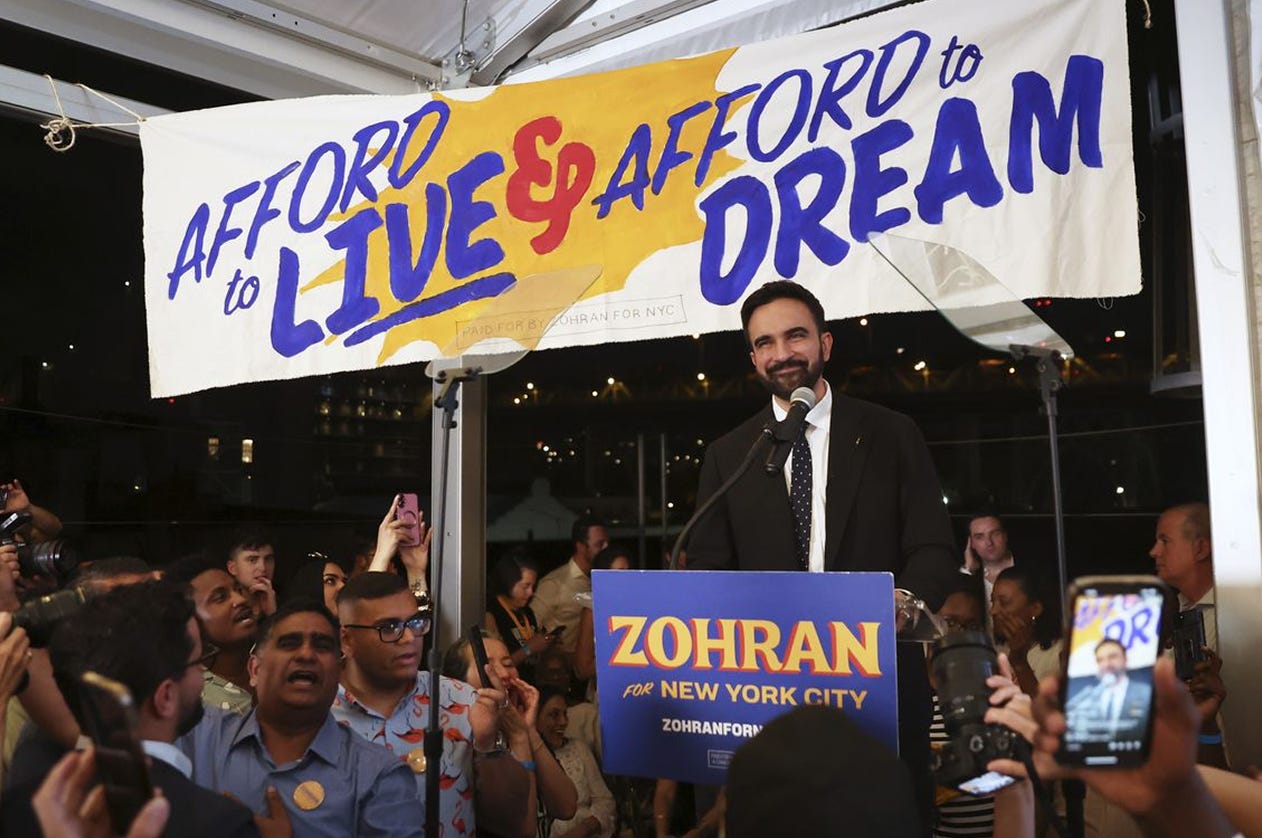
You hear it often in progressive circles: where is Australia’s Zohran Mamdani?
The Democratic Socialist mayor of New York has won hearts worldwide for his unapologetic focus on the cost-of-living crisis, specifically targeting housing, transport and childcare.
Mamdani’s full suite of policies can be found on his Promises Tracker, which shows three out of 100 completed since coming to office, with 18 underway. A First 100 Days website tracked his actions from January 1 to April 10, giving some idea of his priorities.
Australia doesn’t have a position quite like the NYC mayorship, which possesses powers well beyond our local councils (although it’s also worth noting that several of his policies do rely on state funding, which he has had to lobby for). We do however have some politicians pursuing similar goals at the local, state and federal level, to varying degrees of success.
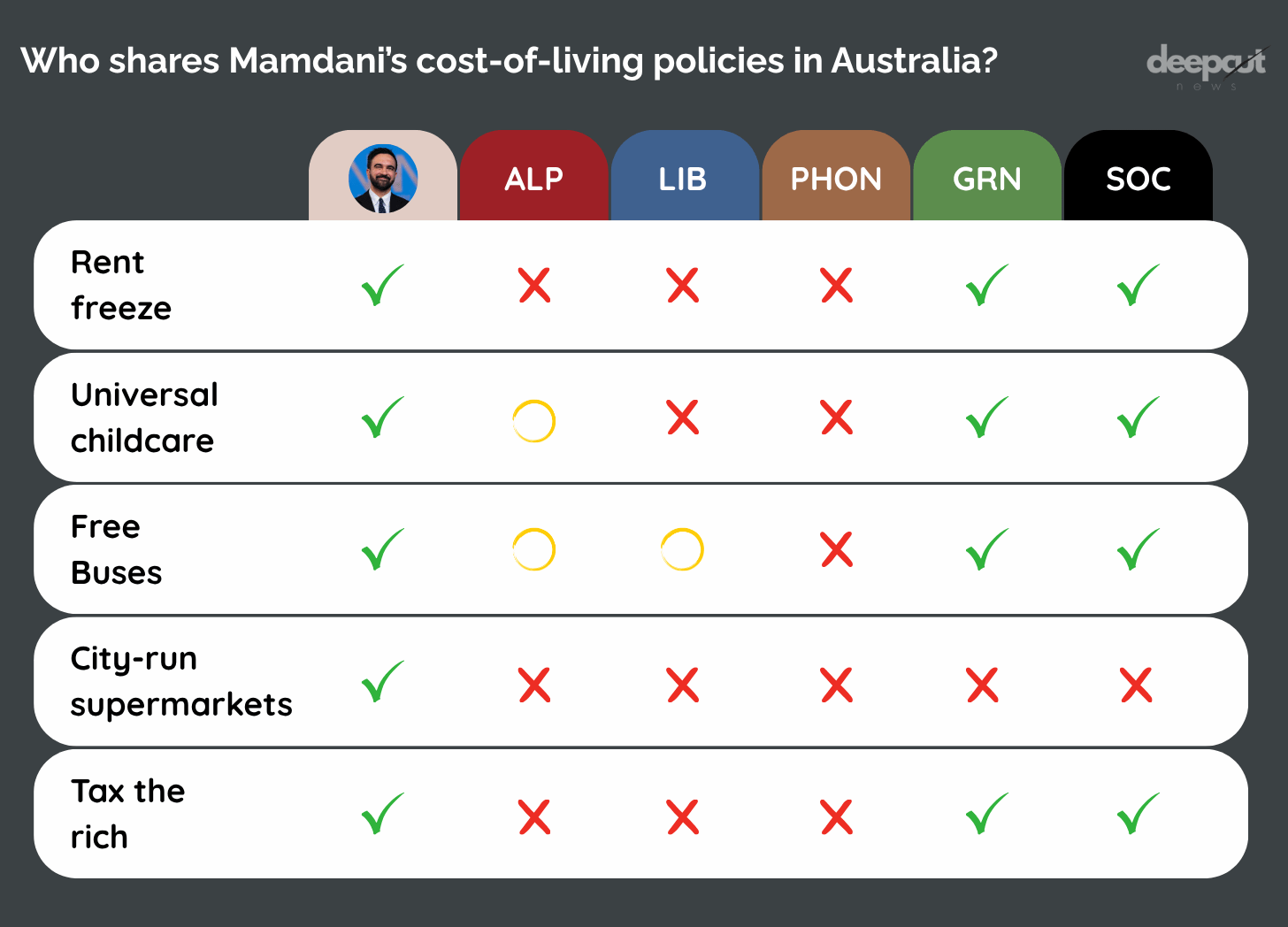
Here are a few of Mamdani’s signature policies, and their equivalents in Australia.
Affordable rents
During his campaign, Mamdani pledged to freeze rents for NYC’s one million rent-controlled units (the mayor is able to appoint members to the city board that makes such determinations). He fulfilled the former on June 25, when the Rent Guidelines Board approved zero percent increases for one- and two-year leases for rent-stabilised dwellings.
What does the Australian public say?
Regulating rents is popular in Australia; a 2023 Australia Institute poll showed three in four Australians back rent caps (limiting increases), while Essential data from the same year showed 60% supported a rent freeze (preventing increases for a set time period).
What do our politicians say?
The Australian Greens regularly call for widespread rent freezes, most recently in response to the fuel crisis. Former housing spokesperson Max Chandler-Mather often demanded one in negotiations with Labor, though this was dismissed as being outside the federal government’s purview (Chandler-Mather argued that the Commonwealth could coordinate state and territory freezes). South Australian Greens MLC Robert Simms recently renewed calls for one in his state, after last year proposing a two-year freeze, while the NSW Greens are now campaigning for rent controls, including caps.
It’s worth noting that the Victorian, Tasmanian, SA and WA governments all froze rents at various points in the pandemic, though there has been little appetite from the major parties in the years since.
One Nation does not support rent caps or freezes, vehemently opposing a Greens push in 2022. Their cost-of-living policies do not mention rents, with their main focus on reducing demand by cutting immigration.
Universal childcare
Mamdani pledged to make childcare free for all children aged six weeks to five years — a pledge which, as the Promise Tracker notes, requires state action. Early state funding commitments allowed his administration to roll out free care for 2-year-olds in low-income areas, with goals to expand the program over four years.
What does the Australian public say?
Recent polling on the idea is hard to come by, though a 2021 Australia Institute poll found that 59% of Australians support reintroducing free and universal childcare.
What do our politicians say?
Federal Labor came to office with a focus on “Cheaper Childcare”, pledging to increase various subsidies; RMIT’s promise tracker gave this a tick in 2023. More recently, the government asked Deloitte to investigate pathways to universal care, which Anthony Albanese has said he would like to be his legacy. As the Australia Institute notes, it won’t be universal care if the government continues to subsidise costly private providers, who can simply increase their fees.
The Greens believe that childcare should be “free, universally accessible and publicly funded,” though it doesn’t appear to be something they are actively campaigning for, while the Victorian Socialists argue for the same.
One Nation wants to reduce government funding for childcare (as well as opposing paid parental leave), and has a family income-splitting policy aimed at encouraging one parent to stay home. The Liberal Party, meanwhile, focuses on “parental choice”, regularly pushing for subsidies to be expanded to include nannies and grandparents.
Free buses
Mamdani has promised to eliminate bus fares, building on a pilot that made five routes fare-free. The $800 million policy has not yet been started according to Promise Tracker, although a separate pledge to expand priority bus lanes to reduce travel times is underway.
What does the Australian public say?
A recent poll showed 78% of respondents back free public transport during “cost shocks”, even if they wouldn’t use it themselves. Numbers on ongoing free PT are harder to come by, though many experts acknowledge it is “popular”, even as they argue money would be better spent on improving services.
What do our politicians say?
The Victorian Labor and Tasmanian Liberal governments recently introduced free public transport in response to the fuel crisis, although sadly there are no plans to make this permanent. Other states were all quick to rule out the idea, although Queensland’s outgoing Labor government did introduce 50c fares in 2024, a popular policy the LNP opposition pledged to keep.
The Greens, who initially pushed for the 50c fares in Queensland, have campaigned for it to be rolled out nationwide, while independent Senator David Pocock and the Greens each called for free nationwide public transport during the fuel crisis. Socialist Alliance and the Victorian Socialists argue all public transport should be free, permanently.
One Nation does not have formal public transport policies, though its South Australian MPs recently voted against a Greens bid to make PT free during periods of fuel rationing.
City-run grocery stores
One of Mamdani’s most socialist policies calls for city-owned and run grocery stores, which would aim to keep costs low as they would not need to turn a profit. This promise is in progress, with a planned pilot network (one in each borough) to cost about $60 million.
What does the Australian public say?
This idea hasn’t been polled in Australia, but public sentiment towards the major supermarkets is overwhelmingly negative: 79% believe they are price gouging according to a recent poll, while 83% said in 2024 that supermarkets deserved some blame for the cost of living crisis, with trust in Coles and Woolworths now at record lows.
What do our politicians say?
No one currently appears to be proposing government-run supermarkets in Australia, although the Victorian Socialists’ cost-of-living policies come close, including putting price caps on essential items sold in supermarkets. The Greens have long called for stronger divestiture powers to break up the big supermarkets if they misuse their market power, as well as pushing to make price gouging illegal.
The Albanese government recently outlawed price gouging, banning major supermarkets from charging “excessive” prices for a grocery product – a rule to be enforced by the ACCC. But the prime minister dismissed calls to break up the supermarkets.
One Nation and the Coalition also talk about “cracking down” on the duopoly, with the latter going to the last election promising divestiture powers as a “last resort”.
Taxing the rich
Mamdani vowed to fund his promises by raising corporate taxes, and introducing a “City Millionaire Tax” of 2% tax on incomes over $1 million — both of which are “in progress”. He also announced a new tax on second homes above $1 million, which has since been passed by the state legislature.
What does the Australian public say?
Polling conducted for Oxfam in 2025 shows 72% of Australians support the introduction of a wealth tax on billionaires and the super-rich.
What do our politicians say?
The Greens have previously proposed various forms of wealth taxes to fund their pledges, with a current campaign to tax the wealth of the top 1%. The Victorian Greens will go to November’s state election promising a new land tax on investments worth more than $5 million, inspired in part by Mamdani’s policies.
The Victorian Socialists, unsurprisingly, go further, with calls for a 10% wealth tax on billionaires, a 90% marginal tax rate on income over $300,000 pa, and a company tax of 50%.
Some Labor members pushed for a billionaire tax to be on the agenda at last week’s ALP National Conference, building on recent changes to negative gearing and capital gains tax. Albanese, however, cautioned against an “anti-wealth sentiment”, arguing Labor stands for “equality of opportunity,” not “equality of outcomes.”
Coalition and One Nation are vehemently opposed to wealth taxes, having both fought against Labor’s recent increases to taxes on passive income.
Listen to the latest episode of Deepthink – an hour-long talk with Palestinian scholar and author Tareq Baconi on the trauma of ethnic cleansing, growing up queer in Amman and why the Palestinian struggle is feminist.

So Albanese says Labor stands for “equality of opportunity,” not “equality of outcomes.” Does the guy realise what a dipshit he sounds like, spouting slogans like that one? Nobody is talking about equality of outcomes. We just want the system to be a little fairer.
Lately, I have been asking myself, Do we have an Ossoff, Buttigeig, Mamdani or Beto? Brilliant communicators who can inspire people to stop and listen and care, and do it in a way that they and their supporters can package up meaningful videos for social media use. If we can't get voters to engage with politics, how will they ever know who has a suite of policies they would like to vote for and who has the chops to deliver on their promises?
We certainly have a Trump, and just like the run up to the last presidential election, we also have a lot of people willing to listen, believe and support, and amongst those are people she is openly and loudly signalling she will harm.