


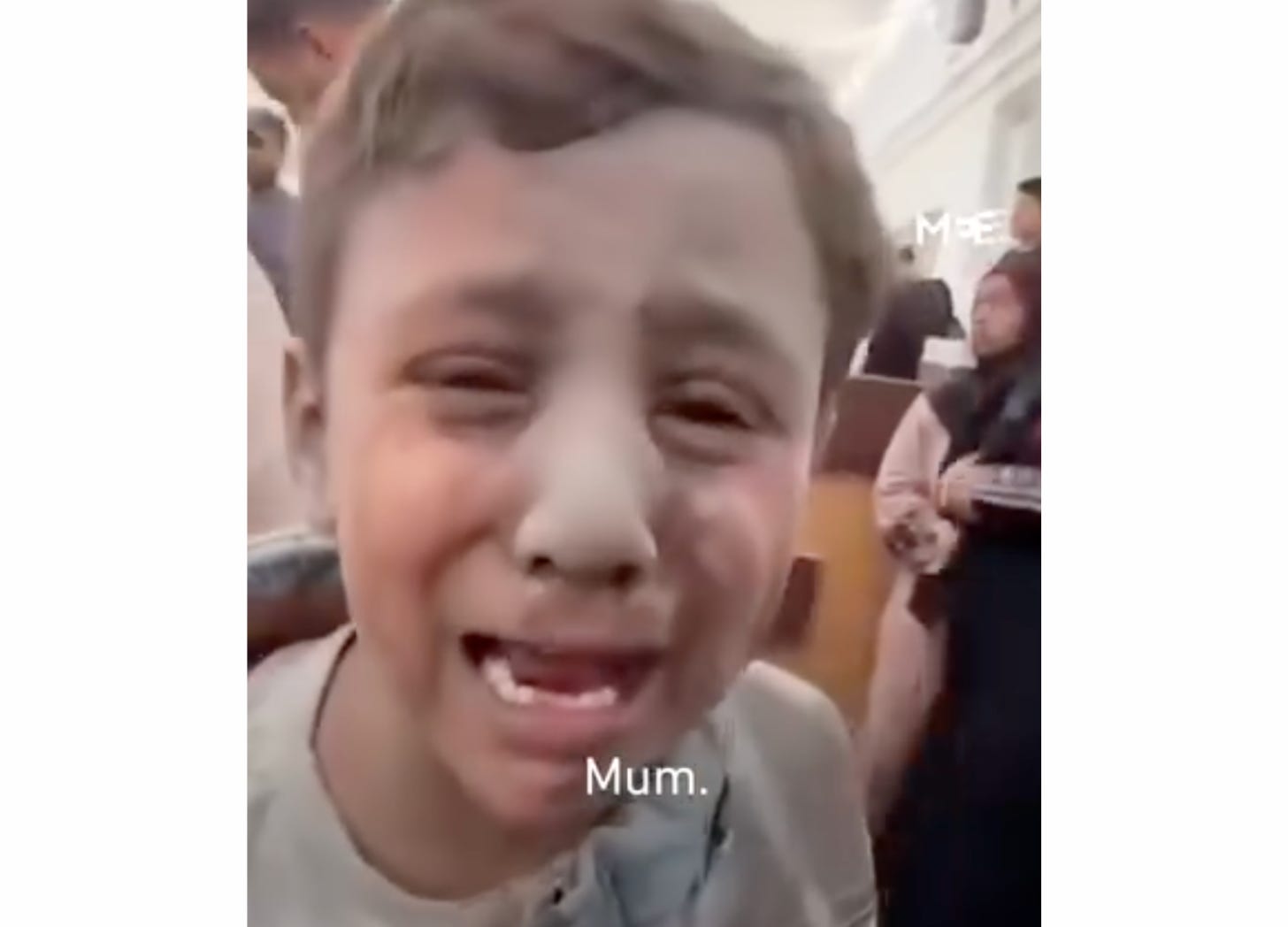
More than 500 Australian doctors and medical students, including a Nobel laureate, have signed an open letter calling on the federal government to “move from statements of concern to action” regarding Israel’s genocide in Gaza.
The signatories – 86 per cent of whom are verified doctors spanning physicians, surgeons and psychiatrists – say they are “legally and morally compelled to protect any child suspected to be at risk of harm or neglect”.
“We cannot remain silent while Palestinian children are being starved, maimed and killed by the actions of Israeli authorities and military forces,” the letter reads (the full letter is published beneath the article).
The open letter is an act of defiance against AHPRA’s – the health sector regulator’s – decision to adopt the controversial IHRA definition of antisemitism in June.
The definition has been roundly condemned as overreach into the realm of free political speech as it includes criticism of Israel and Zionism – a supremacist political ideology. The NSW Supreme Court last month rubbished the IHRA definition as “detached from reality”.
Instead of acquiescing to AHPRA’s attempt to chill expressions of solidarity with the Palestinians, the signatories called on “peak bodies to speak without equivocation in defence of Palestinian children, patients and healthcare workers”.
Health advocacy is ‘core business’
Dr Ruth Mitchell is a neurosurgeon in Sydney and Australia’s first recipient of the Nobel Peace Prize in 2017 for her campaign work to abolish nuclear weapons.
Mitchell volunteered in Gaza in April this year, where she says she saw the “disproportionate impact of the genocide on children and young people … the way in which it’s destroyed the health of children, left them without limbs, left most of them living in tents”.
Although the development of the open letter was underway before AHPRA shocked the industry with its IHRA adoption, Mitchell says the letter will “reclaim the ground” for health professionals.
“Health advocacy is not an added bonus. It’s not discretionary. It’s actually core business,” she told Deepcut, adding that health advocacy is a core competency taught to trainees.
Dr Nadia Hasan, a paediatrician and co-author of the open letter, agrees.
“I hope this letter reminds medical professional bodies and healthcare institutions that this is not an issue that can or should be ignored, that we have an obligation as doctors to advocate,” she says.
AHPRA decision ‘highly irregular’
AHPRA did not consult its more than 960,000 health practitioners when its chief executive, Justin Untersteiner, publicly announced the IHRA adoption, which Mitchell says was “deeply unusual”.
“When this came out, I became aware of it through posts on social media, not from any correspondence from my medical board or from the health regulator,” the Nobel laureate says.
AHPRA normally consults practitioners on significant regulatory decisions, Mitchell says.
“Not seeing any whiff or whisper of consultation on something of this gravity and magnitude, it’s a real outlier. It’s highly irregular. And it’s not the way that AHPRA has done business in the past,” she says.
Mitchell adds that AHPRA’s decision “doesn’t have the feeling of legitimacy because of the way that it was brought about without consultation”.
“And I think we’re aware that there are various ways in which this is likely to be interrogated in the courts and elsewhere as it should be,” she says.
AHPRA’s free speech crackdown
When asked whether AHPRA would reconsider its adoption of the IHRA definition in light of the NSW Supreme Court ruling, why it didn’t consult its profession before making the decision, and whether it would take disciplinary action against practitioners critical of Israel, a spokesperson said:
“AHPRA is committed to free speech and the right of registered health practitioners to enter into professional and public debates. AHPRA is equally committed to the prevention of the harm caused by racism and discrimination.”
The spokesperson directed Deepcut to a page that lists examples where AHPRA might take action against practitioners, raising doubts over its professed commitment to free speech.
The AHPRA examples include potentially targeting practitioners who “call to action, such as signing a petition or attending a protest march, specifically aimed at denigrating or discriminating against a population or group”. It also warns against sharing “intentionally misleading content about citizens of a country, or a cultural or religious identity that is biased”, without defining what would classify as misleading or biased.
Given AHPRA’s adoption of the IHRA definition – which includes criticism of Israel and Zionism – AHPRA’s examples suggest the regulator could target practitioners who condemn Israel’s atrocities.
Deepcut asked whether labelling Israel’s actions in Gaza as a “genocide” would invite disciplinary action, to which the spokesperson replied:
“If commentary becomes demeaning or denigrating and directed toward specific members of the community, this is where AHPRA and the National Boards might undertake regulatory action.”
Gaza remains the focus
Health professionals have a unique role in public advocacy because they “are seen as trustworthy by society”, Hasan says.
“We don’t usually have financial or political interests at heart – we genuinely care about humanity.”
Beyond the moral compulsion, healthcare workers understand better than most the long-term health implications and acute medical needs required to support populations devastated by war.
“Hospitals, homes, educational institutions, and essential infrastructure have been destroyed [in Gaza]. Malnutrition, homelessness, mental and physical trauma, lack of access to clean water, lack of education, lack of access to healthcare all have long-term consequences,” Hasan says, pointing to a line in the open letter.
“When children are being killed, starved and maimed, silence from our profession is not neutrality. It is a failure of our ethical obligations,” the line reads.
The open letter published in full.
Children Are Being Killed, Starved And Maimed In Gaza. As Doctors, We Will Not Be Silent.
We are Australian physicians, surgeons and psychiatrists. We are dedicated to the service of humanity and have pledged to care for our patients with justice, dignity, and without discrimination. We recognise the special vulnerability and innocence of children, and the unwavering obligation of all in positions of power to care for them.
We are legally and morally compelled to protect any child suspected to be at risk of harm or neglect, and to report concerns immediately. That duty does not end at our borders. We cannot remain silent while Palestinian children are being starved, maimed and killed by the actions of Israeli authorities and military forces.
What has been happening to the children of Gaza is indefensible. It demands that we speak and compels us to act.
The Scale of Killing
In June 2026, the United Nations Independent International Commission of Inquiry released its report, “The essence of childhood has been destroyed: Israel’s deliberate targeting of Palestinian children in the Occupied Palestinian Territory since 7 October 2023.” The Commission found that Israeli authorities and security forces continue to commit genocide and war crimes by deliberately inflicting death and severe physical and mental harm on Palestinian children. It concluded that these acts form part of a deliberate strategy to destroy the future of Palestinians by targeting their children.
Chris Sidoti, an Australian expert in international human rights law and Commissioner on the inquiry stated that “every international legal norm has been violated by the actions of the Israeli authorities towards Palestinian children, and they need to be held accountable.”
Since 7 October 2023, the Commission reported that more than 20,000 Palestinian children have been killed and 44,000 injured. It described mass trauma, orphanhood, disability, repeated displacement, starvation, and the collapse of education and healthcare. It also detailed the destruction of health infrastructure on which children, newborns and pregnant women depend, finding that children have been killed both directly by military attacks and indirectly through the destruction of schools, hospitals and essential services. As UNICEF’s James Elder said, “These children were not killed in a war zone. They were killed in their homes. In their schools. While playing football. While fishing. They were shot, bombed and targeted by drones.”
These findings are consistent with converging public health evidence. A peer reviewed population survey published in The Lancet Global Health estimated 75,200 violent deaths in Gaza between 7 October 2023 and 5 January 2025. Women, children and older people comprised 56.2 per cent of those killed violently. Separate research published in The Lancet calculated more than 3 million life years lost, including more than 1 million life years among children under 15.
The Largest Cohort of Child Amputees in Modern History
As medical professionals, it sickens us to see our disciplines converge in ways they never should. The WHO estimates that around 43,000 people in Gaza have sustained life-changing injuries since October 2023, up to a quarter of them children. These are not statistics to us: they are major limb injuries, traumatic amputations, spinal cord injuries, burns and shattered skulls. Save the Children reported that, in the first three months of the war, more than ten children a day on average lost one or both legs, and UNICEF has documented over 1,000 children enduring amputations. Gaza now holds the highest rate of child amputees per capita anywhere on earth.
For these children, the injury is only the beginning. Several of our authors have worked in Gaza and witnessed this firsthand: wasted bodies cannot mount the metabolic response that healing demands. Wounds fail to close, surgical sites break down, and infection takes hold in patients with no physiological reserve to resist it. Malnutrition turns survivable injuries into fatal ones.
The WHO estimates that more than 50,000 conflict-related injuries in Gaza require long-term rehabilitation, yet rehabilitation services have been all but destroyed. Of 2,300 people with amputated limbs assessed between September 2024 and May 2026, fewer than a quarter had received permanent prosthetics. Between May 2024 and mid-April 2026, no rehabilitation equipment entered Gaza at all. Here too the world has failed them, unable to deliver even the most basic prostheses, orthoses or rehabilitative care.
Starvation as a Weapon
In August 2025, famine was officially confirmed in Gaza City. That month, UNICEF reported that 12,800 children across the Gaza Strip were identified as acutely malnourished, with one in five children screened in Gaza City diagnosed with acute malnutrition.
The Integrated Food Security Phase Classification, known as the IPC, later reported some improvement after the October 2025 ceasefire but warned that conditions remained severe. Save the Children’s analysis of IPC data found that four out of five children in Gaza would enter 2026 still facing crisis levels of hunger. Through mid-October 2026, the IPC projects that nearly 101,000 children aged 6 to 59 months across Gaza will suffer acute malnutrition and require treatment, including more than 31,000 severe cases. A further 37,000 pregnant and breastfeeding women are also expected to require treatment for acute malnutrition. UNICEF has reported that one in five babies in Gaza is being born prematurely or underweight.
For many children, even the search for food has become deadly. During humanitarian missions to Gaza in 2025, two of our authors treated multiple children who had been shot at aid distribution sites, many of whom succumbed to their injuries. One was nine-year-old Majed. A bullet fired by Israeli forces tore through his left arm, left lung and spleen. Despite the efforts of the surgical team, he bled to death on the operating table.
Starvation, when deliberately caused or sustained through the obstruction of humanitarian aid by state or military policy, is not a side effect of war. It is a weapon, and its primary victims are children.
The Trauma That Will Outlast the Bombs
The harm being inflicted on Gaza’s children by Israeli authorities is not only written on their bodies. Armed conflict, forced displacement, bereavement, starvation and traumatic injury leave scars just as deep and far harder to see. Even before October 2023, Palestinian children exposed to political violence suffered high rates of post-traumatic stress, depression and anxiety. What they are enduring now is of another order entirely.
Displaced children in Gaza are reported to have extraordinary levels of trauma exposure, PTSD symptoms and psychosocial distress, compounded by hunger, repeated displacement, the loss of home and schooling, and the injury or death of those they love. They are presenting with nightmares, insomnia, emotional dysregulation, social withdrawal, behavioural disturbance and a despair no child should ever know. UNICEF estimates that almost all of Gaza’s 1.2 million children now require mental health and psychosocial support.
This is not distress that will simply resolve when the bombing ends. It is a mental health catastrophe unfolding alongside the physical destruction, and its consequences will include lifelong psychiatric morbidity, developmental disruption, complicated grief and intergenerational trauma.
We Would Never Accept This Here
We would not tolerate Australian newborns denied formula in their hospitals, our schools reduced to rubble, or our children left to die beneath it. We would not accept a single Australian child shot by soldiers, starved by blockade, orphaned by military assault, or torn apart by explosive weapons.
Yet this is what Palestinian children in Gaza are being forced to endure. The Commission reported that, even after the October 2025 ceasefire, Palestinian children have continued to be killed and seriously wounded by Israeli military forces. Since then, at least 265 children have been killed, an average of one child every day.
If these were Australian children, our nation would be united in grief and outrage, and we would demand protection, accountability and justice. We cannot value Palestinian children any less. Their lives are worth no less, their pain is no less real, and their right to safety, care, food, shelter and a future is no less absolute.
This is not only a matter of conscience; it is a matter of law. The Convention on the Rights of the Child guarantees every child’s right to life (Article 6), to health and healthcare (Article 24), and to protection in armed conflict (Article 38). These obligations are not optional. They apply to every child, in every war, without exception.
What Must Happen
We call on the Australian Government and Parliament to:
move from statements of concern to action, using every diplomatic and legal mechanism to compel an immediate and permanent end to the killing and to protect children, civilians and healthcare workers;
undertake a full review of Australia’s diplomatic, trade and defence relations with Israel, and immediately impose a comprehensive arms embargo, ending all defence-related trade including dual-use products, components and technology, so that no Australian support can enable violations of international humanitarian law;
demand that Israeli authorities lift the blockade and allow the unobstructed entry of food, medicine and humanitarian and medical supplies;
pursue accountability through the International Court of Justice, the International Criminal Court and targeted sanctions, and press for the immediate release of detained Palestinian healthcare workers, including paediatrician Dr Hussam Abu Safiya, held without charge;
fund paediatric medical evacuations, surgical and rehabilitative care, prosthetics, and long-term mental health support for Palestinian children and families;
support international efforts to rebuild the homes, hospitals, schools and essential infrastructure children depend on, and to restore the land, water and environment devastated by the conflict.
We call on the Australian Medical Association, medical colleges, specialist societies, doctors’ unions and health sector peak bodies to speak without equivocation in defence of Palestinian children, patients and healthcare workers. When children are being killed, starved and maimed, silence from our profession is not neutrality. It is a failure of our ethical obligations.
We do not need future memorials to tell us what we know today. We need action now, to stop the killing, protect children and save lives while lives remain to be saved. History will remember where we stood. As doctors, and as human beings, we choose to stand with children, civilians and healthcare workers facing catastrophic harm. We call on every Australian, and every person of conscience, to do the same.
Authored by:
A/Professor Vikram Palit, FRACP (Paediatric Respiratory Physician)
Dr Stephen Parnis FACEM FAMA (Emergency Physician)
Professor Jon Jureidini, FRANZCP (Child and Adolescent Psychiatrist)
Dr Nadia Hasan, FRACP (General Paediatrician)
Dr Bushra Othman, FRACS (General Surgeon)
Dr Rasha Rahman, FRANZCP (Psychiatrist)
Dr Safiyyah Abbas, FRACP, FAFRM (Paediatric Rehabilitation Physician)
A/Professor Tarik Sammour, CSSANZ (Colorectal Surgeon)
Dr Ruth Mitchell FRACS FFSTEd FNNSA (Paediatric and Adult Neurosurgeon)
Dr Hemal Kodikara, FRACS (Paediatric General Surgeon)
A/Professor Alasdair Vance, FRANZCP (Child and Adolescent Psychiatrist)
Dr Geraldine M Dyer FRANZCP (Child and Adolescent Psychiatrist)
Such a powerful letter to our government. This is the sort of action I've been waiting to see. Congratulations to these doctors for doing the thing that the majority of Australians know is right!
Keep going and growing!