



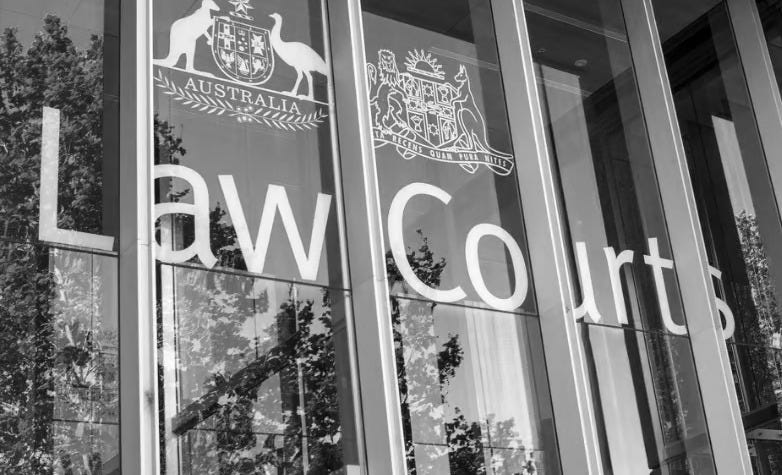
A NSW Supreme Court judge has delivered a sweeping rejection of the International Holocaust Remembrance Alliance’s definition of antisemitism, labelling it “verbose and imprecise”.
Justice Desmond Fagan’s initial criticism of the definition came in a decision rejecting the NSW government’s bid to place a young Sydney man under a terrorism supervision order, after finding prosecutors had failed to establish that his vandalism was evidence of a future terrorism risk.
But in the judgment, to be published today, Fagan went considerably further, taking aim at the IHRA definition itself and questioning its use as a guide to whether political language directed at Israel should be regarded as antisemitic.
The pro-Israel lobby, spearheaded by antisemitism envoy Jillian Segal, is pushing for the integration of the IHRA definition across all government levels, the media and education.
The Albanese government acquiesced to the lobby’s demands following the Bondi massacre, and has been steadily rolling it out across the public service while funding Segal’s initiatives to embed the IHRA definition within education.
IHRA ‘detached from reality’
The NSW Supreme Court decision is the latest setback to the lobby’s attempts to stifle criticism of Israel, amid widespread disapproval in Australia of Israel over its ongoing genocide in Gaza, its violence in the West Bank, invasion of southern Lebanon and attack on Iran.
Fagan said the IHRA formulation did not reflect the established Australian meaning of antisemitism and described it as an attempt to “repurpose” the term to encompass both hatred of Jews and criticism of Israel.
He said the definition could not realistically be attributed to the ordinary, reasonably informed Australian, adding that “the IHRA proposal is detached from the reality of the common usage and understanding of antisemitism in this country”.
Citing a Pew Research poll in June, Fagan said that “it would be preposterous to suggest that 79% of Australians are antisemitic because they disapprove of Israel’s treatment of the Palestinians”.
He said the IHRA formulation “appears to be an attempt to repurpose the term ‘antisemitism’” as an amalgamated concept encompassing hatred towards Jews and criticism of Israel.
Zionism ‘open to criticism’
Fagan was equally forthcoming with attempts to conflate anti-Zionism with antisemitism.
“As an ideology of Jewish nationalism, Zionism is open to political discussion and criticism, notably on grounds concerning the rights of the Palestinians,” the judgement read.
This appears at odds with Segal’s antisemitism plan, which specifically highlighted anti-Zionism as potentially masking antisemitism as part of its call for IHRA to be adopted.
Fagan delivered a stinging rebuke to such assertions.
“It may well be correct that ‘most, but not all Jewish Australians’ regard Zionism as ‘a core part of their Jewish identity’,” Fagan’s judgement read. “That does not mean that anti-Zionists are hostile to that majority of Jews on account of their Jewishness; only that they hold a negative view of a political ideology with which the majority of Jews have chosen to identify.”
Limit to government power
Fagan was equally dismissive of the proposition that institutional adoption of the IHRA definition had altered the ordinary meaning of the word.
He cited former NSW Supreme Court judge Sir Stephen Spedley, who had criticised the formulation because it “fails the first test of any definition: it is indefinite”.
The fact that governments and several institutions had adopted the IHRA wording did not, Fagan said, “change the established meaning of a word that has been in use in the English language for 150 years”.
Instead, he said, the IHRA formulation “propounds a concept different from that which ‘antisemitism’ has long been understood to describe and appropriates that word to the novel concept”.
There was also a legal limit to the power of government policy, he said.
Parliament could enact legislation giving a familiar term a different statutory meaning. But neither the Commonwealth nor NSW parliament had done so in legislation relevant to this case.
The federal government’s adoption of the IHRA core wording as a policy for Australian Public Service workplaces therefore made no difference to the meaning the court was required to apply, Fagan said.
Promoting rejection of Israel as antisemitic
Fagan’s most pointed criticism concerned the IHRA examples dealing with Israel.
Those examples, he said, were “on the face of them” directed towards bringing within the IHRA definition “criticisms of Israel that could not be regarded as hostile to Jews as Jews”.
The result was what he described as an attempt to attach opposition to Israel to the moral force already carried by the word antisemitism.
“Its tendency, and the apparent purpose of promoting it, is to graft onto the community’s abhorrence of antisemitism, understood as hostility to Jews for their Jewishness, a parasitic rejection of protest against Israel,” Fagan wrote.
That distinction was central to the case.
The prosecution had argued that the Sydney man’s use of anti-Israel slogans, attendance at a pro-Palestinian protest and targeting of areas with large Jewish populations supported a finding of antisemitic motivation.
Fagan rejected the proposition that the political message could be separated from the context in which it was expressed and then treated as evidence of hatred towards Jews.
“You are treating all Jews as monolithic,” he told McDonald during the hearing.
“It’s quite wrong to treat all Jews as supporting Israel, because they don’t.”
Justice Fagan demonstrates more intelligence and commonsense than the entire State and Federal governments. Calling out genocide must never be a crime.
Mic drop for Fagan.