


Richard Flanagan has been described by The Washington Post as ‘one of our greatest living novelists,’ and as ‘among the most versatile writers in the English language’ by The New York Review of Books. He won the Booker Prize for The Narrow Road to the Deep North and the Commonwealth Prize for Gould’s Book of Fish. Question 7 was shortlisted for the Prix Femina étranger and the Prix du meilleur livre étranger as a novel, and won the 2024 Baillie Gifford Prize for Non-Fiction. He is the first and only author to have ever won both the Booker and the Baillie Gifford prizes. His latest book is Heresies, a collection of his non-fiction.
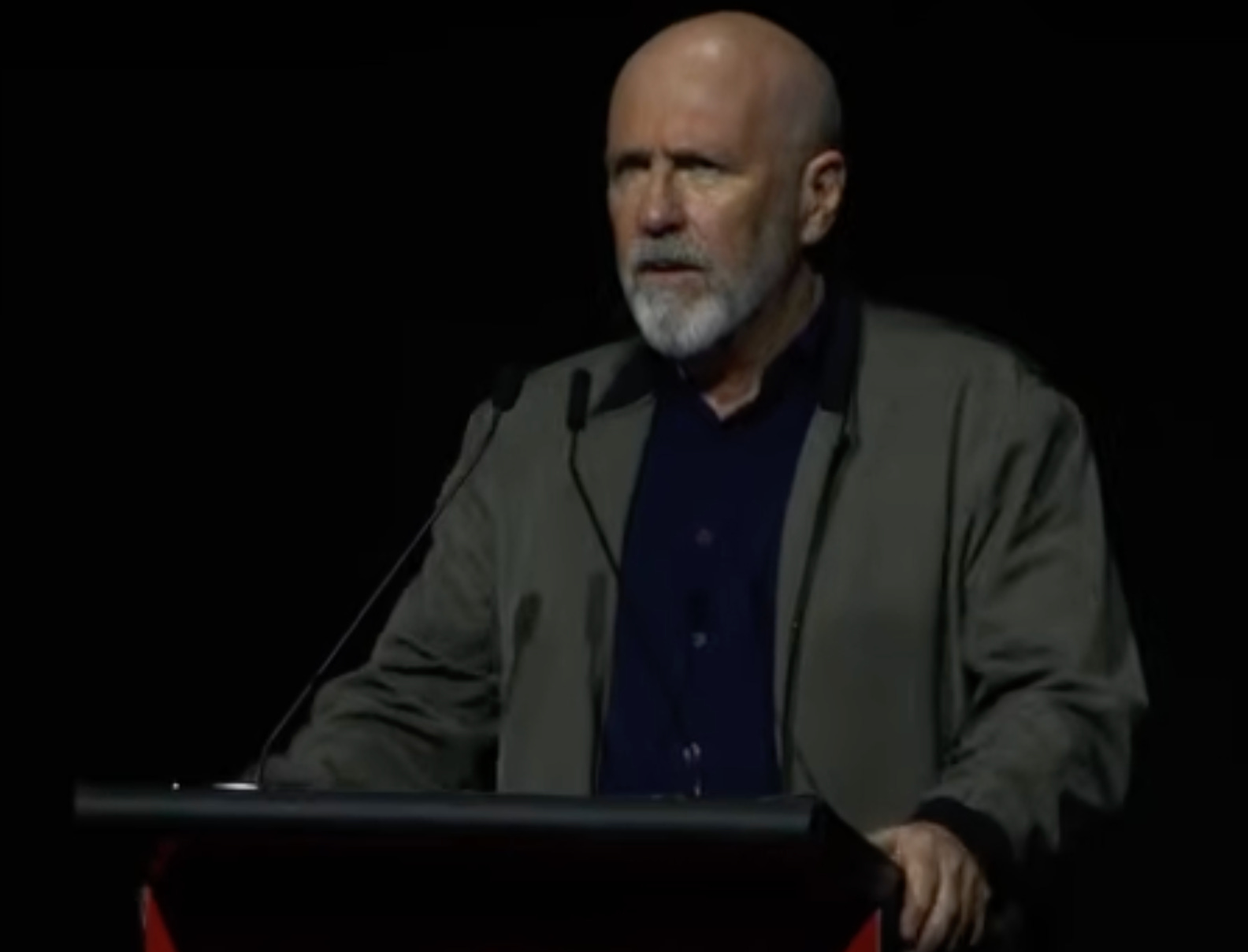
When I set out gathering articles for my new book Heresies I was struck by how certain themes kept recurring. One of the most important was the centrality of freedom of speech and expression. I grew up in Tasmania amidst a great silence about the island’s twin traumas of its origins, a convict slave system and the closest thing to a successful genocide in world history. A shrill, deafening silence. It shaped everything. In a sense it has not simply informed all I have ever written. It is why I write. To name, to point, to bear witness.
I recently came across a story in Haaretz, the last significant opposition newspaper in Israel, which told of a remarkable Israeli called Lee Mordechai[1]. A mediaeval scholar, Mordechai has over the three years of the Gaza war compiled an online report called “Bearing Witness to the Israel-Gaza War“. Referencing thousands of sources, including eyewitness reports, video footage, investigatory materials, articles and photographs, Haaretz described it “as the most methodical and detailed documentation yet of the war crimes that Israel is perpetrating in Gaza”.
“My role as a historian,” Mordechai is quoted as saying, “is to give voice to those who cannot sound their own voices, whether they were eunuchs in the 11th century or children in Gaza.“
The report goes on to describe the unspeakable horrors Mordechai has documented.
Here’s an example: the numerous reports that have come out of Gaza of crying drones: at night IDF drones play the sound of crying babies and screaming women to lure people out of their shelters to help—only to then shoot them.
Here’s another example: the testimony of a distinguished British surgeon who worked in Gaza in 2024 to a British parliamentary committee. Professor Nizam Mamode—and I quote from the BBC report—”broke down as he described children’s accounts of being shot by quadcopters.
“The 62-year-old surgeon told MPs: ‘What I found particularly disturbing was that a bomb would drop, maybe on a crowded, tented area and then the drones would come down.’
“His face shook with emotion as he paused for several seconds to compose himself.” He continued: “The drones would come down and pick off civilians - children. We [were] operating on children who would say: ‘I was lying on the ground after a bomb had dropped and this quadcopter came down and hovered over me and shot me.’“[2]
According to UNICEF, 21,289 children have been killed in Gaza.[3] The World Health Organisation calculated that in 2023 one child was being killed every ten minutes.[4]
Asked which of the thousands of images of horror had had the greatest impact on him, Mordechai spoke of a photo of the body of a 62-year-old man run over by a tank, his body mangled beyond recognition. His hands were ziptied, indicating he was detained when killed.
“I have never in my life seen anything like that,” Lee Mordechai told Haaretz. “But worse than that was the fact that the image was shared by soldiers in an Israeli Telegram group and got very favourable reactions.” The image was captioned: “You’re going to love this!”
Two years ago, I was to travel to Gaza with my friend, the artist Ben Quilty, under the auspices of UNHCR. Our goal was simple—to describe what we saw, heard, smelt and touched with Ben’s drawings and my words. Like Lee Mordechai we saw our work not as taking sides but as bearing witness. The trip fell apart when the sister organisation organising logistics in Gaza, the UNWRA, was banned from Gaza by the Israeli government. Before the ban happened and we were still going, Ben was told a very specific detail by the organisers that we needed to understand: that we would be seen as a legitimate target for killing by the Israeli Defence Force (IDF).
I confess I took that a little personally. But I shouldn’t have. To want to drop a missile on our car, to want to put a bullet through my brain for wanting to do my job or to blow me up or bury me alive or incinerate me, as it has serially murdered so many other journalists in Gaza and now in Lebanon, is nothing other than business as usual for the IDF—acts for which, as Australia learnt last week in the case of aid worker, Zomi Frankcom, Israel absolves its army of any criminal wrongdoing.
According to the Committee to Protect Journalists (CPJ) Israel was responsible for two-thirds of all press killings in the world in both 2024 and 2025. More journalists have been killed in Gaza by the IDF than in all of World War II.[5]
Why would the Israeli state—which claims to be the only democracy in the Middle East—be party to such serial murder of the innocent?
And the answer is very simple: it has to kill every journalist, it has to silence every voice that seeks to bear witness to truth, so that it can keep its own citizens and the world ignorant of the orgy of evil it has visited on the Palestinian people over the last three years in Gaza, and now in the West Bank and in Lebanon. In those countries where a bullet can’t be used, the deadliest slur to throw is that of antisemitism. And Israel is now seeking to silence us here in Australia with just that slur.
This matters—and it matters enormously—for the guarantee of Australian democracy is not to be found in parliament nor with our elected representatives but in freedom of speech and expression and the right to protest.
And these freedoms are now endangered in Australia by the politicisation and weaponisation of the Bondi massacre by what no less a figure than Australia’s former foreign minister, Bob Carr, has described as a foreign influence operation—an operation led by those Carr and many others call the Israel lobby.
The Israel lobby is not the same thing as the Australian Jewish people nor is it composed solely of Jews—ask Chris Minns— while some of Australia’s leading Jewish figures—the likes of Louise Adler, Sarah Schwarz, Antony Lowenstein and David Leser—have spoken out against the Israel lobby and tried to warn their fellow Australians just what is at stake.
There is nothing unusual or necessarily wrong about a lobby group—no doubt the porn industry has one, and Russia has one and so too the United Arab Emirates. But the porn industry is not seeking to limit our right to protest. And neither Russia nor the UAE are seeking to stifle our freedom of speech and threatening to pervert our democracy. Neither Russia nor the UAE is seeking to install oversight committees in every significant arena of Australian public life to ensure that Russia’s criminal acts in the Ukraine war or the UAE’s criminal acts in sponsoring genocidal proxies in the Sudan civil war are never questioned, criticised or truthfully reported.
But these things are just what are being proposed for Australia by the Special Envoy for Antisemitism, Jillian Segal, and her supporters in the staunchly pro-Israel organisations, the Australia/Israel & Jewish Affairs Council; the Zionist Federation of Australia and the Executive Council of Australian Jewry. And these things are happening with the support of a cowed Albanese government, a government with all the spine of a liquorice stick.
The Special Envoy’s initial report last year proved to be too great an overreach, even for the ever-biddable Albanese government, and it was quietly shelved. But then came the horror of the Bondi massacre and with it a renewed attempt by the Israel lobby to use the tragedy to silence discussion around Israel and Gaza.
The history of the last few years was rewritten as the story of a growing antisemitic wave in Australia that culminated in the Bondi massacre. This massacre, it was argued, was the consequence of a government that had done nothing and ignored all warnings about antisemitism. Superficially this seems to accord with what was known. There had clearly been an appalling increase in attacks on synagogues, businesses, in abuse and harassment, some of it deeply shocking. But when we ask questions of this revised history much of it collapses into a more qualified, complex pattern of events.
First, as many of the witnesses to the Royal Commission have made clear, they had experienced little antisemitism in their lives in Australia prior to the October 7 massacre of 1,200 Israelis by Hamas. So, what does this tell us? That Australia has a systemic, longstanding problem with antisemitism demanding draconian action? Or were there other things happening?
A question needs to be asked: to what extent has the Israel lobby itself contributed to antisemitism in Australia by consistently advocating for Israel’s war in Gaza in a highly aggressive fashion, always seeking to identify all Australian Jewish people with Israel’s actions and with the lobby’s own heavy-handed attempts to silence Australians? As anger around the genocide grew could it have been the lobby’s own acts fuelling antisemitism?
For the Israel lobby has to answer to all Jews for such acts of grotesque injustice as the unlawful sacking of ABC presenter Antoinette Lattouf, a decision Justice Darryl Rangiah found was “made to appease pro-Israel lobbyists behind a campaign of complaints”[6] after Lattouf shared a Human Rights Watch post about starvation being used as a tool of war in Gaza.
“The ABC let down the Australian public badly,” Justice Rangiah concluded, “when it abjectly surrendered the rights of its employee Ms Lattouf to appease a lobby group”.
And yet it is exactly that same lobby group still working hard to ensure the Australian public is let down badly over and over and over again in order to protect the indefensible actions of a foreign state from international condemnation.
The gutting of University of Queensland Press is another example of the way the IHRA definition of antisemitism can cause great damage. Because University of Queensland had signed up to the IHRA definition, its subsidiary UQP, one of Australia’s most storied and celebrated literary publishers, was made to pulp a children’s book that had been illustrated by a man who had written an online essay about Israel. The essay was stupid and offensive. But, on the other hand, it had nothing to do with his children’s book illustrations. In consequence of the book’s pulping, many of UQP’s celebrated list of writers left, including its most distinguished Indigenous writers. In this way a once proud publishing house, an important contributor to Australian culture, was laid waste.
Australians were, last time I looked, still allowed to say stupid and offensive things if they are within the law. We wouldn’t have the Murdoch press if it were otherwise. Tony Abbott, for example, has said more than his fair share of stupid and offensive things from far loftier platforms than an obscure website, including when as prime minister he said of the Sri Lankan government’s murderous behaviour at the time of the Sri Lankan civil war, ‘‘We accept that sometimes in difficult circumstances, difficult things happen.”[7] Difficult things like rape, torture and massacring tens of thousands of civilians. Yet last year our ex-prime minister published a history of Australia with Harper Collins. I hear no calls for Tony Abbott’s book to be pulped, and nor would I call for such a thing, nor the gutting of a major publisher.
Second, the story of government inaction doesn’t accord with the facts. By December 2024, the Albanese government had spent $57 million in supporting security measures at Jewish community centres, including schools and synagogues—hardly evidence of an uncaring, unresponsive government.[8]
Third, we know that many events presented and tallied as evidence of antisemitism after October 7 were rather acts of legitimate protest by Australians about the horror of the emerging genocide in Gaza, culminating in the march for Palestine across the Sydney Harbour Bridge which was dismissed as antisemitic, the 300,000 who took part compared to Nazi-era Germans by Australian Israel advocate Shane Shmuel in The Times of Israel[9] and condemned by leading Israel lobby advocates like Alex Ryvchin, co-CEO of the Executive Council of Australian Jewry.[10]
“The Royal Commission,” Louise Adler has written, “afforded individuals the opportunity to express their feelings. Some are tragic, most have no context, while others border on paranoia such as the witness who would have been treated terribly at hospital for being a Jew but wasn’t. None are challenged, scrutinized or tested. Unfortunately, the Royal Commission has not undertaken its own independent analysis of the number and nature of reported antisemitic attacks. Instead, it has relied on statistics provided by interested pro-Israel parties.”
Fourth, we know that some of the worst antisemitic acts—the firebombing of a Melbourne synagogue and the arson attack on a Sydney restaurant—were financed and organised by Iran, not by antisemitic Australians.
Finally, we have the massacre itself. We were told this was an inevitable consequence of the building wave of Australian antisemitism. But was it? The evidence publicly available to date suggests that the two shooters were radicalised by online international terrorist groups, and their mass murder was made possible by a combination of lax gun laws, poor surveillance and inadequate policing on the day.
This leads me to the destructive myth that has been built around the Bondi massacre, the way it is ever more represented as an Australian Kristallnacht, the infamous evening in 1938 Nazi Germany when ordinary Germans turned on their Jewish neighbours or, at best, ignored their sufferings and turned away.
Yet what happened at Bondi was the exact opposite: the story of Bondi is of Australians of every creed, colour and background rushing to the massacre, sometimes at great personal risk, to help the dying and the survivors. We should never forget this. Far from the being the culmination of a wave of national antisemitism it was a refutation of antisemitism: in that moment Australians saw other Australians and rushed to help.
That is the story that needs to be remembered. Amidst that horror it is a good story about who we are and who we are not. And yet it was almost immediately drowned out by the myth of the massacre being the end result of a tsunami of Australian antisemitism.
We become the words we speak. And if we keep telling ourselves we are not that caring, good people who revealed themselves that day of horror, we begin the slow journey to become what we are being defined as: murderous antisemites. But other than the murderous evil of the two gunmen, where was the antisemitism to be found at Bondi on that terrible day?
Nowhere, nowhere, nowhere.
The immediate politicisation of the massacre by the Israel lobby meant that the Albanese government’s correct and best response—to tighten up gun laws—was effectively killed off in days in every state other than NSW. Ex-prime minister John Howard—who got his 1996 gun laws up with bipartisan support—came out to destroy that very possibility, saying he did not want ”the focus on guns be used as a pretext to avoid the broader debate about the spread of hatred of Jewish people and antisemitism.” [11]
Albanese—after being savaged by Netanyahu, after being falsely accused by the Israel lobby for ignoring the plight of Australian Jews, after the Bondi memorial service where Alex Ryvchin in a most appalling and disrespectful way did nothing to stop Albanese, who had come as prime minister to grieve with Australian Jews, being booed—after all that, Albanese caved to the lobby’s demands.
And so instead of fully backing a gun buyback that would have been a practical good for all, not least terrified Australian Jews, he adopted in full the Segal report, the same report he had previously quietly shelved. He ordered a royal commission that immediately and perhaps terminally compromised any findings it might make by adopting the discredited IHRA definition of antisemitism.
Meant to be an enquiry into antisemitism it never even enquired into what antisemitism is and what is its history. As antisemitism’s eminent historian, Mark Mazower, has noted, what began “as a way to describe the hostility faced by Jews as a minority struggling for their legal rights is now used to defend a Jewish majority state depriving the minority within it of theirs. Fighting antisemitism once meant battling ethno-nationalism; now it often justifies ethno-nationalist excesses.”[12]
Yet in the name of that antisemitism the Special Envoy in her report, her handbook and her public utterances has made very clear that every aspect of Australian life over which the government has leverage the Special Envoy now also wishes to have leverage—and solely on her terms, which, given her record, are likely to be terms that please Israel, a foreign nation. From public broadcasting to libraries to schools to universities to sports to medicine, grotesque demands to control every aspect of Australian public life such that most Australians will find themselves unable to question or oppose the acts of the Israeli government.
The mechanism for this silencing of discussion about Israel is the discredited IHRA definition, disowned even by its lead drafter, Kenneth Stern, himself a Zionist, who has warned of it being weaponised, describing it being used as a new punitive state policy as “a horrible idea’ that would lead to McCarthyism. It would mean, he said, that you would ‘have to agree with the state to get official funding”. Worse, in this case, that won’t be the Australian state, but the Israeli state—the same Israeli state that in its official documents lists a number of Australian politicians as antisemites. And why? Because they have been critical of Israel’s actions in Gaza.
Bad as the IHRA definition is, it is made infinitely worse by its interpretations—and therefore the McCarthysim that will follow—being ruled on by none other than JillIan Segal, a long time leading advocate for Israel, an ex-chair of the Australia-Israel Chamber of Commerce and a past president of the Executive Council of Australian Jewry. In 2023, Segal co-signed a statement savaging foreign minister Penny Wong and the Labor government for calling on Israel to stop bombing hospitals while condemning Labor’s support for a UN resolution calling for a ceasefire in Gaza.[10] Mysteriously, Segal was appointed Australia’s Special Envoy for Antisemitism in 2024 after, according to the pro-Israel Jerusalem News Service, sustained pressure on the Albanese government by the Biden administration that saw the Albanese government as having drifted to far from Australia’s traditional support of Israel.[13]
The IHRA definition conflates criticism of Israel and criticism of Zionism with antisemitism. While it admits to the reality that not all criticism of either is antisemitic, the various utterances and publications of the Special Envoy make clear that almost any will be seen as such by her, and it is she who will act as the final arbiter of what will and won’t be defined as antisemitism. Earlier this year, her office released their Handbook of Antisemitism—an official guide for schools, universities, workplaces, government agencies and community organisations. In places, the handbook reads not so much a guide to antisemitism as a manual of contemporary Zionist belief. One has to wonder why the Australian government would agree to the imposition of a foreign state’s political ideology on every aspect of Australian life. On page 76 we find a typically evidence-free assertion: “Antisemitism and antizionism are both expressions of hatred towards Jews.”
Which is not so much a curious idea as simply a historically false one. Zionism is neither the Torah nor matzo ball soup. Zionism arose out of the same fetid ethno-nationalist ferment of the late nineteenth, early twentieth century Europe that also gave the world Nazism, fascism, and extreme nationalism and authoritarianism. Its model of society building was that of nineteenth century imperialism: conquest and violence to create ethnically pure countries. Israel’s supporters bristle at the idea of Israel being a colonial project but the early Zionists had no such qualms. The word colony appear often in its early writings, with an honesty about what a colony meant for a land’s original inhabitants. None of this is remarkable, for as Zionism’s founder Theodore Herzl presciently wrote in 1896 in his foundational text, The Jewish State, “Universal brotherhood is not even a dream. Antagonism is essential to man’s greatest efforts.”
Unsurprisingly, many of the twentieth century’s most celebrated Jews had serious reservations and reasons for not supporting Zionism, from Stefan Zweig to Einstein.[14] Many saw Zionism as a Jewish variation of the fascism that was engulfing Europe, while others saw it as antithetical to Jewish religion, or culture, or history, or spirit, or all of these things. The celebrated Jewish diarist Victor Klemperer was far from alone when he noted in his secret diary while living under Nazi rule that that the Zionists “are just as offensive as the Nazis”. The great Jewish novelist Joseph Roth went further, calling them the “Hitler-Zionists”.[15] Many Jews loathed Zionism and for the first half century of Zionism’s existence it never had anything approaching the majority support of Jewish people. The leading Jewish organisation in the inter-war was the Bund, which was internationalist in aspiration. The Bundists detested the Zionists.
Today, while support for Zionism is strong in Israel, support for Zionism amongst non-Israeli Jews is cratering. In America, with the largest Jewish population outside of Israel, polling by the Jewish Federations of North America found only 37% of America’s Jews identify as Zionist. In Boston, 38% of Jews aged between 18 and 29 considered themselves anti-Zionist, compared to 32% who identified as Zionist.[16]
Making Zionism synonymous with Jewishness, as Segal does, is not unlike making Hansonism synonymous with Australian identity. The chutzpah of such a statement is only surpassed by its idiocy. Is anti-Hansonism an expression of hatred towards Australians? Gina Rinehart might say so. Luckily, she as yet has no oversight committee.
The conflation of criticism of Israel with antisemitism makes even less sense, when 30% of America’s Jews now say Israel has committed genocide in Gaza, according to a July AP-NORC poll.[17]
This argument was put to the sword last week by no less a figure than NSW Supreme Court justice Desmond Fagan, when he ruled that there had been a “serious miscarriage of justice” with the two year imprisonment of Mohommed Farhat for property damage, including spraying the words ‘Fuk Israel’ on a car.[18]
Fagan ruled that police, lower courts and various state agencies all incorrectly labelled Farhat’s actions antisemitic, meaning he was treated more harshly, writing in his judgement, that ‘Fuk Israel’ was “a curse against a foreign state”.
Finding that the crown solicitor had continued to wrongly conflate “political comment” with antisemitism, Fagan asked, “How can it be antisemitic—in the established sense of the word—to disparage Israel when doing so accords with the words and beliefs of many Jews?”
Fagan was particularly scathing of the controversial IHRA definition of antisemitism. “The IHRA proposal is detached from the reality of the common usage and understanding of antisemitism in this country,” Fagan wrote, noting he was “not the first to have criticised the inept drafting of the IHRA formulation”.
Fagan referred to a recent poll from the Pew Research Center, which found 79% of Australian respondents viewed Israel unfavourably.
“It would be preposterous to suggest that 79% of Australians are antisemitic because they disapprove of Israel’s treatment of the Palestinians,” Fagan said.
“Australians who strongly disapprove of Israel’s treatment of the Palestinians have freedom to express their views.”
And there we have it. We are free and we must not surrender that freedom. Yet, it is under attack and we must now fight for it.
The ways in which the Segal report can deeply damage our democracy are frightening to ponder.
Backed only by her unverified, contested claims, Segal recommends that the Australian government defund any university, public broadcaster or cultural institution (such as libraries, galleries and writers festivals) found to have presented views newly defined as ‘antisemitic’. Galleries would risk losing public funding if they exhibited an artist who had simply posted something about Gaza. Hospitals similarly could be compelled to sack doctors for social media posts. Sports people ditto. Charities could lose their tax-deductible status if they featured a writer or artist who had, in whatever form, expressed an opinion deemed antisemitic. I would not be able to speak here today. All Australians would quickly understand that there is now a sphere of human life about which they must be silent—or tempt being blacklisted. That’s the new McCarthyism.
The absurdity is overwhelming and frightening: the distinguished Jewish critic of contemporary tyranny, the journalist M. Gessen, would be hard-pressed to find an Australian public institution prepared to allow them to speak, given they would be defined as antisemitic for writing of Gaza in the New Yorker: “The ghetto is being liquidated.”
Make no mistake: the Segal report will allow government the power to do what the Trump administration has done in the US: defund universities, cower civil society and curb free speech. And you think that won’t happen here? Nationals Senate leader Bridget McKenzie in a recent speech spoke of her ambition to “break” universities, accusing them of allowing unchecked antisemitism and inculcating “white guilt” and “climate catastrophe” among students.
I want to be very clear about what I am saying and what I am not saying. Jewish Australians have suffered terrible acts of hatred and violence over the last three years. Within our laws, these should not be tolerated.
But if you wish to create a machine to destroy social cohesion in this country, a machine to create hatred of Jews such as this country has never known, then endorse the ambitions of the Special Envoy for Antisemitism. Because although this will be the work of the Israel lobby on behalf of Israel, it will be Australian Jews who will be blamed for it.
As more and more ordinary Australians find themselves silenced, their careers destroyed as Antoinette Lattouf’s was, falsely imprisoned as Mohommed Farhat was, their liberties infringed as they were with Chris Minns’s unconstitutional and draconian anti-protest laws, their institutions silenced or gutted as UQP was, anger and resentment towards all Jewish people will only grow.
And perhaps, perversely, that suits the Israel lobby, because it would merely be in accord with their existential message, that only in Israel are Jews safe, and have the effect of binding the Australian Jewish community ever more tightly to the nation of Israel, right or wrong.
And worse: because once the Segal recommendations become reality, a template will exist for other powerful lobbies who wish to see Australians silenced, fearful and divided. There is a disturbing trend throughout the western world to recategorise protest and dissent as terrorism and legislate accordingly. Bob Brown recently said the swathe of new laws and restrictions on protest mean that the Franklin campaign would never succeed today. Get ready for new laws to please the fossil fuel lobby as climate anger grows. Ditto the data centre and AI lobby. And so on and so on.
To end where I began: the Haaretz interview with the mediaeval scholar, Lee Mordechai. After their interview, Mordechai sent the journalist a last link. It was not about Gaza, but a short story by Ursula K. Le Guin, called ‘The Ones Who Walk Away from Omelas.’
I found the story and read it.
Omelas is a beautiful city full of beautiful, happy people. Omelas’s society is one of harmony and beauty and joy.
“All is perfect,” writes Le Guin, “except for one detail: in a tiny, windowless cellar room there is locked up a naked, starving child, that sits in its own excrement in the darkness. It is feebleminded, perhaps from starvation, perhaps for other reasons, fear, neglect, God knows. All the people of Omelas know the child exists …
“They would like to do something for the child. But there is nothing they can do. If the child were brought up into the sunlight out of that vile place … in that day and hour all the prosperity and beauty and delight of Omelas would wither and be destroyed. Those are the terms … The terms are strict and absolute; there may not even be a kind word spoken to the child.
… The[y] [people of Omelas] know that they, like the child, are not free … It is the existence of the child, and their knowledge of its existence that makes possible the nobility of their architecture, the poignancy of their music, the profundity of their science.
And so no one does anything to end the child’s suffering.
Le Guin ends her haunting story this way: “very occasionally a young person or occasionally an old person fall silent for days. Then they go out on the street, and walk down the street alone. They keep walking, and they walk straight out of the city of Omelas … they walk ahead into the darkness, and they do not come back. The place they are going towards is a place even less imaginable to most of us than the city of happiness … But they seem to know where they’re going, the ones who walk away from Omelas.”
It’s time each of us began to walk towards our most fundamental freedom—to name, to point, to bear witness to the truth. It’s time all of us began to walk away from Omelas.
Thank you for listening.
[1]https://www.haaretz.com/israel-news/2024-12-05/ty-article-magazine/.highlight/massive-database-of-evidence-compiled-by-a-historian-details-israels-war-crimes-in-gaza/00000193-979b-d408-a7d3-bfdbf1410000 5 December 2024
[2] https://www.bbc.com/news/articles/c7893vpy2gqo
[3] https://www.unicef.org/sop/reports/unicef-state-palestine-humanitarian-situation-update
[4] https://www.reuters.com/world/middle-east/child-killed-average-every-10-minutes-gaza-says-who-chief-2023-11-10/
[5] https://cpj.org/special-reports/record-129-press-members-killed-in-2025-israel-responsible-for-2-of-3-of-deaths/
[6] https://www.abc.net.au/news/2025-09-24/antoinette-lattouf-costs-decision-in-abc-unlawful-termination/105810052
[7]https://www.aph.gov.au/Parliamentary_Business/Hansard/Hansard_Display?bid=chamber/hansardr/585f8e84-c281-4991-9ab8-437f9b9ff0f8/&sid=0074
[8] https://pmtranscripts.pmc.gov.au/release/transcript-46418
[9] https://blogs.timesofisrael.com/sydney-harbour-bridge-australias-moral-decline/
[10] https://www.jwire.com.au/harbour-bridge-protest-to-proceed-after-court-ruling-as-jewish-leaders-warn-of-rising-tensions/
[11] https://www.smh.com.au/politics/nsw/australia-had-a-chance-to-do-something-big-then-came-weak-leadership-and-fatal-errors-20260624-p609jo.html
[12] Mark Mazower, On Antisemitism. A Word In History (London, 2025) p273
[13] https://www.jns.org/feature/australias-silence-on-jew-hatred-shouldve-drawn-more-attention-right-after-oct-7-former-official-says
[14] https://1drv.ms/w/c/5362b088e24ef006/IQBhBq81cgV9SJyGFHyVZ4HKAclP90RFV36j2Q0nVQ_4-HE
[15] Joseph Roth to Stefan Zweig, 14 August 1935, Joseph Roth. A Life in Letters, (ed. Michael Hoffman) (London 2012) p415
[16] Haaretz Today - 12 August 2026
[17] Haaretz Today email Newsletter 17 August 2026
[18] https://www.theguardian.com/australia-news/2026/aug/19/justice-desmond-fagan-sydney-anti-israel-graffiti-incorrectly-labelled-antisemitic-supreme-court-ntwnfb
Flanagan has nailed it. It's pretty clear that the Zionist lobby in Australia is trying to do what it has done in the UK and the US in the past - totally take over the narrative and getting everyone to cheer for Israel. Except they're a bit late. No one is buying it except the politicians.
But why??? Why is Albanese giving in to Jillian Segal?? I keep coming back to the 'why', its so frustrating, infuriating and just plain old head scratching. Why is he being such a dickhead about this.....( and I'm only singling the prime minister out about this because he's head of government so the buck stop with him). What a nasty hateful piece of work Segal is