


In the last seven days, there have been more than 350 mentions of ‘Albanese’ and ‘broken promise’ across Australian media.
Some of these are double-ups – the media monitoring service Isentia gathers all mentions across the different ABC stations and News Corp papers, even when there are duplicates.
But it is easy to see why the phrase ‘broken promise’ has stuck in voters’ minds, given it appears as the key issue of the budget in almost all media coverage, regardless of masthead or network.
What isn’t covered so well is the context.
News Corp has been running a rabid campaign against the (modest) changes to capital gains tax (CGT) and negative gearing, which makes sense when you consider just how much real estate (real estate dot com, anyone?) matters to the company.
As Christopher Warren pointed out in Crikey last week, “the stock market reckons News Corp’s controlling share of the real estate company is worth about A$13.75 billion, which is about 65% of News Corp’s entire market value”.
So why would anyone be surprised that the news company already ideologically opposed to the government becomes particularly feisty over long-overdue structural tax changes that will take a little bit of heat out of the housing market?
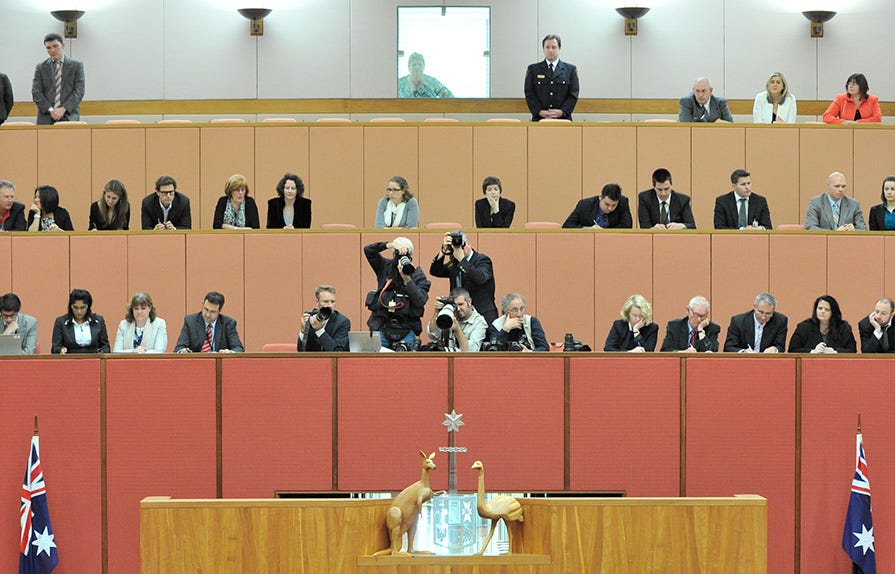
For most of the mainstream media, it has been a Pavlovian response. Many of the journalists in the gallery now in senior positions also covered the Abbott opposition, which took ‘broken promises’ and made it a political artform. The drama and hyperbole of those attacks, which badly wounded the Gillard/Rudd government and contributed to its downfall, looms large in the memory of many press gallery journalists who treat politics as a horse race.
‘Broken promise’ worked 15 years ago – why wouldn’t it work now?
Caught up in their own echo chamber, it’s easy to convince themselves that the broken promise means as much to voters as it does to them.
It’s not a surprise, then, that voters are not only aware the Albanese government broke a promise to not change CGT and negative gearing, but are marking it down for it. But dig deeper into the data and it turns out that the changes are either welcomed or neutral. So it’s not the changes then, but the narrative.
Media in this context love to see themselves as neutral, when the exact opposite is true. The reason the promise exists in the first place is because of the game of rule in, rule out that journalists and commentators love to play during election campaigns.
Once something has been ruled out, it is expected to always be ruled out. This is in part in response to questions the community is asking, but it’s mostly about what the Canberra clique is obsessed with — because it is only ever the promises that the press gallery care about which get attention.
Labor had promised to scrap the Indue card if it won government ahead of the 2022 election, but it still exists under a different name. Ask Indigenous people in the communities where it is targeted if it feels ‘voluntary’. Labor went to the 2025 election with a policy to change the tax concessions on earnings over and above $3m in superannuation balances. Despite winning that election, the opposition and elements of the media waged a campaign against the changes, openly shrugging off the ‘mandate’ that is suddenly so important.
There is no outrage over the changes to the NDIS which will see at least 160,000 people removed from the scheme, let alone those who will never be able to participate in the first place, because that is ‘brave’ and ‘rational’.
But long-overdue changes to the tax system are treated as being an End of Days event.
The press gallery is whiter and wealthier than most of the population. Journalism is increasingly the domain of the wealthy, which means the journalists who cover politicians share the same networks. It’s not unusual to hear of younger journalists arriving in Canberra and settling into apartments their parents have bought them so they can ‘concentrate on their careers’. Older reporters have holiday homes. It’s largely a privileged world, which is becoming more privileged every season.
And it sets what is important for the nation.
The day after the budget was handed down, newsrooms were filled with noisy, aggrieved journalists angry their investments would be taxed at a higher rate (potentially) and how ‘unfair’ it was that they were being ‘targeted’.
Governments should be held to account, but it should be on behalf of all people. Not just those who have the power to elevate their own grievances to the national stage.
That any of us in the press gallery think our concerns reflect the nation’s is one of the major disconnects between the political/media class and the rest of Australia. And that disconnect is only getting wider.
Listen to the latest episode of Deepthink, where Antoun Issa discusses his new book, Rebirth: A Love Story from the Depths of War, with Readings Books. The wide-ranging conversation delves into Beirut’s history, enduring Arab resistance, and interpreting Kahlil Gibran and the purpose of life.
Thanks, Amy - a very interesting perspective from inside the gallery.
I wonder if this is related to something that drives me nuts every year - the media's obsession with 'What's in it for you? Are you a winner or a loser?' coverage of the budget. I don't really bother reading or listening to any budget coverage until around a week later when I can start to see a more holistic picture provided by meaningful analysis.
Very relevant information you have provided Amy - many thanks - I’ve passed this piece on to others👍