


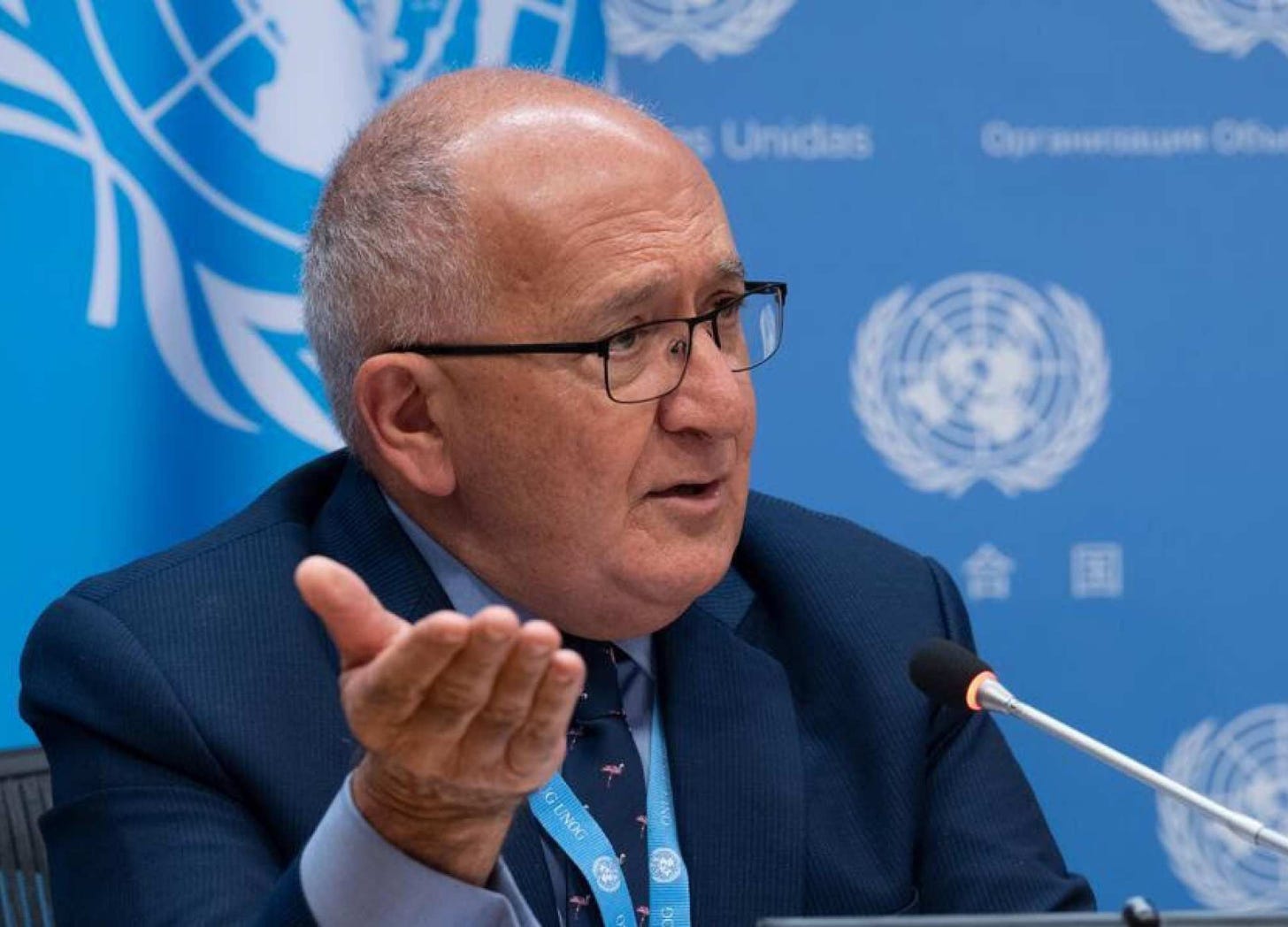
There are a lot of questions to ask someone of Chris Sidoti’s stature. He has had an extensive career tracking human rights abuses, including serving as a former Australian Human Rights Commissioner under two prime ministers and co-leading a UN investigation into allegations of genocide against Myanmar’s Rohingya people in 2017. His most recent work, however, may in fact be his most consequential: as a member of the UN Commission of Inquiry which, in September, found Israel has committed genocide in the Gaza Strip.
We sat down with Sidoti in Sydney, where we discussed the Australian government’s “avoidance” of Gaza; the “fear” among journalists reporting on Palestine; if there’s a future for international law; and what motivates him to keep going.
Thank you to our paid subscribers who submitted questions; we’ve managed to include four below. We do things a bit differently to the mainstream – we like to make sure our community feels part of these important conversations. These are topics that, ultimately, affect us all. It’s a model we’ll repeat, so if you can, become a paid subscriber for as little as $2.30 a week and join in on our next interview.
This interview has been lightly edited for clarity and brevity.
Alex: The government routinely speaks about the genocide in Gaza in terms that actively conflict with reality. It refuses to use the term ‘genocide’; it refers continually to a ‘two-state solution’ that Israel has stated for years it will never allow to happen, and which its settlements have made functionally impossible to realise; it invokes Israel’s ‘right’ to self-defence, which is not recognised by international law; it says that Australia is abiding by international law by supplying what it calls ‘non-lethal’ parts of F-35 fighter jets to Israel.
What do you think are the main underlying reasons for the government’s response to the genocide?
Chris: It’s an avoidance issue. The government is avoiding the reality of the situation in Gaza. It doesn’t deny the existence of genocide, but it doesn’t accept it either. It hides behind the fact that the International Court of Justice (ICJ) has a case before it dealing with the Genocide Convention, and the fact that that case will not be decided for another two or three years. So the government says it can delay taking any action in relation to the genocide until the International Court of Justice has given its final verdict on the subject.
To me, that’s using a fig-leaf to cover up the government’s lack of policy. We have obligations already under international law. We are on notice from the ICJ itself that there is a high risk of genocide. The court made its first set of interim orders in January 2024. Their decision on that occasion triggered the obligation of all states to prevent genocide, and yet there has been no significant action taken by Australia at all.
The government doesn’t have to wait. In fact, our obligation is not to wait – it’s to act. The same is true of war crimes and crimes against humanity. No matter how much avoidance that the government decides it will engage in, there are existing legal obligations. They have certainly been real for the last year and a half. I certainly would have expected that we would have seen action.
The government is moving slowly in conjunction with other western states similar to our own. In spite of the slow movement, I give the government credit for having moved. We’ve had a very long period in Australia of bipartisan, unquestioning, uncritical support for the state of Israel, no matter what it does, and it’s well beyond time that we started being far more critical. The government has been doing that, particularly over the last two years – the recognition of the state of Palestine is a good example.
But we want to travel as part of the pack. That’s fine, but it’s not enough. We also have our own obligations as an individual state under international law – not to wait for others, but to discharge our responsibilities. What’s been done to date has been too slow and too cautious, and our obligations go well beyond where we are.
In September, you said of the Netanyahu government’s response to the Commission’s finding of genocide in Gaza that “they’re producing the responses by ChatGPT these days”. You’ve investigated a number of genocides and conflicts where genocide was suspected or proven to have been taking place. What are the common threads you’ve noticed among the governments and armed forces committing those genocides? How do they talk about what they’re doing, both to the world and domestically?
The first situation of genocide I examined was the removal of Indigenous children in Australia. I was the Australian Human Rights Commissioner at the time the Commission undertook its inquiry into the removal of Indigenous children [the Dodson commission]. That introduced me intensively to the nature of the law of genocide and the experience of genocide.
This is the third time I’ve been required to investigate, to find facts and apply the law to situations that could constitute genocide. The three situations are very different, but they brought home to me how different the law of genocide is to popular understanding of what constitutes genocide. Genocide law was drafted at the end of World War Two. It’s derived from experience, not from theory – the experience of the Holocaust. The principal work on it was done by Raphael Lemkin, an international lawyer and a Holocaust survivor. The understanding that genocide requires mass slaughter is not correct. It requires an intention to destroy a group, in whole or in part, that is defined by race, ethnicity, nationality or religion. It doesn’t require a single death.
In the case of the situation in Gaza, we found that four of the five categories of genocidal act had been committed, and we found that genocidal purpose had also been established. That’s the fundamental groundwork of examining any situation of potential genocide.
One of the common characteristics of the three examples that I’m familiar with is denial. The authorities responsible for the activities deny point-blank that they actually occurred. That’s understandable – why would they accept accountability? It’s like a murderer pleading guilty to murder. Somebody who’s charged with such a serious crime will try to avoid responsibility for it.
But denial lies at the heart of the way in which governments respond, and that’s exactly what we see in the case of Israel now. The responses are routine, they’re trite. The government and military spokespeople persistently lie. They’ve done that for years, and this is just another example of it. It’s part of a common practice of denial, of lying, of personal vilification of those raising criticisms. It’s all an attempt to avoid accountability.
[Israeli finance minister Bezalel] Smotrich and [Israeli national security minister Itamar] Ben-Gvir are examples of another factor – brazen self-justification by way of boasting about what they’re doing. We saw that in Myanmar as well. In Myanmar, there were radical nationalist fanatics who spoke in very blunt language about the Rohingya people and what was going to be done to them. And that’s exactly the same kind of inciting, hateful, destructive language, violent language, that comes from Smotrich and Ben-Gvir and others within the Israeli leadership. For us as investigators, this is all evidence – including the very contradictions in what they’re saying. It’s all evidence of the motivation, the purpose, the objectives and the strategies that are being adopted.
In looking at the situation in Gaza, part of our evidence for concluding that there were genocidal purpose are the very words that come from the Israeli leadership. Smotrich and Ben-Gvir are among the people we named as having incited genocide, but those who are in more direct lines of control – [Isaac] Herzog, the president; [Benjamin] Netanyahu, the prime minister; [Yoav] Gallant, who in the beginning of the war was the defence minister. These are the people who have responsibilities for the operations themselves – more directly than Smotrich and Ben-Gvir.
At the Press Club, you spoke about Australian journalists recounting the pressure they’re coming under when they try to report on this, and that there’s plenty of fear around. Without naming names, can you give a couple of examples of what you mean?
I’ve had a number of journalists who have phoned me to get a background briefing and in doing so, have said, ‘I’d like to have a chat to you on background about what’s going on in Gaza and your assessment of it. I don’t know whether I’ll get approval to write up a story or produce a program about it – there are a lot of sensitivities about this in our organisation. I can’t guarantee that this is going to be used.’
I’ve been doing human rights work for 45 years, in a wide variety of organisations – non-governmental groups, official bodies like the UN, church-based organisations. I’ve dealt with an enormous range of issues since the late 1970s. And I’ve never encountered journalists saying this to me. And it’s not just Australian journalists. International and Australian journalists have said this to me on many occasions.
It seems to me this is a particularly sensitive issue, politically and even ethically. Politically because of the party-political fights that go on – certainly politics in western countries overall has become more polarised, and this is another one of those issues that’s a part of that. Another part of it is the sense that those who are uncritically supportive of the state of Israel will vilify, attack and seek to destroy those who are critical of Israel. That’s a worry for individual journalists and the organisations for which they work. So there is fear of being personally attacked, of being accused of being antisemitic. [There’s the] possibility of economic loss – of losing viewers or people on social media.
I wonder what you think about journalist Chris Hedges’ planned Press Club talk being cancelled earlier this month?
Look, I don’t know everything that’s gone on, especially behind the scenes. Personally, I felt somewhat embarrassed that he had been invited and then the invitation was withdrawn. When I accepted the invitation to the Press Club, I didn’t know he had been invited, and I didn’t know until it was made public that his invitation had been withdrawn.
It’s very disappointing, I have to say, particularly given that Chris is a highly respected international research and investigative journalist with a very strong track record who was visiting Australia for a short time. If I can be blunt, had I known he had been invited, I would have said to the Press Club, ‘well, he’s visiting, he’s an international [speaker], go with him, you can come back to me next year’. I live here, they can get me any time.
I do know that the whole thing is awful. It’s obviously personally hurtful to a very eminent investigative journalist. I wish it hadn’t happened.
Reader question from Kimberley:
In the absence of mainstream accountability and the ongoing impunity afforded to the United States and Israel, is the immediate and long term future of international law in jeopardy? If so, what does the break down of international law look like and what reverberations will that pose if it does break down?
The international law system has been built up over 85 years, since the end of World War Two. It has been one of the most significant postwar projects – to build a system of law and mechanisms that could ensure that what happened in World War Two never happened again. And 85 years on, we are seeing the whole thing in an existential crisis. The situation arising from Israel is one part of that, but the hatred of the international system by the Trump administration is unprecedented, and it could well lead to its destruction.
We have succeeded, over the last 85 years, in building an extremely good body of law that did not exist in 1945. The building of the mechanisms to implement the law has not been as successful. The International Criminal Court and the ICJ are very weak, so there are still great challenges. This is a project that is incomplete, and yet we may find that it is torn down before it reaches the stage of effectiveness in ensuring respect for the law that has been built so carefully. Israel is a key component of that, but if we didn’t have the situation in Israel over the last two years I think that crisis would still exist.
International law is just about the only thing that stands between us and the abyss. Without international law, states can do whatever they like to each other and to their own citizens. As weak as it is, as ineffective as it is, it’s at least an attempt to provide protection for people – an attempt that’s far from successful, but still far better than nothing. And without it, there’s nothing. The alternative is just chaos.
Reader question from Stefano:
A Carlton mascot was just fired for refusing to fundraise for IDF soldiers. While organisations keep funnelling donations to the IDF, opponents face career destruction (Dr Randa Abdel-Fattah, Antoinette Lattouf, Professor Peter MacDonald), and officials face no liability for approving fighter jet parts or Future Fund investments. How is materially supporting genocide legal in Australia while opposing it destroys lives? What legal mechanisms or avenues could reverse this, or activate the laws you’ve identified rather than leaving them dormant while enablers operate freely?
The major issue is not primarily a legal one. There are legal remedies – the case of Antoinette Lattouf has shown how those can be pursued – but they won’t cover every situation. It’s a legal problem, but it’s also a political problem and especially a moral and ethical problem.
Antisemitism and anti-Palestinian racism and hate speech are all very real issues, and becoming more prevalent. But we need to address these issues in comprehensive holistic ways and not rely on the law alone, with all its defects, or by saying ‘this is not a legal matter, we’ll deal with this by having a debate in Parliament’. That’s not good enough either. We’ve got a long way to go in this country of addressing issues of discrimination, vilification and hatred in a way that’s effective.
Alex: The response to antisemitic attacks or pro-Palestinian protests from several state governments, especially in NSW and Victoria, has been to pass new laws. In NSW, the laws outlawing protests in or near places of worship were recently struck down as unconstitutional; in Victoria, organisations that receive government grant funding are now required to sign a ‘social cohesion values commitment’. Do you have an assessment of whether that approach has been effective?
It’s not an effective approach, and one of the reasons why is because there’s still no evidence that these laws have been needed. These are examples of kneejerk lawmaking that’s not based on sound evidence or thorough consultation with affected communities and, for those reasons, does not effectively address the problem.
Antisemitism has increased. So too has anti-Palestinian attacks and Islamophobia. We’re seeing hate speech on the streets far more than we have in the past. I don’t deny the existence of very serious problems that need to be addressed, but kneejerk legislation almost inevitably fails.
It’s very concerning when we see governments failing to observe the fundamental principles of lawmaking that we know of our political system. We know how to make good law, and kneejerk legislation is not how to do it. Many other countries have seen similar activities – I would point particularly to the United Kingdom.
Reader question from Nikki:
In light of your previous appointment as Commissioner of the Australian Human Rights Commission, what is your view on how the AHRC and the various state and territory human rights commissions in Australia have exercised any responsibilities they may hold in responding to the genocide in Gaza and in influencing Australia’s stance on Israel and Palestine?
[The Commissions] have limited legal mandates. Their responsibilities are directed to what happens in Australia. They don’t have roles in Australian foreign policy, except to the extent to which servants of the Commonwealth – civil servants, the military – are committing violations of fundamental human rights. For that reason, I think they’ve played very positive roles when addressing public assembly, freedom of speech, the prohibition of hate speech and so forth. They could be more critical of the Australian government’s policies about activities within Australia that affect the relationship with Israel and Palestine. They have some scope for saying things there.
I think there’s a wish that these bodies could solve all the world’s human rights problems. That’s not their role. More than 30 years ago, when I was secretary at the HRC, the Commission made a report about racist violence in Australia, particularly about incitement to violence and hate speech, and that report was ignored. This was in the early 1990s. There are plenty of reports like that sitting on the shelves.
Theresa O’Sullivan, the NSW Coroner, has been outspoken repeatedly about Indigenous deaths in custody. Her recent comments brought together, I think, a very strong sense of frustration she has in dealing with all these cases still, more than 30 years later. Unless governments and political parties and the wider communities take what these commissions are doing seriously, they will always be voices crying in the wilderness.
Reader question from Karin:
You have seen and investigated many of the world’s horrendous atrocities as part of your work. How do you not lose faith in humanity? Do you have any advice for not losing hope?
If you mean I throw my hands in the air and walk away, then no, I don’t. I have a very strong sense that this is a project that is incomplete, and my role is to make any contribution that I can to that project – towards building it, strengthening it, ensuring that ‘never again’ becomes a reality and not just a slogan. I know that it’s slow. I know it’s far from perfect, but I also know there is no alternative if we want to see things better than they are now.
So gratifying to read such a clear eyed and ultimately positive piece on the state of the world and human rights. Chris Sidoti is right to say that despairing nihilism is not an option. One measure that would help is to educate the public on the history of regions where human rights abuses are occurring. In particular, the issue of conflict between Israel and the Palestinian people is completely misunderstood by the majority of Australians and almost all our politicians. They have a Sunday school version in their minds and are completely ignorant of over two millenia of history. The other problem is the conflation of Judaism with Zionism. The Jewish Council of Australia is trying to address this issue but has been completely ignored by the media and most politicians. Education and humanity are key.