


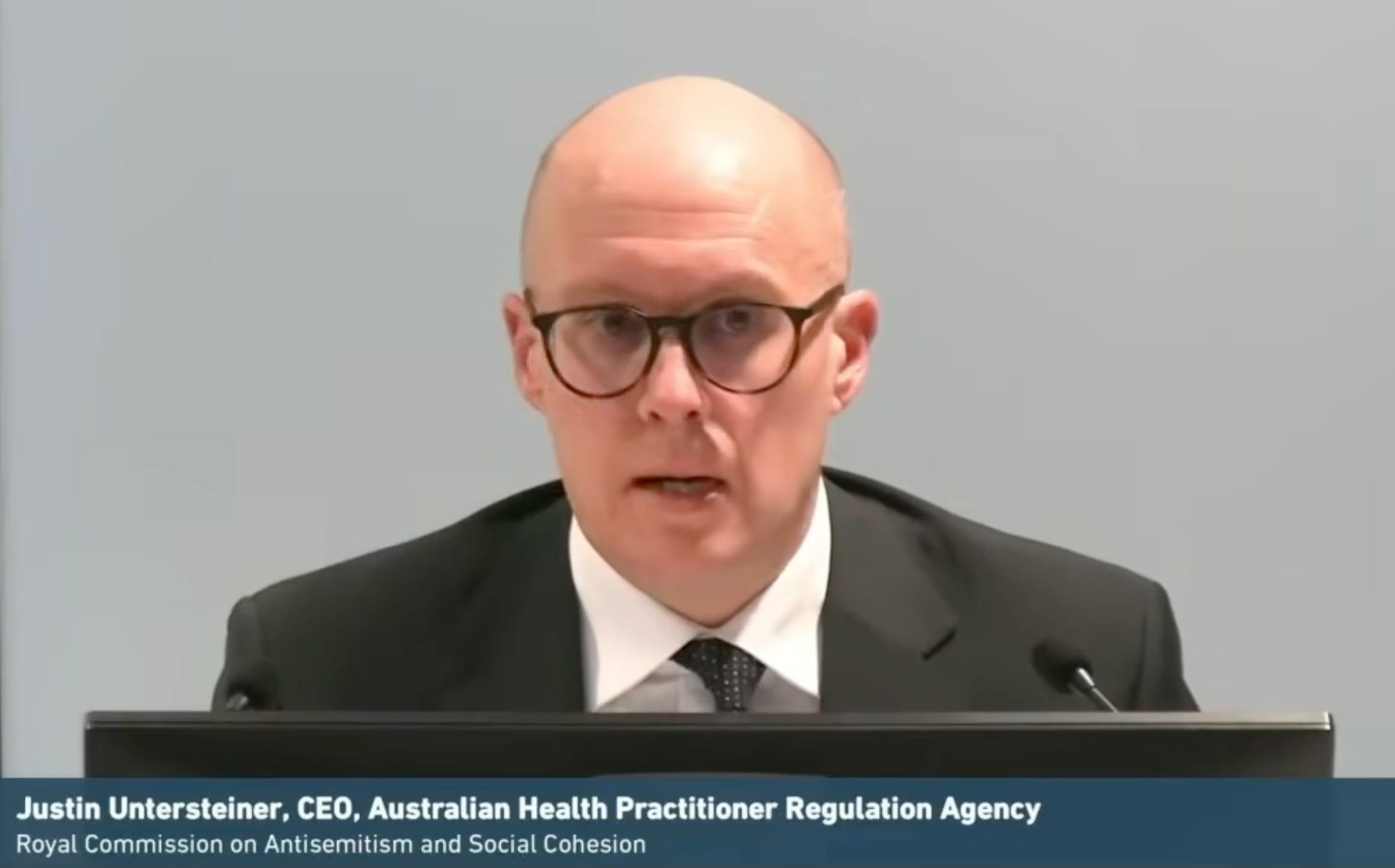
The Australian health regulator bowed to pressure to adopt a contentious definition of antisemitism despite internal concerns it “may create further ambiguity” and “the perception of alignment with particular political positions”, a new trove of documents reveals.
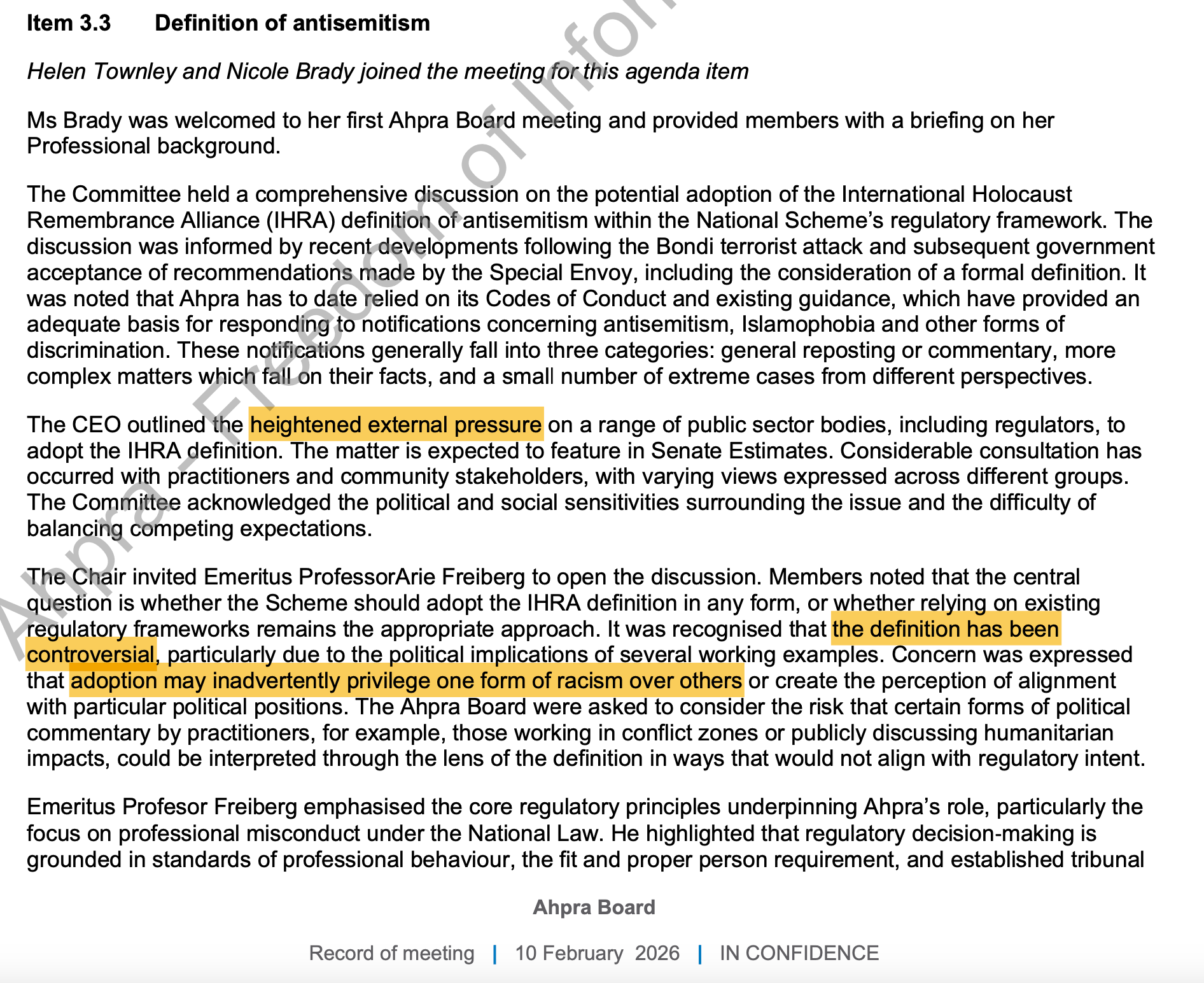
Internal files obtained by Deepcut under freedom of information laws show the chief of the Australian Health Practitioner Regulation Agency (AHPRA) told his colleagues there was “heightened external pressure on a range of public sector bodies” to adopt the International Holocaust Remembrance Alliance (IHRA) definition.
They reveal that “some members” of the AHPRA board raised concerns in February “that the IHRA definition is not fit for regulatory purposes due to its lack of clarity and the political elements embedded within it”.
The AHPRA board resolved in March not to adopt the definition “at this time”, without closing the door entirely. Two months later, though, the same regulator decided to adopt it, eventually announcing the policy shift in a joint statement with the Albanese government-appointed Special Envoy to Combat Antisemitism, Jillian Segal.
This prompted a swift backlash from health workers who felt the move would curb their ability to speak out against Israel’s atrocities against Palestinians in Gaza and the West Bank.
Indeed, the February board minutes included: “The AHPRA board were asked to consider the risk that certain forms of political commentary by practitioners, for example, those working in conflict zones or publicly discussing humanitarian impacts, could be interpreted through the lens of the definition in ways that would not align with regulatory intent.”
Mounting concerns
NSW Supreme Court judge Desmond Fagan last month labelled the IHRA definition as “verbose and imprecise” and encompassing “criticisms of Israel that could not be regarded as hostile to Jews as Jews”.
IHRA says antisemitism “might include the targeting of the state of Israel, conceived as a Jewish collectivity”.
Its examples of contemporary antisemitism include “claiming that the existence of a State of Israel is a racist endeavour” or “requiring of it a behaviour not expected or demanded of any other democratic nation” – wording that critics say is open to wide interpretation and can be used to restrict legitimate political views about Israel’s conduct.
Michael West Media has previously reported on some of the pressure AHPRA had faced to shift its policy.
The new documents shed light on AHPRA’s decision-making at a time it was bracing for scrutiny from the antisemitism royal commission. These deliberations are of public interest because AHPRA and its 15 related national boards have oversight of nearly 1 million Australian health practitioners including doctors, nurses and psychologists.
AHPRA’s chief executive officer, Justin Untersteiner, advised his board in November 2025: “Notifications in relation to public commentary by practitioners on the conflict in Gaza continue to attract media attention.”
‘Our commitment may be questioned’
Internal discussions about the IHRA definition appear to have intensified after the deadly Bondi attack on December 14, with Untersteiner meeting on January 9 with a representative from Segal’s office.
They talked about “a number of actions we have underway, many of which align to the Special Envoy’s Plan”, he said in an update to the AHPRA board.
Untersteiner also told the board he had met with someone – whose name was redacted – “who took me through a presentation of the health and medical crisis facing Gaza” and who regarded the IHRA definition as “penalising doctors for raising awareness of human rights abuses”.
In February the AHPRA board weighed up options including “Don’t adopt the IHRA definition at all” or make “A general statement adopting or referencing the IHRA definition”, which is what it eventually decided to do months later.
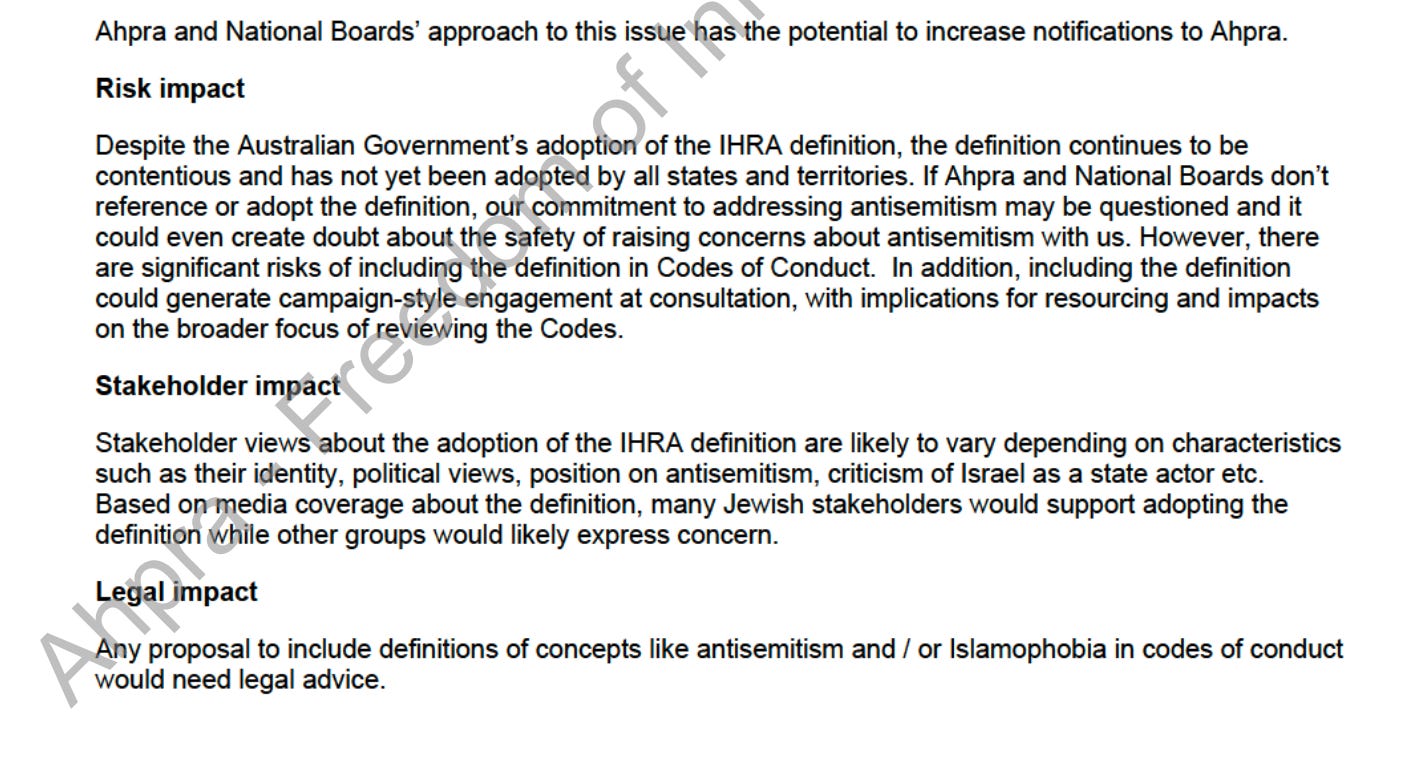
The agenda paper raised fears that if AHPRA did not act “our commitment to addressing antisemitism may be questioned and it could even create doubt about the safety of raising concerns about antisemitism with us”.
“The CEO outlined the heightened external pressure on a range of public sector bodies, including regulators, to adopt the IHRA definition,” said the minutes of the February 10 board meeting.
The “highest risk” option would be a much more expansive move to fully embed the IHRA definition in the various health sector codes of conduct. AHPRA has not done this, insisting the wording will be used only as a “reference tool” and is not legally binding.
The previously confidential agenda papers explained that a “general statement adopting the IHRA definition, similar to the Australian Government, is fundamentally different to including the definition in regulatory documents”.
“Despite the Australian Government’s adoption of the IHRA definition, the definition continues to be contentious and has not yet been adopted by all states and territories,” the papers said.
The board agreed in February to “maintain a consistent and principled position” that “existing regulatory tools are sufficient” but “further work will continue”.
The board discussed the issue again the next month and it “was acknowledged that the definition may create further ambiguity”. Minutes show the board agreed on March 17 “it would not adopt the IHRA definition at this time” but decided to “continue monitoring the environment” and await further work to “better understand the implications for practitioners”.
Policy shift with ‘reservations’
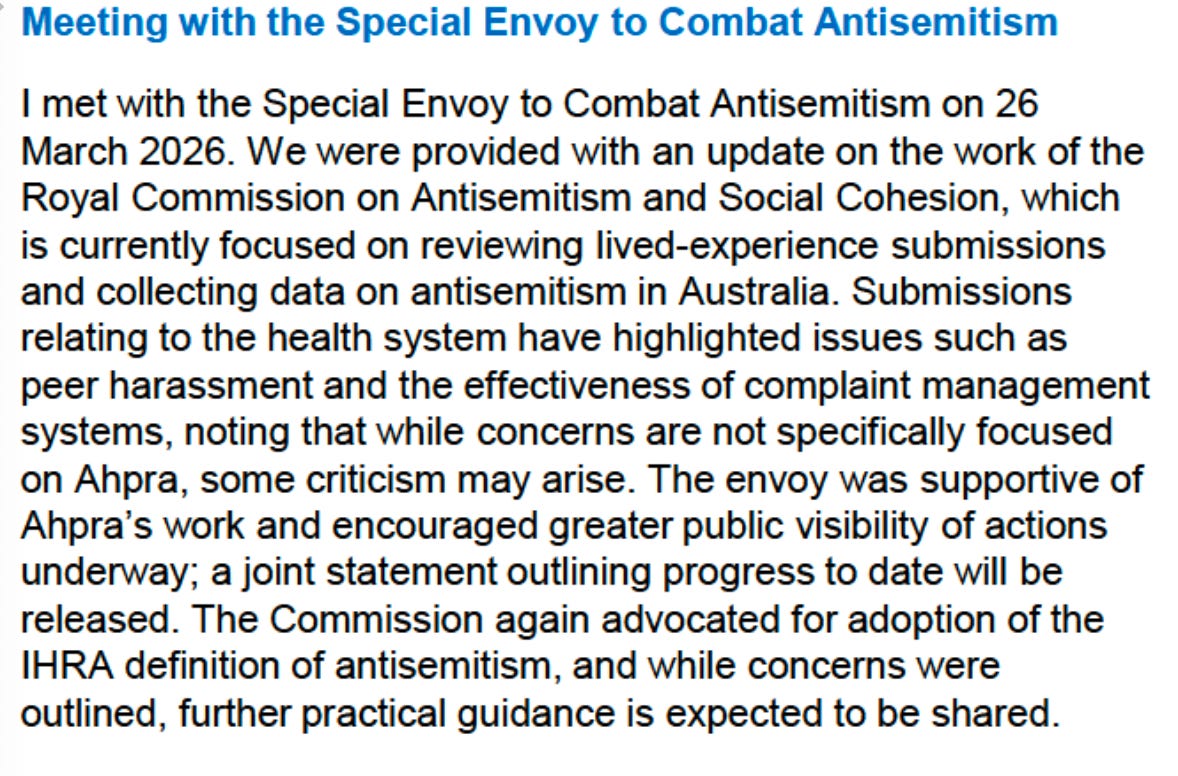
Nine days later, Untersteiner met with Segal and they discussed the antisemitism royal commission’s work, including potential scrutiny of health complaints.
“The envoy was supportive of AHPRA’s work and encouraged greater public visibility of actions underway; a joint statement outlining progress to date will be released,” Untersteiner wrote to his board.
On May 12, the board finally shifted. It agreed to use the IHRA definition “as a reference tool” but without actually incorporating it in health worker codes of conduct.
“In reaching this position, the Board acknowledged that the IHRA definition has been the subject of some public debate, with some members expressing reservations about the potential for its examples to conflate legitimate political criticism of the State of Israel with antisemitism,” the minutes said.
“Notwithstanding those reservations, the Board agreed to treat the definition as a reference tool, noting its value as a source of information to guide its understanding of antisemitism in its contemporary forms.”
‘This looks great’
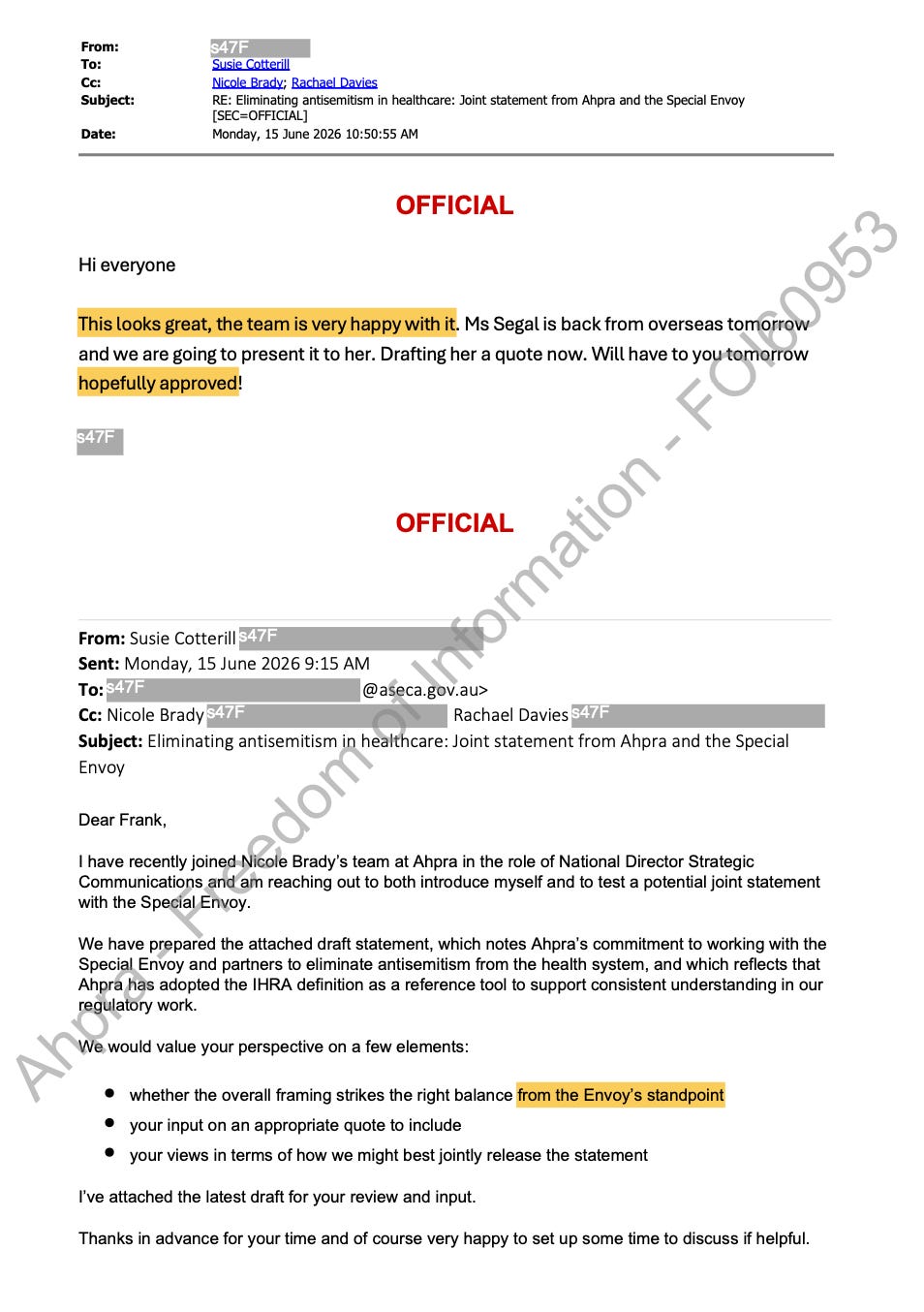
The documents include emails between AHPRA and Segal’s team prior to publication of the joint statement announcing the decision on June 17. “This looks great, the team is very happy with it,” wrote a member of the special envoy’s team to AHPRA on June 15, with Segal herself giving her approval the following day.
During a royal commission hearing in July, Untersteiner said AHPRA had previously “resisted” adopting the definition due to “some concerns about the risk of the IHRA definition stifling free speech”.
But he said Segal’s explanatory handbook, released in April, was “exceptionally helpful” in allaying those concerns and was “an important factor” in the change of stance.
Page 76 of that handbook includes the blanket statement: “Antisemitism and antizionism are both expressions of hatred towards Jews.” The same page describes a social media post “as antisemitic because it included statements that accused Israel of apartheid, oppression, racism and genocide”.
Under questioning by Kirsten Edwards SC, appearing for the Jewish Council of Australia, Untersteiner declined to give an iron-clad commitment that agreeing with international court rulings or UN committee findings would escape scrutiny, saying it would depend on the context.
“If there is a ruling in an international court and someone was to repeat that ruling, again, on the surface, I couldn’t see an issue with that,” he told the royal commission. “But ... we would need to be looking at the specific case and the evidence surrounding it.”
AHPRA was offered the opportunity to comment on the newly released internal documents. Its spokesperson told Deepcut earlier this month that AHPRA was “committed to free speech” and might undertake regulatory action only if “commentary becomes demeaning or denigrating and directed toward specific members of the community”.

It's a pity APHRA didn't realise that siding with Zionism would eventually cause them more problems than being impartial. When all this lobbying occurred the world already knew what they were doing in Gaza and Lebanon. Doesn't take a rocket scientist to work out which way it was going...