


We’re now four weeks into the Royal Commission on Antisemitism and Social Cohesion’s public hearings. We’ve so far heard numerous statements, led by pro-Israel lobby groups, seeking to equate antisemitism to criticism of Israel, Zionism and displays of Palestinian culture.
Also aired during the Commission – which is costing taxpayers $131.1m – were several inaccuracies about Israel, Palestine and Lebanon that went unchecked. So we’ve decided to help the Commissioner by correcting the record.
Some of the clearest errors were historical:
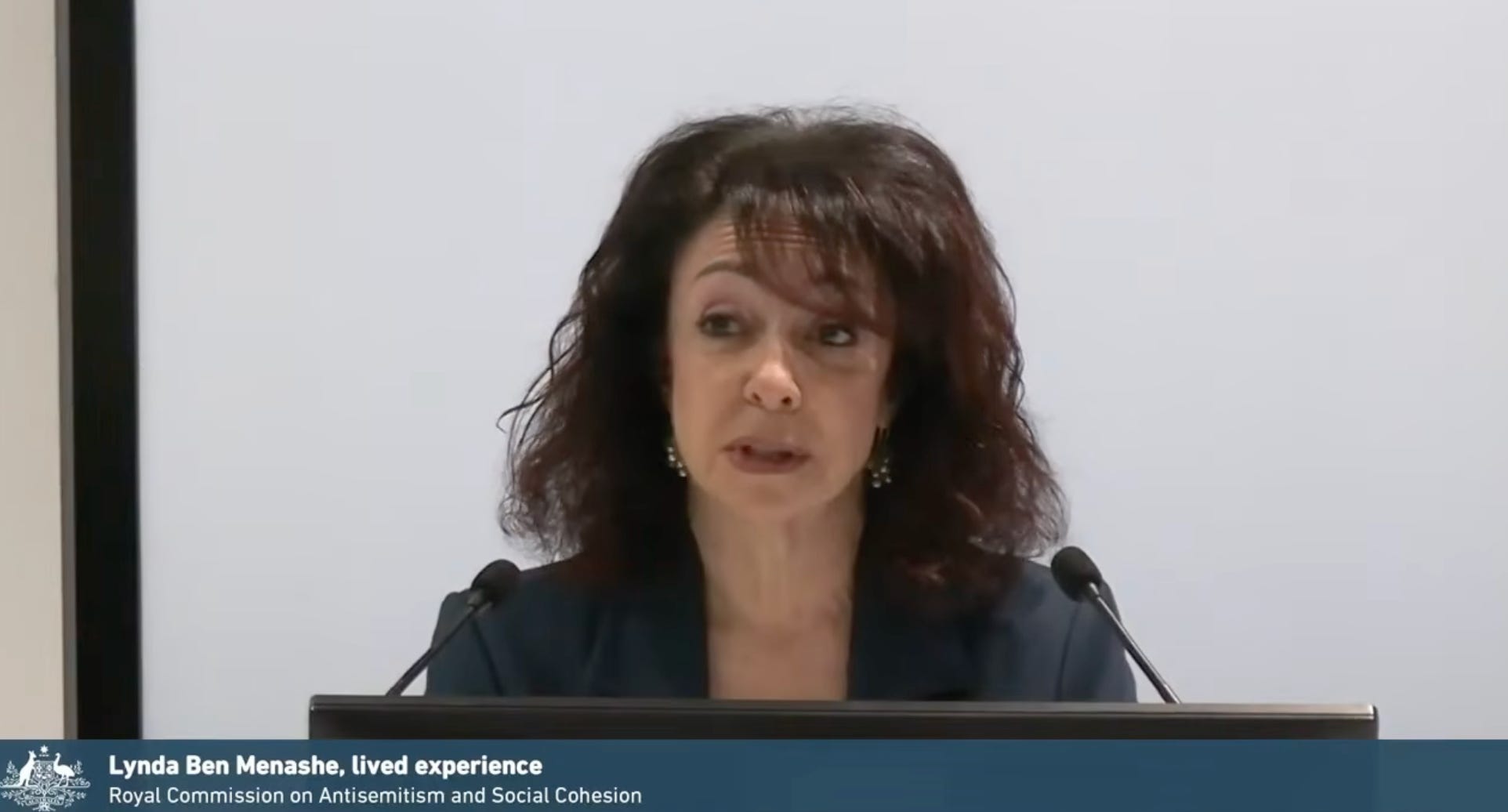
“But then by the time I was at university, I think the morph into anti-Zionism, a hate movement against the Jewish collective, really. I joined the Jewish student union AUJS, and we had – that my first year of university [in 1982] was the beginning of the war in Lebanon between Israel and Hezbollah, the terrorist organisation.” – Lynda Ben Menashe – May 7, day 4, p371, line 5.
Israel initially invaded Lebanon in 1978 to establish a security zone along its border (similar to what it is attempting to do today). In 1978, Hezbollah did not exist. When Israel launched a full-scale invasion in 1982 towards the capital, Beirut, Hezbollah still did not exist in its current form. Both invasions targeted the Palestinian Liberation Organisation and other Palestinian factions. Hezbollah was founded in response to the Israeli invasion, which had devastated Lebanese Shia communities in south Lebanon. Fighting between Israel and Hezbollah took centre stage after Israel’s invasion, spanning the subsequent 18-year Israeli occupation of south Lebanon.
“Well, you know, the Israeli-Palestinian conflict has been going on for centuries and there’s nuances and a lot of convoluted information with that.” –
The Israeli-Palestinian conflict does not date back centuries. The conflict began with British colonisation after World War I, with a promise to create a settler-colony for Jewish arrivals from Europe in Palestine. Prior to British colonisation, Arab Jewish communities – which numbered 3-4% in the 1800s – coexisted for centuries in Palestine with their fellow Muslim and Christian Arabs. The main conflict arose during Israel’s war of independence in 1948, which led to the expulsion of 750,000 Palestinians.
One of the most obvious pieces of misinformation concerned Israel’s military response following October 7:
“And we also see [on October 9] before Israel had responded, before Israel had done anything – and it was a sign of what was to come – what was the response we at least saw? The police instructed the Jewish community not to attend the Opera House.” – Jeremy Liebler – May 6, day 3, p324, line 25.
By the time the Sydney Opera House protest happened on October 9, Israel had in fact responded, killing hundreds, injuring thousands and displacing tens of thousands in Gaza. By October 8, the UN reported Israel had shut off electricity to Gaza and killed 413 Palestinians, injured 2,300 and displaced 123,000. By October 9, the number of dead rose to 687, the number of injured to 3,800 and the number of displaced to 187,518. On October 9, then Defence Minister Yoav Gallant said words that would later be referenced as potentially demonstrating genocidal intent in an International Court of Justice case brought against Israel in January 2024.
“I have ordered a complete siege on the Gaza Strip. There will be no electricity, no food, no fuel, everything is closed … We are fighting human animals and we are acting accordingly.”
Another statement contradicted the witness’ own written account:
“And towards the end of the session, approximately between 50 and 60 minutes, there was a Q and A, at which a woman stood up got to her feet and said, ‘We are all’ - quote unquote, ‘We are all missing the elephant in the room, the Jewish tentacles’.” – Vic Alhadeff – May 5, day 2, p185, line 25.
Alhadeff’s own submission which was before the commission, stated the woman said “the ‘tentacles’ of Australia’s ‘Israel lobby’”, as does his piece in the Jewish Independent describing the incident.
Other statements made assertions about Israel’s depiction in the media that do not accord with reality:
“I think it’s very hard to avoid accusation of Israel of starvation and genocide and all of that, that they are accused of. For example, when I go to work, I work in an office building. I have to spend about 30 seconds in the lift to go up to my office. There is a screen playing the ABC and every single morning during the war, I had to look at the headline of all of the accusation against Israel but always one-sided. They never talked about Israelis’ pain and it’s very difficult to avoid.” – Léa Levy – May 5, day 2, p154, line 20.
ABC extensively covered the October 7 attacks and Israeli suffering throughout the conflict. Our joint analysis with Newscord found consistent bias towards Israel in ABC coverage. A search of ABC’s digital archives reveals dozens of stories focusing on Israeli civilians, see examples from the last year here, here, here, here, here, here, and here.
“And, I mean, if you look at it – so no other country in the world is compared to Nazi Germany, only Israel. So, in a way, they’re saying it because they know that that will also hurt Jews, that we are incredibly offended by that.” – Julie Nathan – May 11, day 6, p517, line 40.
Many states have been compared to Nazi Germany given it is, as pointed out by antisemitism expert Dr David Rich (May 14, day 8, p710, line 30), a common analogy. The accusation has been levelled at Russia, the United States, Iran, Syria and Iraq among others.
At the time of publishing, the Royal Commission had removed the transcript record for days 2 and 3 from its website.
Pro-Palestinian groups refused leave to appear
While the Jewish Council of Australia appeared in hearing block one and questioned numerous expert witnesses, other progressive Jewish and Palestinian organisations were refused leave to appear.
The Commission refused the applications of both the Australian Palestinian Advocacy Network (APAN) and the Loud Jew Collective to appear, with both groups’ submissions arguing against the conflation of antisemitism and anti-Zionism. The Loud Jew Collective’s submission focused on the experience of antisemitism suffered by its members at the hands of Zionist Jews and the far right.
APAN said its submission “provides a relevant and useful history of Palestine and Palestinians” and that “the failure to allow APAN to appear will mean the commission will not have a legitimate counter narrative to the one proffered by those seeking to criminalise the pro-Palestine movement.”
Listen to the latest episode of Deepthink, where Antoun Issa discusses his new book, Rebirth: A Love Story from the Depths of War, with Readings Books. The wide-ranging conversation delves into Beirut’s history, enduring Arab resistance, and interpreting Kahlil Gibran and the purpose of life.
As a tax payer I am paying "costing taxpayers $131.1m" that will not deliver anything to benefit the oveall Australian community.
It will only deliver the agenda required by very few and divide the country more and we dont question or mention the hidden agenda of the groups behind it.
Aren't there consequences for knowingly giving false information under oath/affirmation at RCs (and inquiries)?