


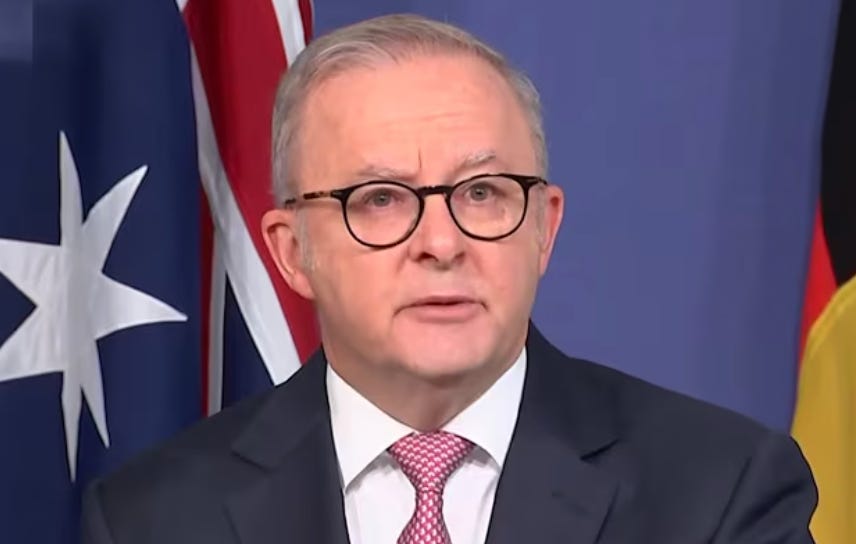
Anthony Albanese’s statement expressing support for the war on Iran exposed two truths: first, how dangerously entrenched Australia is in the unhinged US/Israeli alliance; and second, how utterly feeble and out of depth Albanese is to lead Australia at a time of great global upheaval.
Let’s take stock of this global context, and Australia’s position in it, before diving into the specifics of the Iran war. The United States is not an ‘ally’ of Australia – it is whom this nation’s leaders have chosen to depend upon for Australia’s national security. There is no equivalence in this relationship – Australia outsources its defence to the US military (at an exorbitant cost to Australian taxpayers) in the hope that the US will always come to Australia’s aid in its hour of need. It’s why Australian leaders have continuously followed America down its destructive path of endless wars.
Those leaders, such as Albanese, have remained unflinching – naively so – in refusing to accept rapidly shifting global conditions. The United States is wallowing in its own rot, and at the core of this rot – as the Epstein files and the last two years of the genocide in Gaza have shown – is Israel and its perverse class of billionaire supporters. The same billionaire class who form the backbone of the various pro-Israel lobbies strangling western democracies, including our own.
US analysts, and indeed much of the wider public, see Trump’s war on Iran as an obvious war on behalf of Israel. Understandably, public opinion continues to turn against Israel. A recent Gallup showed, for the first time, that more Americans sympathise with the Palestinians than the Israelis.
‘America First’ pundits would have surely been enraged to hear the US president admit, with an air of indifference, that American lives would be lost in this needless war – and the death toll has already started.
US decision-making has been captured by the Israel and the pro-Israel lobby, which renowned US political scientist John Mearsheimer routinely says is “unprecedented in history”. Trump is not acting in America’s own national interest, but sending US troops to die for Israel. And by supporting this war, Albanese too is prioritising Israel’s ambitions for a ‘Greater Israel’ over Australia’s interests – assuming he has a coherent vision for those interests at all.
As expected of an out-of-control, narcissistic billionaire (with credible allegations of child rape and molestation contained within the Epstein files), Trump is wildly deploying America’s military might across the world and unravelling the ‘rules-based order’ that the Albanese government so regularly professes to uphold. Trump’s violence isn’t limited to the global arena – he is also doing it internally, tearing away at whatever remains of the American democratic project.
All of these various strands of Trump’s Israeli-backed lunacy – wars abroad and authoritarian assaults at home – are converging into a crisis so deep that former US diplomats are sounding the alarm of the “end of the US republic”.
But Albanese – and the rest of Australia’s hapless political and media class – appear stunningly blind to the world around them, clinging onto the foolish hope that some illusory centrist ‘normalcy’ can be restored. That Trump is a blip and all Australia needs to do is ride through the moment until America corrects itself.
If that is indeed the political establishment’s view, then it demonstrates a profound misunderstanding of the tremendous geopolitical shifts underway, and shackles a naive Australia to the mountain ridge as the volcano spews above.
Seismic moments in history require bold leaders with a clear vision. We are living in such a moment without a leader up to the task.
Key updates on the war on Iran
Carnage from Tehran to Tel Aviv, Bahrain to Beirut
Iran
US-Israeli strikes have hit civilian targets in Iran, including residential districts, the headquarters of IRIB – Iran’s state television – as well as Tehran’s Gandhi Hospital, with footage of infants in incubators being rushed out. The attack on civilian targets comes a day after a strike hit a girls’ primary school in Minab, southern Iran, killing roughly 150 people, the majority of them schoolgirls. UNESCO, the UN education agency, condemned the attack as “a grave violation of humanitarian law”.
Israel says it carried out 1,200 strikes in the first day of the war, which killed Iran’s Supreme Leader Ayatollah Ali Khamenei as well as a slew of top officials.
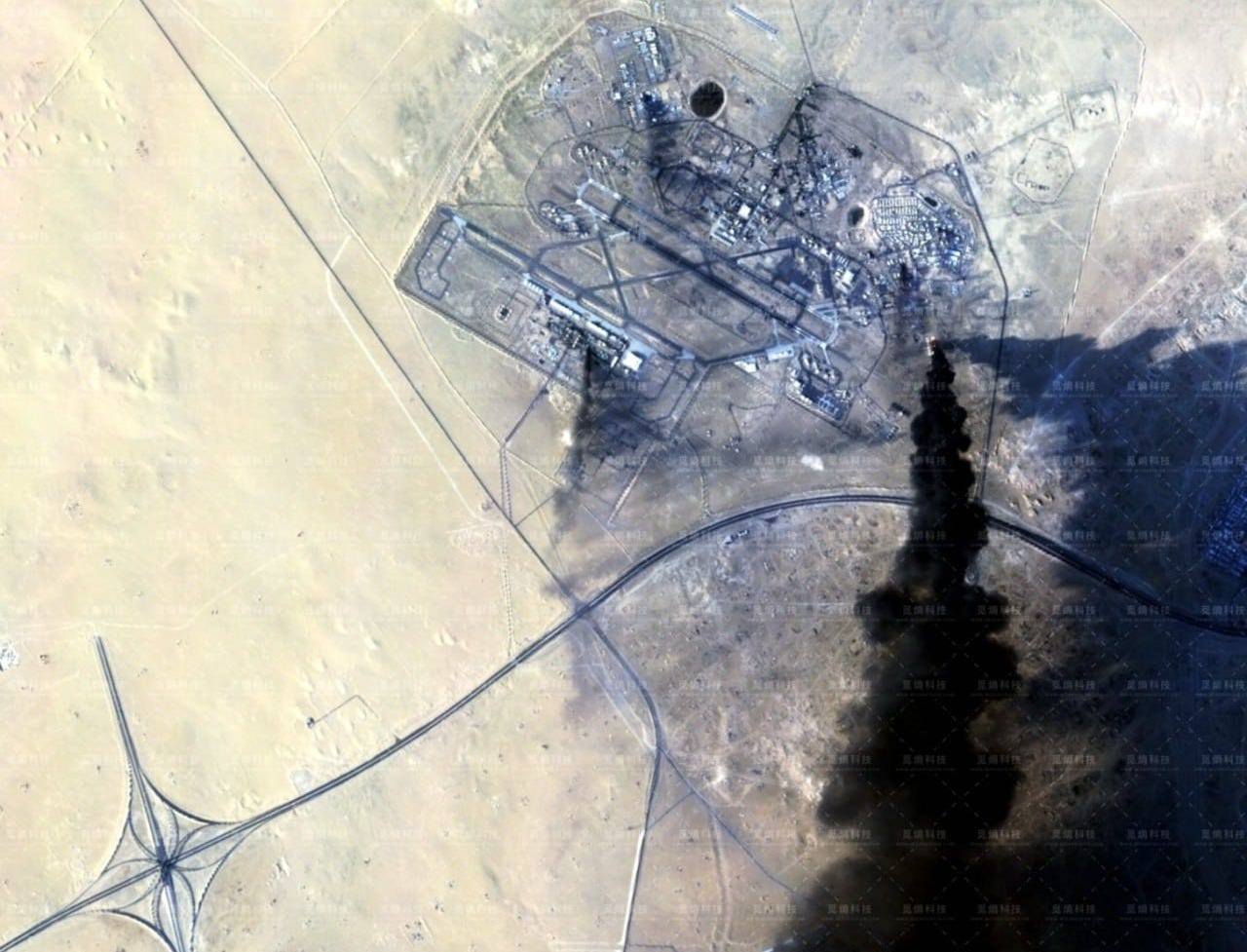
Iran has been launching missiles and drones around the clock targeting US bases in the Gulf Arab states and Jordan. At least three US service members have been killed thus far, with reports that the deaths came in an attack on a US airbase in Kuwait. The Pentagon is investigating how Iranian drones were able to penetrate US air defences. The Islamic Revolutionary Guards Corps (IRGC) says at least 200 US service members have been killed or wounded in attacks on US bases.
Other key US and western targets struck by Iran include:
Al Udeid air base as well as radar systems in Qatar – America’s largest base in the region, serving as the forward headquarters of CENTCOM
US Navy’s Fifth Fleet headquarters/Naval Support Activity in Manama, Bahrain, as well as radar systems and Bahrain International Airport
Al Dhafra air base, as well as Dubai and Abu Dhabi international airports in the UAE
French naval base, Camp de la Paix, in Abu Dhabi, UAE
Ali al-Salem air base in Kuwait, where three US service members were confirmed killed
Prince Sultan air base in Saudi Arabia
US bases in Erbil, Iraqi Kurdistan
Camp Victory at Baghdad airport in Iraq (used by NATO; Iraqi militia group Saraya Awliya al-Dam has claimed responsibility)
Muwaffaq Salti air base in Jordan
UK’s Akrotiri air base in Cyprus
Iranian missiles and drones have repeatedly struck Israel since the beginning of the war, with footage showing destroyed buildings in Tel Aviv. Nine Israeli deaths were confirmed in a strike on Beit Shemesh. The Israeli military censor forbids disclosure of targets struck in Israel, obscuring what information gets released.
Quick analysis: Iran would be feeling more confident after the 12 Day War last June. It learnt it could drain Israel’s air defences within a short timeframe, and it has the missile stockpile to sustain attacks for a significant period. Both sides to this war excel in offensive capabilities, but are light on defence. US bases in West Asia and its ships in the Arabian Sea are sitting ducks and will continue to be targeted by Iran, limiting US offensive power over time, with public anger in the US likely to rise (both at Trump and Israel) the longer the war drags on. The race for US and Israel is in taking out Iran’s missile launching capabilities – a daunting effort given the size of the country and a missile inventory rumoured to be in the thousands – before their air defence stockpiles run out.
Oil
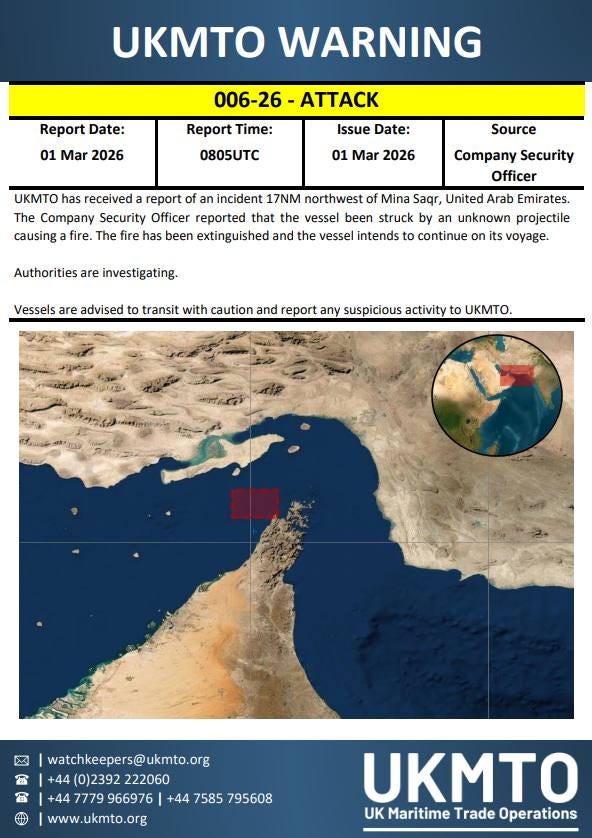
Iran has closed the Strait of Hormuz and has attacked ships disobeying its command. At least five tankers are said to have been attacked, with Danish shipping firm Maersk suspending operations in the strait. Roughly 20% of the world’s oil supply transits through the Strait of Hormuz. Brent crude jumped 10% with fears oil prices could spike to $100 – adding steep inflationary pressure on western economies (fuel prices will skyrocket if the strait remains blocked).
Iran also struck Saudi Arabia’s Ras Tanura oil refinery, one of the largest in the region with a capacity of 550,000 barrels per day. Saudi Aramco shut the facility after the attack. Qatar Energy also suspended LNG production at its Ras Laffan facility after being hit by an Iranian projectile. European gas prices have jumped 28%.
Quick analysis: On top of bodybags of American troops, Trump will have to contend with the severe economic pain of crippled energy supplies and surging oil prices. Saudi Arabia and Qatar are talking tough about retaliating against Iran, but it’s unclear what more they can do given their defences are heavily dependent on the US – which is already proving incapable of stopping the Iranian missile barrage.
Lebanon
The war has spread to Lebanon after Hezbollah fired rockets and drones into northern Israel. In a statement, Hezbollah said it fired the rockets in “retaliation” for Khamenei’s killing, as well as the past 15 months of thousands of Israeli violations of the ceasefire in Lebanon. Israel responded with heavy bombardment of Beirut’s southern suburbs and the Bekaa in eastern Lebanon, killing 31 people. The Israeli army has also ordered the evacuation of more than 50 Lebanese villages in the south, with hundreds of thousands fleeing north.
Israel assassinated Mohammed Raad, a longtime Hezbollah MP in the Lebanese parliament and not a member of the party’s military wing, in its first round of strikes, according to media reports.
Tensions are at fever pitch internally with the Lebanese government moving to ban Hezbollah’s military activities and the Lebanese Prime Minister Nawaf Salam demanding Hezbollah surrender its weapons.
Quick analysis: Both sides have been waiting for a resumption of war. Israel sees an opportunity to move deeper into southern Lebanon, deliver a final blow to Hezbollah and expand its occupation, potentially laying the groundwork for colonisation. Hezbollah sees an opportunity to push Israel back and re-establish a level of deterrence, particularly if Iran succeeds in exhausting Israel’s air defences over the coming weeks. Hezbollah will, however, have to grapple with internal Lebanese anger at entering the war.
Protests
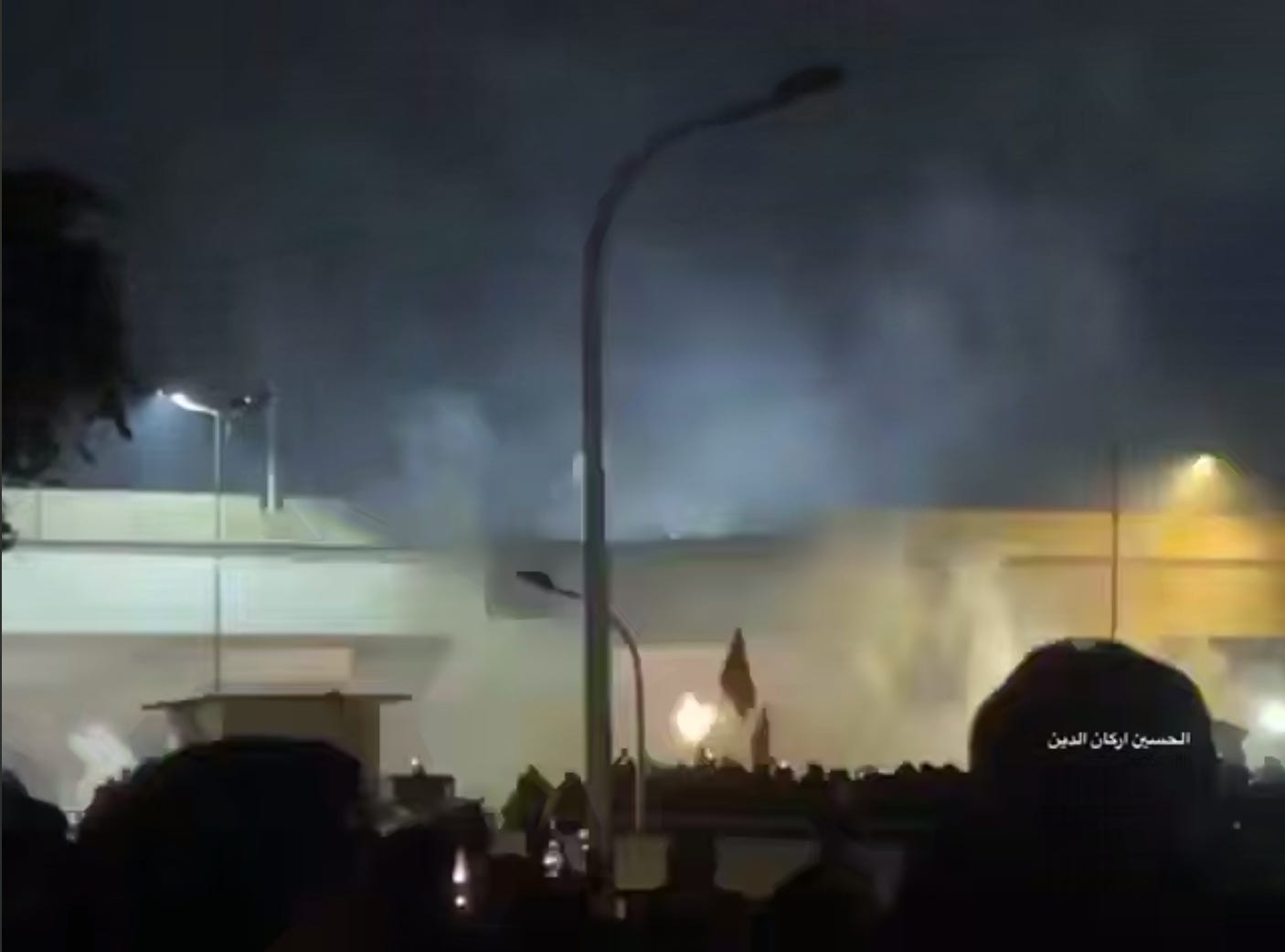
Khamenei’s killing has sparked protests among Shia Muslim communities worldwide. Twenty-three people were killed across Pakistan, including 10 in Karachi when protesters tried to storm the US consulate. Similar scenes were seen at the US embassy in Baghdad, and hundreds of protesters clashed with police in Bahrain.
Ceasefire push and American ‘paranoia’
Trump is reportedly seeking a swift end to the war, stupefyingly assuming it would be a “four-to-five day operation”, according to Israeli media. The report says Trump, through Italy, sought a ceasefire with Iran “today or tomorrow”. Iran rejected the offer, with its military leadership vowing to escalate. Now there’s “anxiety” and “paranoia” within the Trump administration that “the fighting will extend for weeks, further stressing limited US air defence stockpiles”.
US officials are now changing tune, saying the war will “last multiple weeks” with Trump conceding that more US troops are “likely” to die.
Quick analysis: This is what happens when fools sit atop large militaries. Trump thought he could do a swift Venezuela-like operation – kill the leadership, get a new one that will negotiate and surrender. According to Israel’s Channel 12, they had hoped Iranian President Masoud Pezeshkian – seen as a moderate – would have negotiated and capitulated to US/Israeli demands following Khamenei’s killing. That hasn’t happened, and anyone who understands Iran knows that was never going to happen.
Trump is now in a mess of his (and Netanyahu and the pro-Israel lobby’s) making, and hundreds more – Iranians, Americans, Israelis, Lebanese – are going to die as a result.
Dangerously out of his depth. Was there no one to warn him it would be a “courageous” decision? The man’s a complete twat.
Antoun, your analysis is terrifying. This terror will inevitably come closer to home.
I listened to an interview with Professor Jeffrey Sachs this morning and his view is that all countries hosting US bases are not only vassal states; they are countries 'occupied' by the US. By this logic, Australia occupied by the US. Ouch. In this context, the Labor government, the Coalition and One Nation are unfit to lead Australia in a way that prioritises our national interests.
Thanks to 'leaders' like Albo, international law is now dust and ashes.