


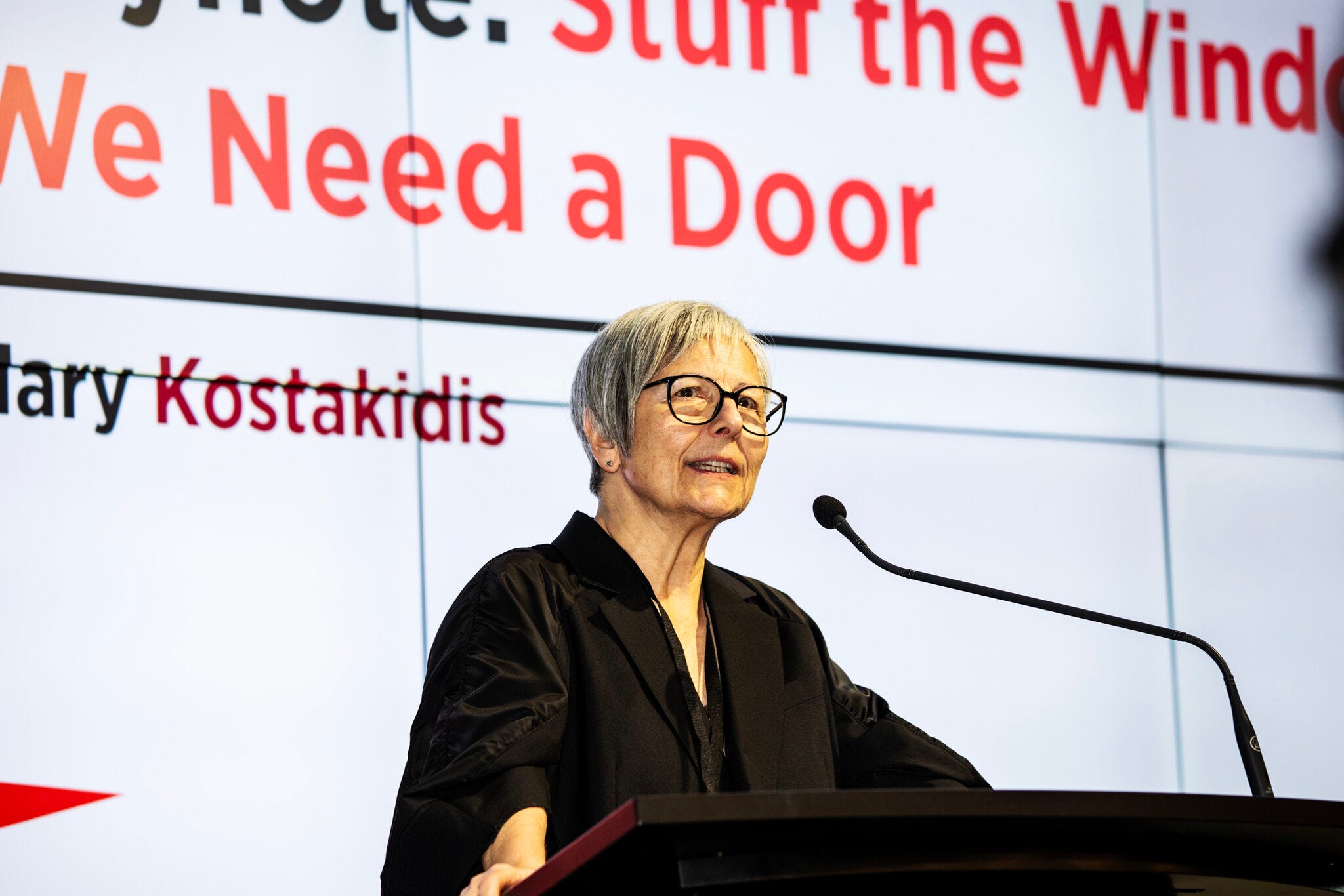
Three very apt words – Truth, Trust and Tribalism. Much of what I say will focus on the last. Because of it, the first and second often become casualties.
Our Holy Grail of journalism centres on four pillars: objectivity, impartiality, balance and neutrality. Four pillars that are all too often weaponised in the service of gatekeeping the Overton window, so that establishment interests aren’t threatened by a restless citizenry.
While this has operated somewhat more subtlety in the past, it has become a charade in which allies who wield enormous power on the global stage, have dropped their masks – they have shed pants as well – and it has become harder to drink this glass of milk because there are big fat flies floating on the surface. The world order intended to be based on international law, and one that has often failed to deliver accountability in the case of the most powerful, has now been comprehensively debased.
In examining the media’s role and its pretence at neutrality and balance – when it actually behaves in a most tribal, partisan way – I’ll share with you some of my own experience over decades, including where I have failed.
I will argue an important weapon in our arsenal are the principles of our shared humanity that underpin universal rights, and that adherence to those principles necessitates an ability to view and analyse the world through multiple lenses, not just that of the Global North. This is not something we need permission to do. It is part of the core business of being a journalist if we are serious about impartiality and objectivity. It is also part and parcel of diplomacy, and should also be integral to the work of leaders, otherwise we have no chance of bringing an end to forever wars, to collaboratively resolve matters in a manner that has regard to equality, freedom and dignity for all.
In understanding conflict and embarking on an assessment of a situation, objectivity and impartiality are vital. However, it is not necessary for an experienced journalist to remain neutral in interpreting the significance of events. Indeed, most memorable works of journalism, such as Robert Fisk’s Great War For Civilisation, cannot be described as ‘neutral’. To hold journalism in a perpetual state of neutrality and continue to provide selective ‘balance’ (there is little to no ‘balance’ in the coverage of China, Russia, Iran or Israel) is to render plausible deniability, to shield crime, to deliver impunity and to compound and perpetuate injustice, as has occurred in the way Israel’s actions have been historically and predominantly reported in western legacy media.
A multipolar world demands multiple lenses
This era is unprecedented – there has not been such widespread repression throughout the west, and not only in our profession – it is society wide. And what strikes you of course, is that contrary to this oft weaponised Code of Ethics, what operates – with a few notable exceptions – is an unacknowledged partisanship, as tribal as geopolitical protagonists themselves.
Whilst we have achieved diversity in the media in terms of presence and visibility, we have not yet succeeded in injecting the diversity of perspectives required. Other than in independent media, we still must all use one lens: that of the Global North. I had certainly hoped we would have multiple lenses in our toolkit when we started up SBS in 1980. It was however too ambitious, and we settled for the possible. And so here we find ourselves today.
I don’t wish to diminish the significant impact of the second public broadcaster. But our task is to look critically at our industry and how it serves the Australian public, our democracy, and how it equips us to be global citizens, in addition to being Australian citizens. In today’s world, this type of dual citizenship is mandatory if we are to have any chance at putting an end to forever wars and belligerent partisanship to move to more respectful relationships as a multipolar world community, to look out for the survival of our fellow human beings and planet, where interests can coalesce rather than collide.
After seeing its identity and purpose reflected solely in the eyes of the British Empire, and moving seamlessly into subservience to the US, and after doing away with the White Australia Policy, our country went through interminable navel gazing in the media – who are we? What is our identity as a nation?
The answer it landed on, was ‘Multicultural’. Yes, we came from many cultures, and wasn’t that fab.
‘Multiculturalism’ was a word I studiously avoided including during my almost three decades at SBS. Not because I was a closet Pauline Hanson. But because in the very early days at the broadcaster, I had hoped for something more.
One of the early on-air promotional campaigns was centred around the Overton window metaphor: ‘Channel O - a Window to the World’. I was banking on a Door.
It was not to be. The debate settled on whether what was being provided was ‘ethnic’ or ‘multicultural’ television. Cosmopolitanism, a prism conducive to the practice of journalism, was a bridge too far for Australia in 1980. We were to celebrate our particularity – our food, dance, music and movies, but the serious work demanded by our shared humanity and diverse perspectives lay dormant.
I recall Melbourne ABC Radio Broadcaster Jon Faine asking me when I was appointed to present SBS World News, whether it would cover stories from a different perspective. It was a question I studiously circumvented by banging on about running background stories, which were in my view one of our strengths. I knew that our lens captured a greater part of the world, but feared it’s portrayal in the end remained comfortably within the Overton window.
SBS’s descent into establishment sameness
On Day 1 of my induction to the newsroom, the then-Chief Producer made a remark I considered a statement of the obvious – that ‘One Man’s Terrorist is Another Man’s Freedom Fighter’. But it proved not to be obvious at all and it was soon forgotten. And she and it went the way of those background stories we used to run. We gradually transitioned from the possibilities and potential understanding offered by the perspective epitomised in that adage, to dividing the world into our allies versus an ‘Axis of Evil’ against which a ‘War on Terror’ needed to be fought. This occurred in stages and among the various contributing factors was the purging of full-time staff in favour of contractors who were less likely to raise objections due to job insecurity, as well as selecting out anti-establishment views in executive roles which is the natural state of institutions. And the broadcaster slid into the natural state of the media club in manufacturing consent.
Validation was sought in sameness, the assurance you have got it right. An at times bellicose partisanship bubbled to the surface, due to both overt support for establishment views as well as a subliminal cultural bias, all of which became more pronounced with the passage of years as the organisation went through multiple changes.
There were times when SBS could have made a difference but chose not to, and I see that also as a personal failure. Whilst I did not have editorial control, I did have influence.
It is true that decision makers in the newsroom were almost exclusively Anglo-Celtic, but the Board was not and we know culture is determined by the government-appointed Board which selects the CEO who appoints those beneath him or her etc. Ethnic diversity on the Board did not prevent the organisation heading down the path it did. Visible diversity was an achievement, but it was a mere beginning, not an end in itself. It did not deliver the next stage because its ambition was limited. Whatever I did, it was not enough to have the impact required. I’ll give you a couple of examples.
In October 2006 (I left in 2007), you may recall The Australian sent a young Arabic-speaking reporter to a Lakemba Mosque expecting he would document incitement to terrorism by the Imam. He returned empty handed, but his translation of the sermon included a reference to women who do not dress modestly as ‘uncovered meat’. The story was front page news in The Australian and subsequently across all media mastheads and platforms in the country, including the SBS World News bulletin I presented, despite attempts on my part to explain this sort of comment was hardly unusual, didn’t merit singling out given what is routinely said by preachers of other faiths. The incident was nevertheless used to fan the flames of strong anti-Muslim sentiment in the aftermath of 9/11 and in support of US-led wars.
The atmosphere in the newsroom was at fever pitch, it was part of a pack that smelt blood. It was a day of great shame for me personally. I’d had two experiences with another organised religion that were significantly more egregious, but comments around acceptable standards of modesty, whether you adhere to them, or think they are backward and damaging for women, did not warrant singling out for public humiliation as a serious, unacceptable and unique threat to Australian society, posed by Muslim rhetoric. The speech of Greek Orthodox Sunday school teachers or rabbis was never subjected to a public microscope.
Israel lobby’s entrenched influence
During my almost three decades at SBS, first in management and then in the newsroom, in discussions with the Heads of Programming, News, and Television, I was aware of the exceptional pressure brought to bear on decision-makers when it came to purchasing and broadcasting a film, or running a story, that portrayed a Palestinian point of view as opposed to the non-negotiable version of the Israel lobby.
The program would have to be of a higher standard than usual to justify the resources that would inevitably be required to defend it.
After a staff meeting in the newsroom in 2004, at which I argued strongly that we had to run a particular story that the News Director had been asked to pull, he told me he believed his days were numbered. There would be retribution for him after the election if the Coalition won, because in the end, he had defended our right to run the report. This marked the end of an era of possibility, with more evident influence of editorial staff by the Israel lobby.
The imbalance in our coverage became even more pronounced and entrenched and it became virtually impossible to include the perspective of Palestinians. For many years, we crossed to an Israeli spokesperson, usually an IDF or former IDF member – for a long time Mark Regev – for ‘an update’ as if it was to a neutral observer.
I well recall an occasion during my last year when I suggested to the on-duty Chief Producer that we have a Palestinian on for a change. I have not forgotten his short response, though 20 years have passed. ‘Why? They’re all mad’. He had just returned from a junket to Israel, par for the course for senior journalists across media organisations. Some years earlier, I had been baffled by the boasting of another Chief Producer about the size and quality of the steak and bottle of red he had just consumed in a long lunch shouted by an Israel lobbyist, before returning to his shift.
Different histories, different outlooks
It’s not surprising that legacy media has struggled with reporting on the Gaza genocide – even without using the word – because for decades we overlooked Israel’s modus operandi for demographic engineering, either in ignorance or complicity – both inexcusable.
Small victories in resistance to this diminished, along with the dilution of solidarity on the floor. In my specific role, I resorted to a kind of reverse weaponisation of neutrality. Because of my role as anchor, I argued, I could not use expressions like the much-loved ‘War on Terror’, it had to be ‘George Bush’s War on Terror’, or a dead pan ‘the so-called War on Terror’.
Personal family history led me – since childhood – to want to understand how power was exercised because of the catastrophic consequences for ordinary people. Interrogating the nature of identity and the function of tribalism were pieces in that puzzle, as my grandparents had come from a multiracial society at a time when such societies were being transformed into ethno-states. The heritage of pluralism remained in my DNA and a cosmopolitan outlook was to remain my prism. Ethnic particularity, however, was just one aspect of pluralism, as it was also only just one aspect of personal identity. Furthermore, the centrality of ethnic particularity was a core characteristic of ethnonationalism and often provided fertile ground for chauvinism and racism.
So I was somewhat of a Martian in the newsroom because my background provided a perspective that my contemporary environment had no time for. In 1967, when Israel took the West Bank, Gaza, East Jerusalem, the Sinai, and the Golan Heights – which it ethnically cleansed, wiping out 100 villages – my generation at age 13 were reading ‘The Diary of Anne Frank’, soon followed by Leon Uris’s ‘Exodus’ which documented the noble struggle of Jewish pioneers forging a new life, taming ‘a barren’ land, creating an ‘egalitarian’ society in ‘a land without a people for a people without a land’.
On this cultural and formal education, British historian William Dalrymple says he was ‘sold a lie’. This was the prism through which the creation of Israel was seen. Arabs were an inconvenient peripheral menace. How many adults in the western world went on from Exodus to read Rashid Khalidi’s ‘The Hundred Years’ War on Palestine’ or Ghada Karmi’s Married to Another Man, or any of the books of Ilan Pappe? How many western journalists?
Authoritarian repression won’t work
For a variety of reasons, the media’s treatment of Israel is most exceptional. In general, holding our allies to the same standards as our foes would be laughed out of any newsroom – let alone questioning why said countries are considered ‘allies’ to begin with. An attitude unhealthy in an ethnonationalist state, but in a multicultural one, it seeded problems that can’t be swept away. Certainly not with motherhood statements by politicians who avoid accountability for their policies or their obligations under international law. And the discontent spawned can’t be controlled with repressive institutional behaviour and authoritarian legislative measures.
Just as you can’t stop an oppressed group of people from rising up against its oppressors, the rest of us can’t allow our conscience to be criminalised, and so we will not be intimidated into silence.
I have made my anti-establishment views known across a raft of matters and have been trenchant in my criticism of the US government as well as our own government, but Israel was a no-no, no matter how flagrant its conduct. The first public shot across the bow in this stepped-up phase of cancellation since October 7 was the sacking of Antoinette Lattouf. I say public because there are many cases that are not known about.
I was chosen because of my public profile and reputation, because I dared step outside the narrow Overton window we must all remain within at all cost, particularly in the case of Israel. I’m aware that my sharing of articles by many Jewish journalists and a range of other reputable experts who have been either shut out of mainstream media or would never get a look in, was making Zionists apoplectic. The newly-minted young CEO of the Zionist Federation of Australia (ZFA) and a compliant journalist in the legacy media decided they would smear me as an antisemitic rape denier and fruit loop conspiracy theorist. And because no decent smear ends without references to Holocaust denial, one of the two ‘exclusives’ remarkably managed to end on that note. Radio silence from that Masthead ever since. They all have egg on their face because the ZFA had to drop the case knowing they had no prospect of winning.
The two posts they selected for the alleged breach were a clip of a speech by the late Hezbollah leader Hassan Nasrallah; one post with a comment from me that the Israeli government was getting some of its own medicine and that Israel has started something it can’t finish with this genocide; and the other a mere retweet of a post by British journalist Richard Medhurst who simply reported Nasrallah’s words. It was an interesting choice for a number of reasons, not least of which was that Medhurst was arrested three weeks after the case against me was filed.
The affront at these posts was because I had the temerity to share a clip of Nasrallah himself – a listed terrorist in Australia – and draw some sort of moral equivalence between his threat and the conduct of the Israeli government, and to indicate the consequences of that conduct would continue to escalate. How dare I compare a threat by a listed terrorist with the conduct of a terrorist state.
But Israel must be spoken of with reverence while it couches its erasure of Palestinians and theft of their land as defending itself, and those defending Palestinians must be roundly condemned as terrorists and part of that Axis of Evil, when they are seen as neither by many millions of people around the world. That we, as journalists, must take this position as if we were mouthpieces for the US alliance or the Australian government, let alone Israel, is preposterous. It dispenses with our capacity to view our own country’s perspective and that of our allies as critically as we would any other country’s, and to have media organisations participate in this journalistic malpractice as openly as they have is astonishing.
You will be familiar with directives and guidance given to staff here, and recall the New York Times leaked memo in early 2024 directing journalists to avoid even the use of the term ‘Occupied Territory’, and CNN staff revealing pressure resulting in credulous reporting of Israeli claims and silencing of Palestinian perspectives, with similar pressures reported at the BBC.
Over the last decade we saw distinct fragmentation of the audience – some still relying on legacy media while others accessing information and perspectives from independent media where we have seen an explosion of outlets including YouTube channels where experts and scholars publish information and commentary.
The result has been two very different perceptions of reality. However, this chasm between segments of the public is closing for large numbers of people as the situation in Gaza and in other spheres reach such extremes. Israel’s brutal colonialism in the West Bank and Lebanon, Donald Trump’s overt gangster-capitalism and proxy war on Iran, and the rise of the far-right cannot be glossed over with a comprehensive avoidance of reality in legacy media. The consequences are too visible and too extreme.
We can take heart that on the whole the courts won’t back the suppression of political speech – with the exception of the disappointing Jayson Gillham decision where the judge did not have a problem with the Melbourne Symphony Orchestra discriminating in the colour of political comment it endorsed, legitimising support for Ukraine as policy but not so for Palestinians. NSW Supreme Court Justice Desmond Fagan’s judgement on the heels of this decision is a masterclass in calling out the lack of common sense, gaslighting and utter bullshit.

Thank you for your bravery in holding yourself up to the highest standards of journalism despite being fully aware of the personal consequences and fall out to yourself and your career.
Thank you for your openness and honesty. You have offered me and others insights we could never have known without an insiders view of faults in the media.
We are all human and fail from time to time. Our faith in humanity is restored by honest admission of our failures and a commitment to do better.
May the enduring distinctive features of humanity like kindness, compassion, generosity, humility, inclusion, respect, honesty and integrity prevail.