


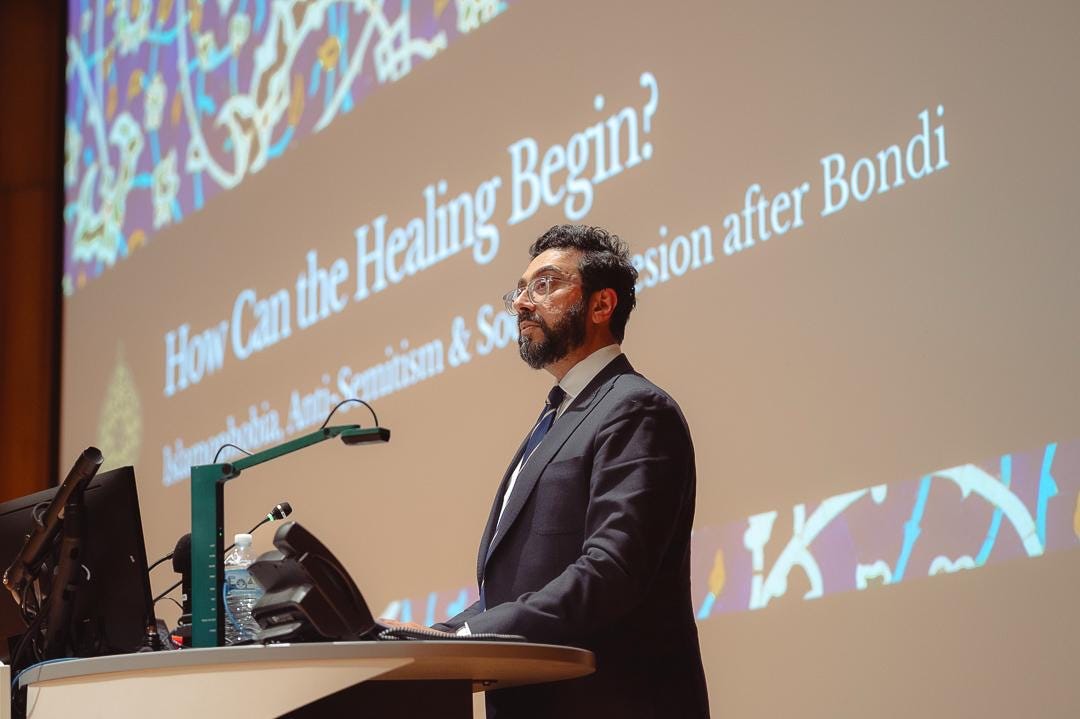
Aftab Malik’s bookshelf takes up most of the wall behind him, and he is happy to give a tour, via Zoom.
There is a section on Islamophobia and one on Islamic civilisation. Out of view are shelves on Zionism and Islamism. He says he owns more than 800 books on Zionism alone. He pulls down a 1,200-page volume by a rabbi who argues that Zionism has nothing to do with Judaism, then a university press study of how debate about Israel has been narrowed.
“I read a lot of literature that I don’t necessarily agree with,” says the British-born scholar, “to understand the mind that I’m talking with.”
It is a habit that runs through his work as Australia’s inaugural Special Envoy to Combat Islamophobia. As his three-year term enters its final year, Malik has made a practice of sitting down with the people who most distrust Muslims, and with the Muslims who most distrust him. While the role has given him access to the highest levels of power, from Prime Minister Anthony Albanese to policymakers and institutions he says he never knew existed, it has also earned him bruising criticism closer to home.
Muslim distrust of envoy role
Malik built his early career writing about Islam and terrorism. In the mid-2000s the United Nations designated him a global expert on terrorism, and he wrote, by hand, a three-volume study of antisemitism in modern Muslim thought that remains unpublished.
He was about to start a PhD at Oxford in 2013 when the Lebanese Muslim Association in Sydney asked him to become its scholar in residence later that year. He saw a chance to reach young Muslims grappling with religion, identity and belonging, and took it, “much to the dismay of my [Oxford] professor”. He still jokes that he chose “Lakemba over Oxford”.
Then came the call to the federal role, as reports of Islamophobia surged in the wake of October 7, 2023. The Islamophobia Register Australia says reported attacks have since jumped 612 per cent in the past three years.
However, in the lead-up to his appointment, a vocal number of Muslims and commentators called it “farcical” to think he could combat Islamophobia.
“I actually thought Muslims would see this [the envoy role] as a good thing,” he says. “I was genuinely shocked how many people thought it was a bad thing.”
Some of the distrust was about who had appointed him. Many Muslims were angry at the Albanese government’s response to the genocide in Gaza, and saw its envoy as an extension of it. “People thought that I was part of the Labor government,” Malik says. “I’ve got no coercive power over the government. All I can do is articulate as powerfully as I can the Muslim concern.”
Other concerns also stemmed from his background in countering violent extremism, or CVE, work that many Muslims associate with surveillance and suspicion. “CVE work is a red flag for many of us,” says Dr Yassir Morsi, a La Trobe University lecturer who has written books on Islamophobia and in his scholarly capacity, contributed to a paper on the 2005 anti-Arab/Islamophobic Cronulla hate riots for the envoy’s office.
Morsi argues that CVE treats terrorism as a religious problem rather than a political one, born of decades of war and western intervention in West Asia, particularly the Iraq war. He sees Malik as fluent in the government language of social cohesion but silent on the role of the state, and he considers the envoy’s office “toothless”.
Disagreements on approach
In late 2024, Malik spent six weeks touring the country to meet more than 200 Muslims from all walks of life. Some asked why he had taken the job. Others told him they had thought he was intelligent until then. Most said it to his face, which he respected, but some were courteous in the room and scathing on social media afterwards.
His first eight months, he jokes, felt like being “punished for my sins”. “I got the scars on my back to prove it.”
Few moves drew more criticism than his response to Pauline Hanson. After the One Nation leader declared on national television that there were no “good Muslims”, Malik publicly invited her to an iftar. Condemnation from some in the Muslim community was swift. Her office has never responded to the invitation.
Yet, Malik makes no apology for the approach. “Being nice doesn’t mean you cannot be firm,” he says. He models himself on the Prophet Muhammad, whom he describes as gentle but unyielding when it mattered. He also has a strategic reason for staying calm. “In the Islamophobia space, being angry is one of the stereotypes,” he says. “I don’t want to capitulate to the angry Muslim.”
His approach to his opponents is where opinions of him divide and even he admits he says things that make Muslim audiences uncomfortable. Muslims have done “horrific things” in the name of their religion, he says, and the community has to recognise it. He also understands, without excusing it, why some Australians believe their fear of Islam is rational: they have little contact with Muslims and are fed a steady diet of terrorism headlines.
“When Muslims talk about Islamophobia, they talk about what western nations are doing,” he says. “When non-Muslims talk, they’re talking about what Muslims are doing in the name of Islam.” He sees his job as bringing those two conversations together.
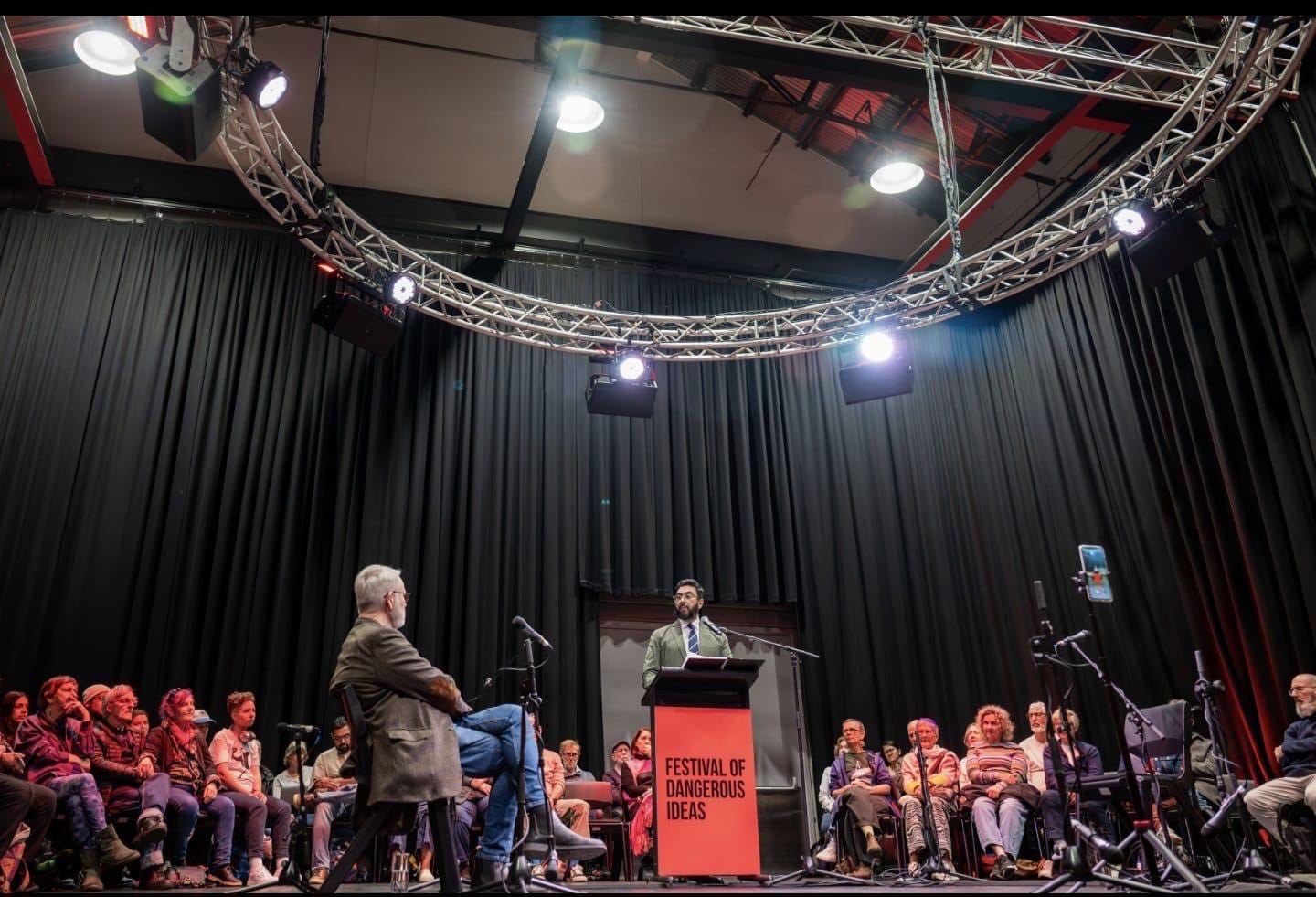
That is not appeasement, he insists. “I can say that this speech is reckless,” he says, “and at the same time say, if you want to talk to me about why, come and speak to me.”
Morsi sees it differently. Engaging figures like Hanson, he says, only gives them media minutes and “makes her look better”. He would rather Muslims stop performing for their detractors and invest in their own lawyers, filmmakers and journalists. “Racism is always going to exist,” he says. “It’s kind of like the weather.”
Government ignores key recommendations
Much of Malik’s work has gone into his report to the government, which he wrote alone before his staff arrived in January this year. He asked every community the same key questions, promised to focus on whatever came up most, and sent drafts to 30 experts in Australia and abroad for feedback. Wherever he went, the same three concerns kept coming back: political rhetoric, media coverage and education.
Among his 54 recommendations to the Albanese government are a code of conduct for politicians, a youth hub where newsrooms can hear directly from young Muslims, and recognition in the national curriculum of Islam’s contribution to civilisation. His central argument, though, is that grants and dialogue are welcome but not enough. “You can’t deal with the after-effects of Islamophobia,” he says. “You need to address it on a structural basis.” For him that also means law reform, policing and the counterterrorism framework.
That argument was tested twice. When the federal budget set aside nothing for Islamophobia, he says he spent two weeks telling ministers that Muslims read it as proof they weren’t being taken seriously. Then in July, 10 months after he handed over his report, the government accepted 35 of the 54 recommendations and committed almost $42 million to mosque security, community grants, an education taskforce, leadership programs and research.
It did not accept the structural reforms he had pushed hardest for. Those included an inquiry into anti-Arab and anti-Palestinian discrimination, stronger legal protections for Muslims against religious discrimination, and a review of whether counterterrorism laws had unfairly targeted Muslim communities.
The limits of a government role
Those who have worked with him see the pros of an envoy and the wider limitations. Mohammed Bouras, a physics PhD candidate and vice-president of the Swinburne University Islamic Society, has been fighting the university over new rules for its Muslim prayer space.
Malik advocated for the students, and Bouras credits his intervention with getting the university to the table. Even so, he thinks the envoy role was created to “pander to Muslim voters” and given little power, especially compared with the antisemitism envoy, Jillian Segal.
The government formally adopted Segal’s controversial plan and announced a package of legislative reforms that critics warn impinge on free political expression. Malik got 35 of his 54. But Bouras separates the role from the man. “It’s not about Aftab,” he says. “He might be the best one for the role but he is already limited.”
Mohamed Mohideen, president of the Islamic Council of Victoria, says those limits come with any government job. As a former Victorian Multicultural Commissioner, he says he had to temper what he said even under a supportive government, and he will never take such a role again. “You can get a good salary,” he says, “but you have to keep your mouth shut.”
What Malik says he has gained, despite those limits, is trust. He draws a sharp line between his first eight months and the period since his report was published. The second edition, he says, carries twice as many endorsements as the first. He counts winning over some of his harshest critics in the community among his proudest achievements, and credits patience and never overpromising. “People in the community often tell me ‘you don’t come across as a salesperson’,” he says. “You’re always clear about what you can do and what you can’t do.”
Understanding history is key
In Canada, Amira Elghawaby, the country’s first Special Representative on Combatting Islamophobia, learned how much rides on that trust, and how little it can guarantee. She held a similar role until her office was abruptly shut down in February, with a year of her mandate left.
It had been created at the community’s request after two massacres in which Muslims were targeted and killed, and she took it on with strong community backing. She has swapped notes with Malik and calls his report “important”. “The moment you lose the trust of communities,” she says, “the government won’t engage on the difficult issues.”
Unlike Malik, who looks forward to having a break after his tenure ends in late 2027, Elghawaby says she would take the job back “in a heartbeat”.
The job has cost Malik and his family more than he expected. Ask him when it ends and the answer comes instantly: October 2027. Then a smile. “Not that I’m counting.”
Asked whether Australian Muslims should despair at the rise in Islamophobia, he reaches for history. When the Mongols sacked the heartland of Islam in the thirteenth century, he says, many Muslims believed it was the end of the world. Yet new Muslim empires followed in Spain, India and Anatolia. “You’ve got to understand the past to understand the present,” he says.
He doesn’t want Muslims to treat Islamophobia as simply a test to be endured. He wants them to report it and to use the rights their citizenship gives them. Getting jaded is human, he says. “But don’t fall into hopelessness.”
His critics argue that no envoy can fix Islamophobia, nor the problems in community leadership that Morsi says have left Muslims “talking about the same thing” for two decades. Malik doesn’t disagree. On that first bruising tour, he says, even the people tearing into him told him the same thing: nobody expected him to solve Islamophobia in three years.

Thank you.