


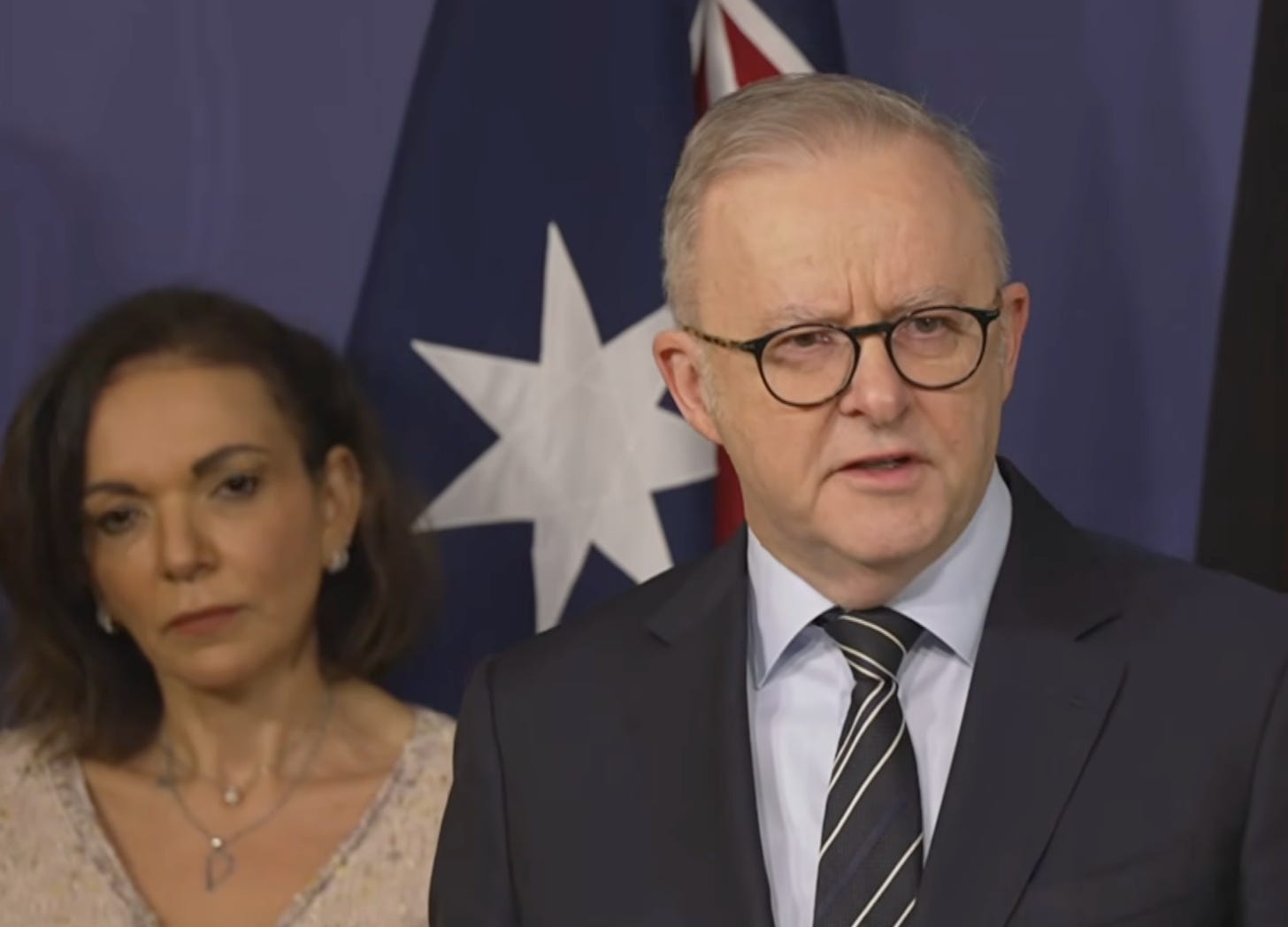
It took the Albanese government 10 months to respond to Aftab Malik’s inaugural report as Special Envoy to Combat Islamophobia. Given the wait, you might have expected sweeping reforms. Instead, the response was so light on substance it could’ve been an email.
Labor accepted 35 of the envoy’s 54 recommendations, backing them with almost $42 million for mosque security, community grants, an Islamophobia Education Taskforce, leadership programs and research into Islamophobia. Those are welcome investments and no one should dismiss the value of funding that will make Muslim communities safer and better supported.
But what Anthony Albanese didn’t accept proved to be the most telling.
Malik called for an inquiry into anti-Arab and anti-Palestinian discrimination. Yet despite the countless reports of people being abused, vilified or even losing their jobs for expressing support for Palestine or simply wearing a keffiyeh, it was not considered a priority for the Labor government.
Equally baffling was its refusal to strengthen legal protections against religious discrimination. Malik also urged the government to review whether Australia’s counter-terrorism framework has unfairly targeted Muslim communities and whether existing legal protections were sufficient.
Instead, Albanese said he had “confidence” in the nation’s security agencies. For those whose lives have been upended by flawed security investigations or years of over-securitisation, his words offered little consolation to their ongoing trauma.
Even worse, it maintains a problematic status quo that Muslim religious and community leaders should continue to expend hours of time doing complex counter-terrorism work that ultimately fails their communities anyway.
It’s how the AFP can run an undercover operation encouraging an autistic 13-year-old boy to engage in terrorist activity even when his parents went to authorities for help, and still publicly stand by it.
“We operate our terror laws on the basis of appropriate advice from national security agencies,” Albanese said.
So, if Australia’s existing institutions are already equipped to deal with Islamophobia, why was there a need to appoint a Special Envoy in the first place?
If the government was serious about addressing institutional failures, these were the recommendations that warranted the closest consideration and yet they were ignored.
One of the most predictable aspects of the government’s response was its repeated invocation of “social cohesion” (Albanese argued that tackling Islamophobia was a way to “strengthen our social cohesion”).
Communities don’t become more cohesive because governments tell them to. They become more cohesive when people have confidence that the institutions designed to protect them are prepared to confront discrimination, even when doing so is politically inconvenient. For Muslim Australians, there remain legal blind spots that leave Islamophobia discrimination insufficiently addressed.
At federal level, religion itself is not protected under the Racial Discrimination Act and the Australian Human Rights Commission has called for laws expressly prohibiting religious discrimination. One key reform Malik called for was clarifying that Muslims are protected as an ethno-religious group under the Racial Discrimination Act 1975 (Cth), just as Jews and Sikhs are.
What is hard to ignore is the disparity between the government’s response to Islamophobia and its response to antisemitism. The contrast hasn’t been lost on Muslim communities. Bilal Rauf, the spokesperson for Muslim peak body Australian National Imams Council, described the absence of legal consequences and enforcement as “one glaring omission”, saying it left many questioning whether Islamophobia is being treated with the same urgency as antisemitism.
None of this is to suggest every recommendation by the Islamophobia Envoy or any independent advisory group should deserve a rubber stamp. Governments are elected to govern, not outsource decision making to independent advisers, as Albanese made a point of saying himself during the press conference announcing the response (yet, did the complete opposite for with the antisemitism envoy’s recommendations)
But if you’re going to reject the recommendations that ask the hardest questions of government, you should at least explain why. The government did not provide specific responses as to why individual recommendations were accepted, rejected or merely noted – a level of transparency the Islamic Council of Victoria has since called for.
That matters because transparency is what distinguishes a considered policy decision from a political one. Without clear reasons for rejecting individual recommendations, it becomes impossible to know whether they were dismissed because they lacked merit or simply because they asked questions the government was unwilling to answer.
Muslim communities, many of whom have long supported Labor, have a right to know what their federal government is doing on their behalf, even when it doesn’t align with their interests.
And the ordinary Muslims from all walks of life who spent months sharing their experiences with Malik during consultations across the country shouldn’t be left to speculate why key recommendations were knocked back.
Against a backdrop of rising Islamophobia, this should have been the moment for a more honest national conversation about whether Australia’s laws and institutions are doing enough to protect Muslim communities. Instead, Labor delivered a response that acknowledged the problem but largely avoided confronting the systems that help sustain it.
Listen to the latest episode of Deepthink – an hour-long talk with Palestinian scholar and author Tareq Baconi on the trauma of ethnic cleansing, growing up queer in Amman and why the Palestinian struggle is feminist.

Unfortunately the Labor Party that we knew no longer exists. It is now the new LNP not surprised by their non response to the recommendations after 10 months of sitting on report .. it’s been clear from the start who butters their bread.
Very well said