


It’s a saga that’s been dragging on for three years, and one that pits corporate might – backed by political power – against grassroots activists striving for a better future.
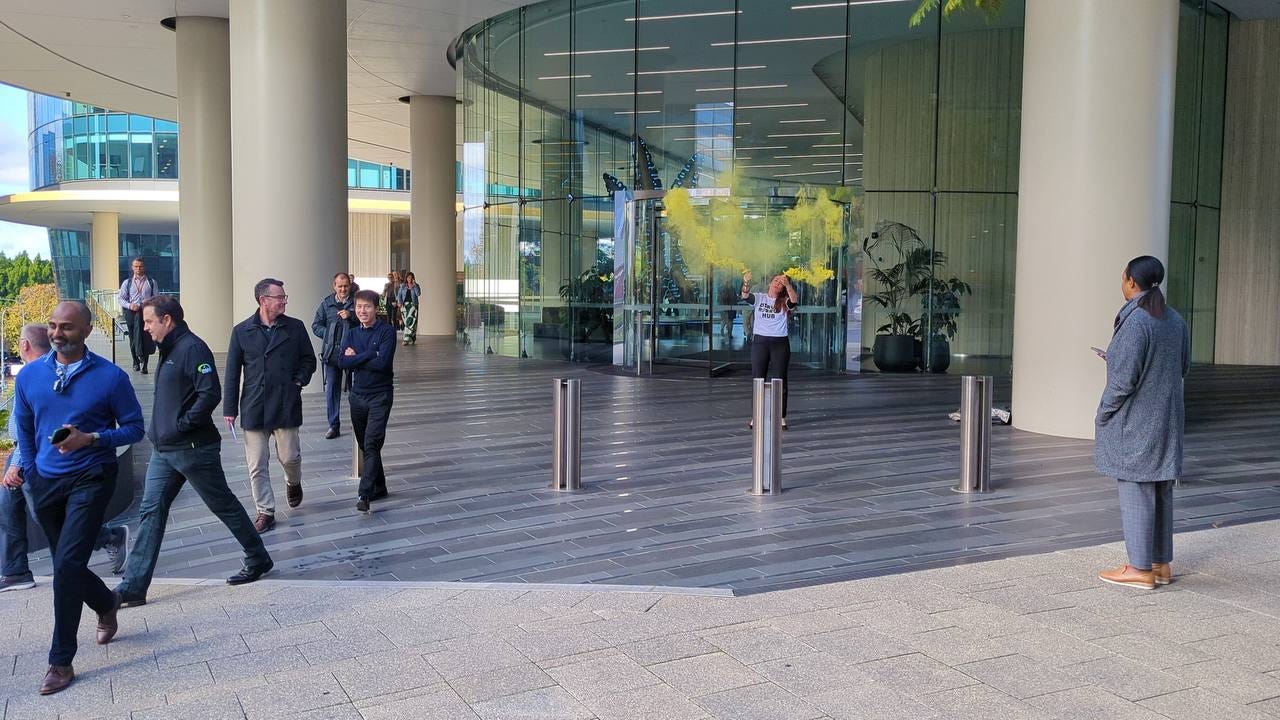
In June 2023, Kristen Morrissey – a music teacher – released stench gas in the lobby of Woodside Energy’s Perth headquarters during a protest about the company’s ongoing fossil fuel extraction. The protest focused on the development on the Burrup Peninsula in northern Western Australia that is said to place ancient Indigenous heritage at risk.
The non-toxic gas, ethyl mercaptan, is commonly used in the mining industry to alert workers to hazards. Morrissey released it from a canister in her handbag, prompting the evacuation of 2,500 Woodside employees from the building and a response from the bomb squad.
Woodside presented the event as a direct assault and, in a state where fossil fuel giants are deeply enmeshed with local politics, authorities took them at their word. Not long after, the state’s counter-terror police were unleashed, carrying out raids against the music teacher and fellow activists Emil Davey and Joana Partyka as part of their investigations.
During early court hearings, police prosecutors presented the protest as a “form of terrorism”. Two years later, the activists were convicted for creating false belief, with Morrissey copping an extra charge of causing poison to be administered.
In July 2025, Morissey was sentenced to 11 months prison, suspended for 18 months and Partyka was sentenced to seven months prison, suspended for 12 months. Davey was handed a community-based order.
Woodside seeks damages, information
That was not the end of it for Woodside, with the company filing a civil case against the three activists in December 2023, seeking to pursue the activists for cleaning costs and lost productive hours.
As there were pending criminal proceedings, the activists refused to comply with the request at the time and there were no new developments until the company recently sought to continue its discovery application.
Woodside is seeking to force the activists to hand over any documents that “identify or contain a description of other persons involved in the planning, preparation and/or execution of the incident” and to compel them to appear as witnesses in any future matter.
Should they refuse, the activists risk being charged with contempt of court – an offence that carries with it the potential for jail time.
Partyka, a Greens staffer, alleged the company’s continued pursuit of the matter was a strategic lawsuit against public participation – or SLAPP suit – designed to “make an example of us”.
“This is not a genuine bid to recover damages,” she said. “They’re a multi-billion dollar corporation. I don’t think they’d be pursuing this if it had not been a successful protest action.”
Partyka said the continued application showed the “influence of corporations on our democracy has been super charged” in recent times.
“Their influence and their power, it’s become this flywheel where it’s self-perpetuating. The more power they get, the more power they get. This is just symptomatic of that,” she said.
Woodside was contacted but a spokesperson said the company does not “comment on matters that are before the court”.
Silencing community with SLAPP suits
Regina Featherstone, a senior lawyer from the Human Rights Law Centre, said she had no knowledge of the matter and could not speak to specifics, but added that generally Australia was unusual in that it has no protection against SLAPP suits.
“A SLAPP is a lawsuit or legal tactic that is brought to silence some sort of engagement, political engagement, free speech or some sort of public participation, whether they are journalists, climate defenders, victim-survivors, or whistleblowers,” Featherstone said.
“Really, it’s somebody, a powerful actor or person, weaponising the law not for a legitimate purpose, but rather to silence.
“It’s intended to cause financial and emotional distress by tying someone up in legal proceedings and draining all of their resources.”
Unlike in Canada and the US where a court can quickly end a lawsuit if it qualifies as a SLAPP-suit, Featherstone said there are no similar protections in Australia with the exception of outdated laws in the ACT.
Without reform, she said these tactics will continue to be relied upon by large companies with significant resources.
“What’s at stake are the values and pillars of the democracy that is the foundation to Australia,” she said. “If we can’t have individuals and organisations taking positive steps for, and speaking up for the environment, or other public interest issues, our democracy is in jeopardy.”
The WA Supreme Court will hear the matter on Thursday, July 16.
Correction: The teaser was amended on 15 July 2026 to clarify that Woodside had branded the activists “extremists” as opposed to building a “terrorism” case, which was an argument put forth by police prosecutors.
Listen to the latest episode of Deepthink – an hour-long talk with Palestinian scholar and author Tareq Baconi on the trauma of ethnic cleansing, growing up queer in Amman and why the Palestinian struggle is feminist.